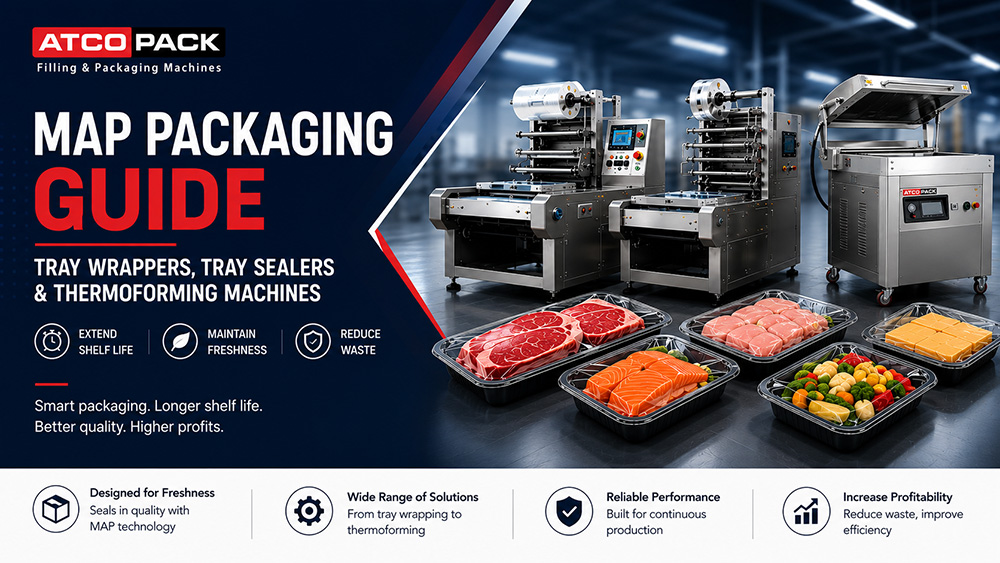
MAP Packaging Guide: Tray Wrappers, Tray Sealers & Thermoforming Machines
In many food factories, packaging becomes a problem only when something goes wrong. Trays leak. Film does not seal properly. Products lose freshness before the expected shelf life. Operators slow down the line because changeovers take too long. In chilled food production, even a small packaging issue can quickly become a quality complaint, a supermarket return, or a rejected export order.
Modified atmosphere packaging, usually called MAP packaging, is used to reduce these risks by changing the air around the food inside the pack. Instead of packing the product with normal air, the machine replaces or adjusts the atmosphere using gases such as carbon dioxide, nitrogen, and oxygen depending on the product type. The goal is not to make food last forever. The real goal is to slow down spoilage, protect appearance, reduce leakage, and give the production team better control over shelf life.
A counterintuitive point is this: the most expensive MAP machine is not always the best choice. In real production, the right choice depends on product behaviour, tray format, film quality, sealing area, target output, operator skill, cleaning needs, and how much flexibility the factory needs. A machine that looks powerful on paper can still create downtime if it is not matched to the product and daily operating conditions.
Tray wrappers, tray sealers, and thermoforming machines are often discussed together, but they do not solve the same problem in the same way. This is where many early buying discussions become confusing.
A tray wrapper is commonly used when the product already sits in a tray and needs film wrapped around it for protection, presentation, and handling. It is widely seen with fresh produce, bakery items, retail meat trays, fruits, vegetables, and supermarket-ready packs. It can be useful where attractive display and moderate protection are the main requirements. However, it is usually not the first choice where controlled gas flushing, leak resistance, and longer chilled shelf life are critical.
A tray sealer uses a pre-formed tray and seals film onto the top of the tray. In MAP applications, the air inside the tray is removed or replaced with a controlled gas mixture before sealing. This is widely used for fresh meat, poultry, seafood, ready meals, cheese, fresh pasta, salads, and chilled convenience foods. It gives better pack integrity than simple wrapping and can support higher food safety and shelf-life targets when the tray, film, gas mix, and sealing parameters are correct.
A thermoforming machine forms the bottom pack from rollstock film, places the product into the formed cavity, applies vacuum or MAP, and seals the top film. This approach is often selected by factories with higher volume, repeatable pack formats, and a need to reduce pre-made tray handling. It is common in meat, poultry, cheese, processed food, seafood, and sliced products. Thermoforming can reduce packaging material cost per pack, but it usually needs more space, stronger technical support, and better planning around film, tooling, cleaning, and maintenance.
| Machine Type | Best Suited For | Main Strength | Key Limitation |
|---|---|---|---|
| Tray Wrapper | Fresh produce, bakery, supermarket display packs | Simple operation and good product presentation | Limited control over modified atmosphere |
| Tray Sealer | Meat, poultry, seafood, ready meals, dairy, salads | Better seal integrity and MAP control | Requires correct trays, films, gas mix, and sealing setup |
| Thermoforming Machine | High-volume chilled and processed food production | Automated pack forming and lower tray dependency | Higher technical planning, space, and maintenance requirement |
This comparison is useful during early discussions, but the final decision should be based on product testing. Two products that look similar can behave differently after packing. A marinated chicken tray, for example, creates different sealing and leakage challenges compared with dry sliced cheese or fresh mushrooms.
MAP packaging does not fail only because of the machine. In many factories, problems come from the full process around the machine. Product temperature may be too high before packing. Trays may have poor flange quality. Operators may overload trays. The sealing area may be contaminated with oil, sauce, blood, powder, or moisture. Film may not match the tray material. Gas flushing may be too short for the tray depth. The machine may be capable, but the process is unstable.
In chilled food operations, product temperature is one of the most underestimated factors. If the product enters the packaging area too warm, MAP will not correct that weakness. It may only hide it temporarily. Good packaging starts before the product reaches the machine. Cooling, hygiene, portion control, tray loading, and line speed all affect final pack quality.
A practical scenario is a ready-meal producer running multiple tray sizes in one shift. The team may want a tray sealer because it supports MAP and gives a premium retail pack. But if changeovers are frequent and operators are not trained, the line may lose time during tool changes, film adjustments, and seal checks. In this case, the buying decision should not focus only on maximum packs per minute. It should also consider changeover time, skill level, spare parts availability, and how easily the maintenance team can clean and inspect the sealing station.
Industry figures vary by product, tray size, film type, gas system, and operator skill. As a practical reference, semi-automatic tray sealing may support smaller batch production, while automatic tray sealers can commonly run from a few thousand packs per shift to significantly higher volumes depending on lanes and indexing speed.
Thermoforming lines can offer stronger output potential for repeatable packs, but downtime from film change, cleaning, tooling, or poor loading discipline can reduce real efficiency. In many factories, a 5–10% loss in packaging uptime is enough to create dispatch pressure at the end of the day. Labour savings are also not only about reducing headcount. Automation can reduce rework, pack handling, manual sealing errors, and dependency on highly experienced operators.
Food producers in the UAE, Saudi Arabia, Oman, and wider GCC often work under strong delivery pressure, high ambient temperatures, and growing retail quality expectations. Even when the factory is air-conditioned, loading docks, staging areas, and transport movement can affect product temperature and shelf life.
Export requirements add another layer. Packs must survive handling, transport, display, and sometimes longer distribution windows. This makes sealing reliability, gas control, coding clarity, inspection systems, and cold-chain discipline important parts of the same packaging decision.
One common mistake is asking first, “How many packs per minute can this machine run?” Output is important, but it should not be the first question. A better starting point is: “Can this machine repeatedly produce a sealed, safe, attractive pack with our product, tray, film, gas mix, staff, and cleaning routine?”
Speed without stability creates hidden cost. A fast tray sealer that produces leaking packs is slower than a modest-speed machine that runs cleanly throughout the shift. A thermoforming machine that reduces material cost can still become expensive if tooling changes are too frequent or technical support is weak. A tray wrapper can be the right choice for simple retail presentation, but the wrong choice if the factory expects serious MAP shelf-life performance.
This is why production trials matter. During evaluation, factories should test real products, not only empty trays. They should check seal strength, gas residual levels, film behaviour, leakage, pack appearance, barcode and date coding area, cleaning access, and operator comfort. Maintenance teams should also review wearing parts, heater access, vacuum system layout, gas connections, and changeover method before final approval.
- Product behaviour: Is the product wet, dry, oily, fragile, sharp-edged, breathing, or temperature-sensitive?
- Packaging format: Will the factory use pre-formed trays, wrapped trays, or rollstock thermoformed packs?
- Shelf-life target: Is the goal basic protection, retail display, leak prevention, or extended chilled shelf life?
- Daily output: What is the real shift requirement after breaks, cleaning, changeovers, and inspection time?
- Support systems: Are cooling, gas supply, coding, checkweighing, metal detection, conveyors, and end-of-line packing ready for the selected speed?
If the product mainly needs retail display and simple protection, tray wrapping may be enough. If the product needs stronger seal integrity, better freshness control, and professional chilled food presentation, a tray sealer is usually more suitable. If the factory has high volume, stable pack formats, and wants stronger automation with rollstock films, thermoforming deserves serious evaluation.
The decision should not be made by procurement alone, and it should not be made by production alone. Procurement sees budget, supplier terms, and ownership cost. Production sees output pressure and labour dependency. Quality teams see shelf life, leakage, hygiene, and complaint risk. Maintenance sees access, spare parts, utilities, and downtime. The best decision usually comes when all four views are considered together.
ATCOPACK is associated with filling and packaging machinery discussions across food production environments, but the important point for the reader is broader than one brand: MAP packaging is a process decision, not only a machine purchase. The right equipment must support the product, the people, the factory layout, and the quality target.
Before selecting tray wrappers, tray sealers, or thermoforming machines, a production manager should ask one practical question: which option will produce the most consistent pack quality during a normal busy shift, with real operators, real products, real cleaning routines, and real delivery pressure?



GET A QUOTE
Tell us about your business requirement, one of our technical expert will be in touch with you soon..!
NEW PRODUCTS ALERTS