Perfume Filling & Packaging Lines: Rotary Filling, Bottle Washing & Crimping
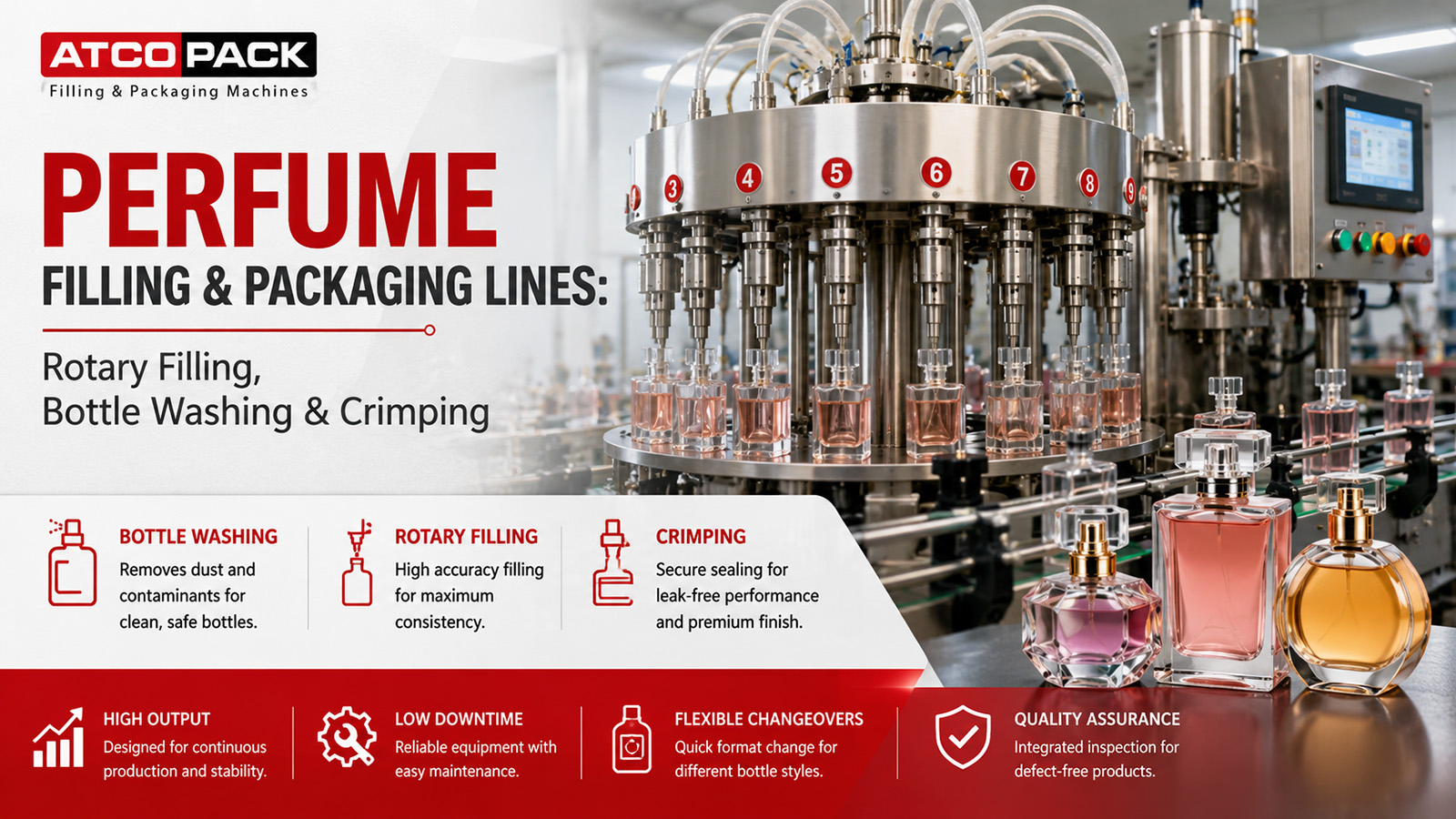
A finished perfume bottle may look simple, but producing it consistently is not. Before it reaches the carton, the bottle must be cleaned, positioned, filled, fitted with a spray pump, crimped and checked. A small problem at any one of these stages can lead to leakage, uneven fill levels, damaged collars or repeated line stoppages.
Many factories first look at filling speed. In practice, speed is only useful when the bottles remain stable, the pumps are placed correctly and the crimping result stays uniform. A line running at a lower but steady rate often produces more acceptable bottles per shift than a faster line that stops frequently.
A perfume filling and packaging line normally combines bottle cleaning, filling, pump placement, crimping, inspection and transfer to labelling or secondary packing. The exact arrangement depends on production volume, bottle design, pump type, batch size and the number of product changes handled during the day.
Perfume is usually thin and free-flowing, but that does not make it easy to package. Alcohol-based products can evaporate quickly and may create vapours that require proper ventilation, earthing and electrical safety review. The liquid may also splash or foam if the nozzle position and filling speed are not properly set.
Bottle design creates another challenge. Fragrance bottles are often made for appearance rather than easy handling. Some are tall and narrow. Others have thick bases, curved sides or an off-centre neck. A bottle that looks stable by hand may tilt when it moves through guides, star wheels or transfer points at production speed.
Filling accuracy is influenced by more than the filling valve. Product temperature, supply pressure, nozzle depth, bottle position and air inside the product path can all affect the result. The filler must therefore be tested as part of the complete line, not as a separate machine.
Bottle washing and preparation
Empty bottles may contain carton dust, small glass particles or residue from storage and transport. Cleaning before filling reduces the chance of visible contamination inside the bottle. The cleaning method may use filtered air, ionised air, vacuum extraction, liquid rinsing or a combination of these methods.
Air rinsing is useful when the factory wants to avoid introducing water into the bottle. Liquid washing can provide deeper cleaning, but it also creates the need for controlled water quality, drainage and complete drying. The right method depends on the condition of the incoming bottles and the required cleanliness level.
Rotary perfume filling
A rotary filler carries bottles around a rotating turret while filling takes place. The continuous movement can support higher production rates and use floor space efficiently. It is generally suited to stable production where bottle formats and output requirements justify automatic infeed and controlled star-wheel transfer.
Inline fillers move bottles along a straight conveyor and are often easier to access when production involves smaller batches or frequent format changes. Rotary filling is not automatically the better choice. The decision should be based on actual daily output, cleaning frequency and changeover time.
Pump placement and crimping
After filling, the spray pump is placed into the bottle. This may be done manually, with operator assistance or by an automatic pump-feeding system. Automatic placement can reduce repetitive work, but the pumps, collars and dip tubes must feed reliably. Long dip tubes and decorative components can be difficult to orient without proper trials.
The crimping head then forms the metal ferrule around the bottle neck. If the crimp is too loose, the pump may leak or move. If it is too tight or uneven, the collar may deform, the bottle neck may be damaged or the finished pack may look poor. Crimp quality should be checked through leakage tests, pull tests, spray tests and visual inspection.
- Test the actual bottle, pump, collar and dip-tube combination before final approval.
- Check fill accuracy during start-up, normal running and restart conditions.
- Record crimp settings for every approved bottle and pump format.
- Confirm leakage and spray performance after each planned changeover.
Rejects are easy to see. The larger loss is often the time spent correcting small problems. Operators may stop the conveyor to straighten bottles, remove a misfed pump, clean a spill or readjust the crimping head. Each stop may take only a few minutes, but the total loss across a shift can be significant.
For example, a line running at 40 bottles per minute loses 400 bottles of potential output during a ten-minute stop. If the same type of interruption happens three times, the shift loses 1,200 bottles before restart checks and cleaning time are counted.
One common purchasing mistake is choosing equipment mainly by its maximum speed. Stated speed is usually based on a defined bottle, pump and product condition. Actual output may be lower when the factory handles several bottle shapes, short batches, manual pump placement or frequent fragrance changes.
Changeover time should be reviewed just as carefully as production speed. If guides, nozzles, star wheels and crimping tools take too long to adjust, the line may lose more time between batches than it gains while running. Clear reference settings, stored recipes and easy-access adjustment points help operators repeat the correct setup.
Line selection should begin with the production plan, not the machinery catalogue. The factory should define average batch size, peak daily demand, bottle range, fill volumes, pump types, cleaning frequency and the number of changeovers expected during a normal week.
| Production condition | What to prioritise |
|---|---|
| Small batches and many fragrances | Quick cleaning, low product hold-up and simple format changes |
| Stable bottle format and higher volume | Rotary filling, automatic transfers and reliable pump feeding |
| Premium or irregular bottle shapes | Bottle stability trials and format-specific handling parts |
| Frequent pump or collar changes | Flexible feeding, quick tooling changes and recorded settings |
| High-temperature GCC conditions | Room ventilation, product storage and temperature control |
Trials should use the real perfume, bottle, pump, collar and dip tube wherever possible. Running empty bottles can confirm movement through the conveyor, but it cannot show filling behaviour, evaporation, leakage or spray quality. The most difficult bottle and closure combination should be included in the test, not only the easiest one.
Maintenance access also matters. Technicians should be able to reach filling valves, product hoses, sensors, crimping heads and transfer parts without removing several unrelated components. A compact machine saves space, but poor access can make routine cleaning and fault-finding much slower.
In the UAE, Saudi Arabia and Oman, spare-parts planning deserves early attention because imported components may take time to arrive. ATCOPACK can be referenced during application discussions, but every final specification should still be based on actual samples, production targets and agreed acceptance tests.
- What output is required after cleaning, changeovers and planned stops are included?
- Which bottle and pump combination is the most difficult to handle?
- How will fill level, leakage, crimp quality and spray function be checked?
- Can operators repeat the correct setup after every format change?
- What safety requirements apply to the fragrance and production room?
The final choice should balance speed, flexibility, cleaning time, product recovery, component compatibility and maintenance access. A slightly slower line with reliable changeovers may deliver more saleable bottles over a month than a faster line that needs frequent correction.
Before approving the line, ask one practical question: can the proposed washing, filling and crimping process produce the same acceptable result after start-up, during normal running and after every product or bottle change?



GET A QUOTE
Tell us about your business requirement, one of our technical expert will be in touch with you soon..!
NEW PRODUCTS ALERTS