TAWI Vacuum Lifters for Manufacturing and Logistics: Safe Lifting from 25 kg to 1,000 kg
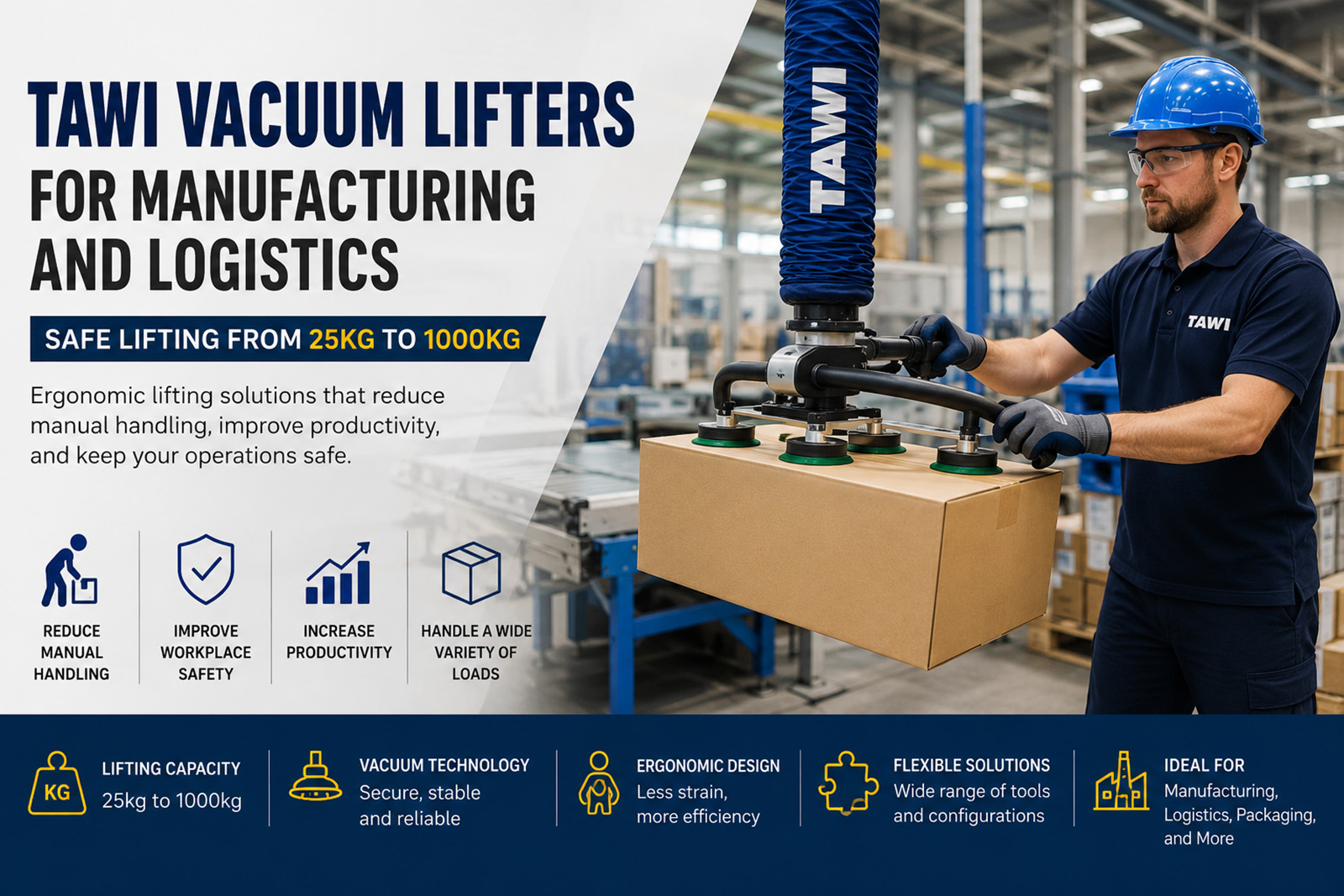
A production line may be running normally, yet finished cartons are still building up beside the packing area. Two operators lift each box onto a pallet while another worker waits to move the completed load. The individual boxes may not appear difficult to handle, but hundreds of repeated lifts during a shift gradually slow the operation and increase fatigue.
The same issue occurs with sacks, drums, metal sheets, glass panels, rolls, components, and other loads that are difficult to grip. A forklift may be available, but it is unsuitable for lifting individual items from a conveyor, machine, pallet, or worktable. An overhead crane may handle heavier loads, but it can be too slow or complex for frequent, repetitive handling.
Vacuum lifting equipment fills this gap by helping operators pick up, move, rotate, and place loads with less physical effort. TAWI vacuum lifters are used in manufacturing and logistics operations for applications ranging from relatively light cartons to heavy industrial materials. Depending on the model, gripping tool, support structure, and application, lifting capacities can extend from approximately 25 kg to 1,000 kg.
A vacuum lifter uses suction to create a secure connection between the lifting device and the load. The operator positions the suction foot or gripping attachment on the item, activates the vacuum, raises the load, guides it to the required position, and releases it in a controlled way.
The lifting unit may be supported by a jib crane, overhead rail system, mobile structure, or another suitable mounting arrangement. The support structure carries the weight while allowing the operator to control the direction, height, angle, and final placement of the load.
For a warehouse or factory worker, the main difference is that the equipment carries most of the physical load. The operator guides the movement instead of repeatedly lifting, holding, and turning the item through manual effort.
Vacuum lifting is not limited to very heavy items. A 25 kg carton may be within the lifting ability of one worker, but lifting it repeatedly throughout a shift can still cause fatigue and inconsistent handling. In many operations, lifting frequency is therefore as important as individual load weight.
Manual lifting problems often develop gradually. A process may begin with a small number of daily loads, but production volume increases while the handling method remains unchanged.
Operators start working faster to keep up. Loads are pulled from awkward positions, twisted while being carried, or placed above shoulder height. The process may still appear functional, but fatigue, product damage, inconsistent cycle times, and lost production time begin to increase.
Common warning signs
- Two workers are regularly required to lift loads that should move through a controlled handling process.
- Cartons, sacks, or components accumulate because operators cannot match conveyor or production speed.
- Loads are dropped, dragged, tilted, or placed unevenly.
- Operators repeatedly bend, stretch, twist, or lift above shoulder height.
- Forklifts are used inefficiently for short movements of individual items.
- Production machines wait because materials are not loaded or removed quickly enough.
- Staff rotation is frequent in physically demanding handling areas.
These problems affect more than safety. When two workers are required for every lift, labour dependency increases. When operators become tired, cycle times become less consistent. When goods are damaged during handling, the cost may include repacking, rejected products, delayed orders, production interruptions, and customer complaints.
In GCC manufacturing and logistics facilities, these effects may become more noticeable during long shifts, high-temperature conditions, peak dispatch periods, or seasonal production demand. Reducing physical lifting effort can help maintain a steadier workflow when operating conditions are demanding.
One of the most common equipment selection mistakes is choosing a vacuum lifter mainly by its maximum lifting capacity. A unit rated for the required weight may still be unsuitable if the suction attachment cannot form and maintain a reliable seal against the actual load.
Smooth metal sheets, sealed cartons, glass panels, plastic containers, porous sacks, drums, wrapped products, and irregular components all behave differently under vacuum. A surface may be dusty, flexible, uneven, wet, textured, damaged, or partially open. Each condition affects the gripping method.
The required load orientation must also be considered. Some applications only require horizontal lifting. Others require the item to be tilted, rotated, turned, or positioned vertically. A lifter suitable for moving cartons between pallets may not be suitable for rotating a heavy panel before machine loading.
Pre-selection evaluation checklist
- Confirm the minimum, average, and maximum load weight.
- Check whether the surface is airtight, porous, flexible, rough, dusty, or irregular.
- Review whether the load dimensions and packaging remain consistent.
- Measure lifting cycles per hour and per shift.
- Confirm whether the load must be rotated, tilted, turned, or placed vertically.
- Measure pickup height, placement height, operating reach, and travel distance.
- Assess dust, moisture, heat, hygiene, and cleaning requirements.
- Verify structural support for a jib crane, rail system, or mobile arrangement.
Testing the actual product is particularly important for sacks, wrapped loads, damaged cartons, and irregular surfaces. A controlled lifting trial can show whether the gripping method remains stable during pickup, movement, rotation, and release.
Safety equipment is sometimes viewed as something that adds another step to the job. A properly selected vacuum lifter should do the opposite. It should make the safer handling method easier, faster, and more practical than repeated manual lifting.
The operator should be able to grip the load quickly, guide it through a controlled path, and release it accurately. Controls must be positioned so the user can operate the equipment without awkward hand, wrist, shoulder, or back movement.
The surrounding layout also matters. A well-selected lifter will not correct a poorly arranged workstation. If pallets are placed outside the crane coverage area, operators may still drag or manually carry loads for the final distance. If the lifting path crosses forklift traffic, the installation may create a new safety conflict.
The handling area should be reviewed as one complete process. Pickup position, operating reach, pedestrian movement, pallet location, machine access, forklift routes, and emergency access should all be considered together.
Vacuum lifting equipment depends on reliable suction, suitable seals, sound hoses, functioning controls, and secure supporting structures. Wear, blockage, leakage, or damage in any of these areas can reduce lifting performance.
Routine inspection should include suction pads, filters, hoses, connections, controls, warning systems, and crane or rail components. Dusty manufacturing environments may require more frequent filter checks, while food, pharmaceutical, or clean production areas may require specific cleaning procedures and compatible materials.
Maintenance access should be considered before installation. Equipment positioned above a production line may be difficult to inspect if safe access has not been planned. A small maintenance task can then require production stoppage, access equipment, and additional labour.
The support structure must match the workflow. A jib crane may suit a fixed workstation, while an overhead rail system can support movement across a longer production or packing area. A mobile arrangement may be useful where lifting is required in different locations, provided stability, floor condition, available space, and safe positioning are properly assessed.
TAWI vacuum lifters can support safer and more consistent handling in manufacturing, warehousing, logistics, food processing, construction materials, metalworking, packaging, and distribution operations. Their value is strongest where loads are repetitive, awkward, difficult to grip, or physically demanding to position.
The equipment should not be selected as an isolated machine. It must fit the load, operator, workstation, building structure, production speed, maintenance plan, and surrounding material flow.
Before approving a system, managers should observe the complete handling cycle during a normal busy shift. Where does the operator first touch the load? Which movement causes the most strain? Where do products wait? Does the load need to be turned? Are forklifts, conveyors, pallets, machines, or structural columns restricting movement?


GET A QUOTE
Tell us about your business requirement, one of our technical expert will be in touch with you soon..!
NEW PRODUCTS ALERTS