Cosmetics Filling Lines: Tube Filling, Cream Filling & Capping
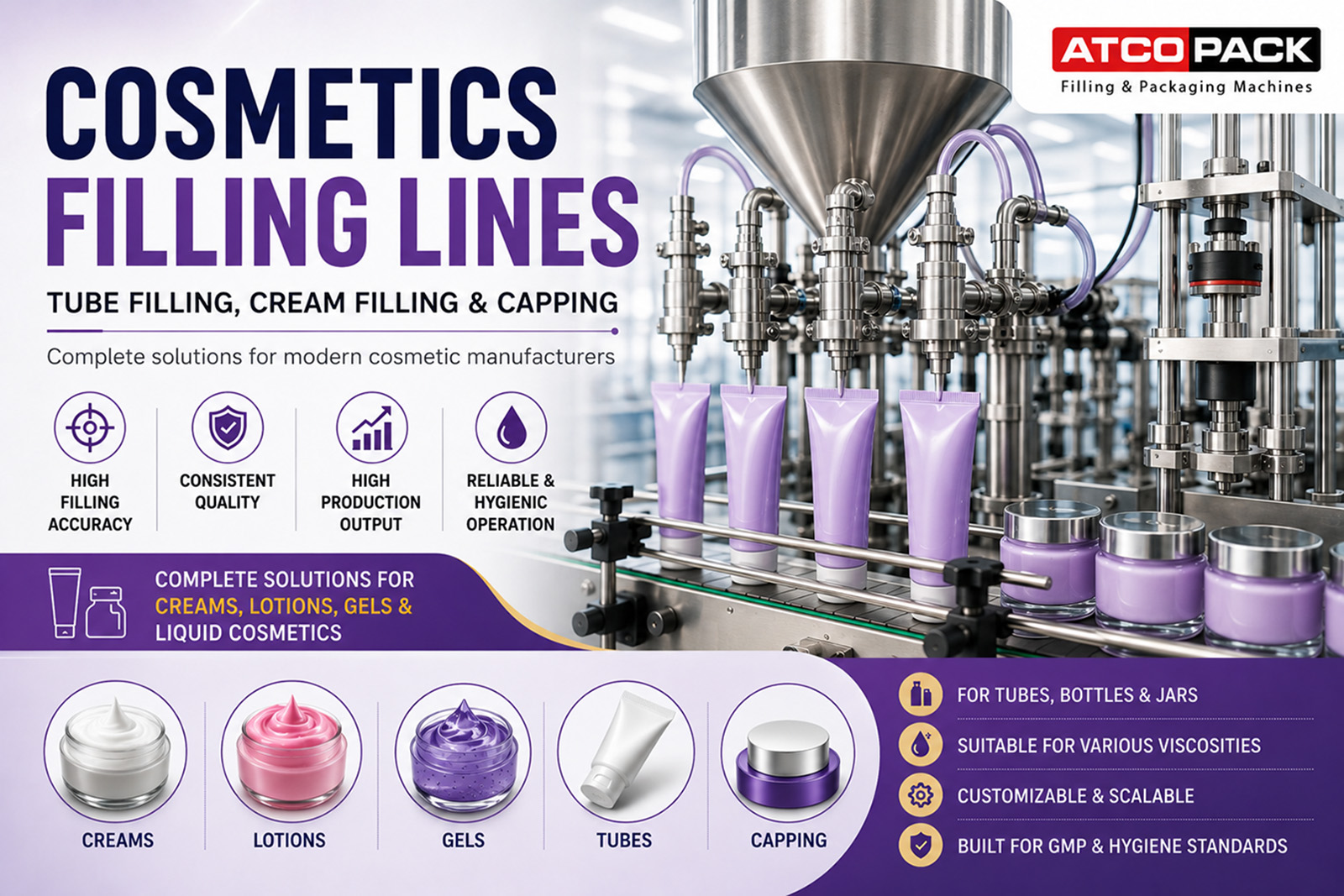
A cosmetics filling line may look straightforward from the outside: dispense the product, close the container, and move it to packing. In practice, creams, lotions, gels, balms, serums, and similar products behave differently under pressure, temperature, and speed. A line that works well with a light body lotion may struggle with a dense cream. A capper set for one bottle may create leaks or damaged threads when the container changes.
This is why many filling problems are not caused by the filler alone. They come from the interaction between product viscosity, container handling, dosing method, capping control, cleaning routines, and line balance.
The counterintuitive point is that a faster machine does not always produce more saleable units. If the filler creates air pockets, product strings, inconsistent doses, or unstable containers, the additional speed can increase rejects and stoppages. Consistent output usually matters more than maximum rated speed.
How a Cosmetics Filling Line Works
A cosmetics filling line brings several operations into one controlled process. Empty tubes, jars, or bottles are fed into the line, positioned, filled to a set quantity, closed, checked, and discharged for labelling, cartoning, or secondary packaging.
The exact arrangement depends on the product and container. A bottle line for lotion may include container feeding, filling, cap placement, capping, labelling, coding, and inspection. A tube line may include tube loading, orientation, filling, sealing, trimming, batch coding, and discharge.
The filling system must move the product without changing its texture or creating avoidable waste. Pumps, pistons, hoppers, nozzles, valves, and servo controls all influence how accurately the product is dosed. Heated hoppers may be required for products that become easier to fill at a controlled temperature. Agitation may also be necessary when ingredients separate during production.
For production managers, the key question is not simply, “How many containers can the machine fill per minute?” A better question is, “How many correctly filled and properly closed containers can the complete line produce during a full shift?”
Tube Filling for Creams, Gels, and Ointments
Tube filling machines are commonly used for facial creams, hand creams, gels, ointments, conditioners, sunscreens, and similar products. They can handle plastic, laminated, and aluminium tubes, but the sealing method changes with the tube material.
Plastic and laminated tubes are normally sealed using heat or hot air. Aluminium tubes are usually folded and crimped. The machine must also orient printed tubes correctly before filling and sealing, especially when front-facing artwork must align with the seal.
A typical tube filling cycle includes loading, orientation, filling, cleaning the sealing area, sealing, coding, trimming, and discharge. Depending on tube size, product behaviour, and automation level, production can range from modest semi-automatic output to high-speed automatic operation. The quoted machine speed should always be checked against the actual product and tube combination rather than accepted as a fixed production figure.
One practical scenario is a manufacturer running both a light hair gel and a heavy medicated cream on the same line. The gel may fill quickly but continue dripping from the nozzle. The cream may require more pressure and a slower nozzle movement to prevent trapped air. The correct setup may therefore involve recipe-based control of filling speed, nozzle lift, cut-off timing, and hopper conditions.
The sealing area must remain clean. Even a small amount of product near the tube mouth can weaken the seal and create leakage during transport. This is especially important for export shipments across the GCC, where cartons may experience high ambient temperatures and extended handling periods.
Cream and Lotion Filling into Bottles and Jars
Cream and lotion filling lines must handle a wide range of viscosities. Light lotions may flow easily, while dense creams, body butters, and scrubs require controlled pressure and larger product pathways. Products containing particles or suspended ingredients may need special valves and wider nozzles.
Piston filling is often used for viscous products because it provides controlled volumetric dosing. Pump-based and servo-controlled systems may be preferred when recipe flexibility, electronic adjustment, or a wider fill range is required. The correct choice depends on the product, required accuracy, cleaning method, speed, and number of stock-keeping units.
In many cosmetic applications, a well-configured line may achieve filling accuracy within approximately plus or minus 0.5 to 1 percent under stable conditions. Actual performance depends on product consistency, fill volume, temperature, air content, and machine setup. Buyers should therefore request trials using their own product and containers wherever possible.
Nozzle design is another important factor. Diving nozzles can reduce splashing and foaming by entering the container and rising during the fill. Shut-off or suck-back nozzles can limit dripping and product strings. For jars with wide openings, nozzle positioning may appear simple, but product build-up around the rim can later interfere with sealing or lid application.
Temperature can also affect repeatability. A cream that is filled at one temperature during testing may behave differently during summer production, especially if storage and processing conditions are not controlled. High-temperature operating environments in the UAE, Saudi Arabia, and Oman make product conditioning and air-conditioned production areas operational considerations rather than comfort features.
Capping Is Often the Hidden Bottleneck
Capping is sometimes treated as a secondary process, but it can determine whether the final pack leaks, looks professional, and survives distribution. cosmetics may use screw caps, flip-top caps, pumps, trigger closures, droppers, disc-top caps, or overcaps. Each closure requires different handling and torque control.
Caps must be presented in the correct orientation, placed accurately, and tightened without damaging the thread or deforming the bottle. Too little torque can cause leakage. Too much torque can crack the cap, distort the neck, or make the product difficult for the customer to open.
Pump and trigger closures create additional challenges because dip tubes can bend, catch, or miss the bottle opening. These closures may reduce the practical speed of the line even when the filler itself can run faster.
A common buyer mistake is selecting the filler based on output while giving limited attention to cap feeding and container stability. In real production, the capper may create more stoppages than the filling station. Lightweight bottles, irregular caps, and flexible packaging components can reduce line efficiency unless they are tested together.
Where Output Is Lost During Daily Production
Line losses rarely come from one major failure. More often, they are caused by repeated short stops: a cap jam, a misaligned tube, a dripping nozzle, an empty hopper, a sensor blocked by product, or an operator waiting for packaging materials.
A line may have a rated output of 60 containers per minute but operate below that level during the shift because of changeovers, cleaning, refilling, adjustments, rejects, and minor stoppages. Even a 10 percent loss in effective production time can significantly affect daily output when the same line runs multiple batches.
Useful operational measures include:
These figures help maintenance and production teams identify whether the main constraint is the filler, capper, container feed, cleaning process, or material supply.
Cleaning, Changeover, and Maintenance Considerations
cosmetics manufacturers often run many products in smaller batches. This makes cleaning and changeover performance as important as filling speed. A line that runs quickly but requires several hours to clean may not suit a facility with frequent product changes.
Product-contact parts should be accessible and designed to minimise residue traps. Tool-free removal, quick-release connections, recipe storage, adjustable guides, and easy nozzle access can reduce changeover time. Where cross-contamination is a concern, separate product paths or dedicated components may be justified.
Preventive maintenance should focus on seals, pistons, hoses, valves, nozzles, capping heads, conveyors, sensors, and pneumatic components. Product deposits can create gradual performance loss before a visible breakdown occurs. A nozzle that closes slightly slower each week may eventually cause dripping, dirty containers, and label adhesion problems.
Maintenance teams also need realistic access to spares. Imported components, specialist sealing parts, and control items can create long delays if they are not identified during procurement. Keeping critical spares for wear items is often more cost-effective than waiting for a low-value component to stop an entire line.
How to Evaluate a Cosmetics Filling Line
The best line is not necessarily the most automated one. Automation should match production volume, labour availability, product range, quality requirements, and future plans. A semi-automatic system may suit a small batch operation with frequent product changes. A fully automatic line may be more appropriate where output is high, packaging formats are stable, and labour dependency must be reduced.
Before comparing quotations, buyers should define the real operating requirement:
Product trials should use actual creams, lotions, tubes, bottles, caps, pumps, and jars. Water trials alone may confirm that a machine runs, but they do not prove that it will handle the real product without dripping, aeration, poor seals, or unstable output.
ATCOPACK may be referenced during equipment evaluation as one regional source of application knowledge, but the final decision should remain based on verified product trials, line integration, maintenance access, documentation, and local technical support.
A practical final question is this: can the proposed line maintain the required fill accuracy, closure quality, and good output across the full product range after cleaning, changeovers, and a complete production shift?
That answer is more valuable than the highest speed shown on a machine specification sheet.
This is why many filling problems are not caused by the filler alone. They come from the interaction between product viscosity, container handling, dosing method, capping control, cleaning routines, and line balance.
The counterintuitive point is that a faster machine does not always produce more saleable units. If the filler creates air pockets, product strings, inconsistent doses, or unstable containers, the additional speed can increase rejects and stoppages. Consistent output usually matters more than maximum rated speed.
How a Cosmetics Filling Line Works
A cosmetics filling line brings several operations into one controlled process. Empty tubes, jars, or bottles are fed into the line, positioned, filled to a set quantity, closed, checked, and discharged for labelling, cartoning, or secondary packaging.
The exact arrangement depends on the product and container. A bottle line for lotion may include container feeding, filling, cap placement, capping, labelling, coding, and inspection. A tube line may include tube loading, orientation, filling, sealing, trimming, batch coding, and discharge.
The filling system must move the product without changing its texture or creating avoidable waste. Pumps, pistons, hoppers, nozzles, valves, and servo controls all influence how accurately the product is dosed. Heated hoppers may be required for products that become easier to fill at a controlled temperature. Agitation may also be necessary when ingredients separate during production.
For production managers, the key question is not simply, “How many containers can the machine fill per minute?” A better question is, “How many correctly filled and properly closed containers can the complete line produce during a full shift?”
Tube Filling for Creams, Gels, and Ointments
Tube filling machines are commonly used for facial creams, hand creams, gels, ointments, conditioners, sunscreens, and similar products. They can handle plastic, laminated, and aluminium tubes, but the sealing method changes with the tube material.
Plastic and laminated tubes are normally sealed using heat or hot air. Aluminium tubes are usually folded and crimped. The machine must also orient printed tubes correctly before filling and sealing, especially when front-facing artwork must align with the seal.
A typical tube filling cycle includes loading, orientation, filling, cleaning the sealing area, sealing, coding, trimming, and discharge. Depending on tube size, product behaviour, and automation level, production can range from modest semi-automatic output to high-speed automatic operation. The quoted machine speed should always be checked against the actual product and tube combination rather than accepted as a fixed production figure.
One practical scenario is a manufacturer running both a light hair gel and a heavy medicated cream on the same line. The gel may fill quickly but continue dripping from the nozzle. The cream may require more pressure and a slower nozzle movement to prevent trapped air. The correct setup may therefore involve recipe-based control of filling speed, nozzle lift, cut-off timing, and hopper conditions.
The sealing area must remain clean. Even a small amount of product near the tube mouth can weaken the seal and create leakage during transport. This is especially important for export shipments across the GCC, where cartons may experience high ambient temperatures and extended handling periods.
Cream and Lotion Filling into Bottles and Jars
Cream and lotion filling lines must handle a wide range of viscosities. Light lotions may flow easily, while dense creams, body butters, and scrubs require controlled pressure and larger product pathways. Products containing particles or suspended ingredients may need special valves and wider nozzles.
Piston filling is often used for viscous products because it provides controlled volumetric dosing. Pump-based and servo-controlled systems may be preferred when recipe flexibility, electronic adjustment, or a wider fill range is required. The correct choice depends on the product, required accuracy, cleaning method, speed, and number of stock-keeping units.
In many cosmetic applications, a well-configured line may achieve filling accuracy within approximately plus or minus 0.5 to 1 percent under stable conditions. Actual performance depends on product consistency, fill volume, temperature, air content, and machine setup. Buyers should therefore request trials using their own product and containers wherever possible.
Nozzle design is another important factor. Diving nozzles can reduce splashing and foaming by entering the container and rising during the fill. Shut-off or suck-back nozzles can limit dripping and product strings. For jars with wide openings, nozzle positioning may appear simple, but product build-up around the rim can later interfere with sealing or lid application.
Temperature can also affect repeatability. A cream that is filled at one temperature during testing may behave differently during summer production, especially if storage and processing conditions are not controlled. High-temperature operating environments in the UAE, Saudi Arabia, and Oman make product conditioning and air-conditioned production areas operational considerations rather than comfort features.
Capping Is Often the Hidden Bottleneck
Capping is sometimes treated as a secondary process, but it can determine whether the final pack leaks, looks professional, and survives distribution. cosmetics may use screw caps, flip-top caps, pumps, trigger closures, droppers, disc-top caps, or overcaps. Each closure requires different handling and torque control.
Caps must be presented in the correct orientation, placed accurately, and tightened without damaging the thread or deforming the bottle. Too little torque can cause leakage. Too much torque can crack the cap, distort the neck, or make the product difficult for the customer to open.
Pump and trigger closures create additional challenges because dip tubes can bend, catch, or miss the bottle opening. These closures may reduce the practical speed of the line even when the filler itself can run faster.
A common buyer mistake is selecting the filler based on output while giving limited attention to cap feeding and container stability. In real production, the capper may create more stoppages than the filling station. Lightweight bottles, irregular caps, and flexible packaging components can reduce line efficiency unless they are tested together.
Where Output Is Lost During Daily Production
Line losses rarely come from one major failure. More often, they are caused by repeated short stops: a cap jam, a misaligned tube, a dripping nozzle, an empty hopper, a sensor blocked by product, or an operator waiting for packaging materials.
A line may have a rated output of 60 containers per minute but operate below that level during the shift because of changeovers, cleaning, refilling, adjustments, rejects, and minor stoppages. Even a 10 percent loss in effective production time can significantly affect daily output when the same line runs multiple batches.
Useful operational measures include:
- Actual good units produced per hour, not only theoretical machine speed
- Filling rejects caused by underfill, overfill, air pockets, or dripping
- Capping rejects caused by missing caps, cross-threading, low torque, or cap damage
- Average changeover and cleaning time between products
- Minutes lost to repeated minor stops and operator intervention
These figures help maintenance and production teams identify whether the main constraint is the filler, capper, container feed, cleaning process, or material supply.
Cleaning, Changeover, and Maintenance Considerations
cosmetics manufacturers often run many products in smaller batches. This makes cleaning and changeover performance as important as filling speed. A line that runs quickly but requires several hours to clean may not suit a facility with frequent product changes.
Product-contact parts should be accessible and designed to minimise residue traps. Tool-free removal, quick-release connections, recipe storage, adjustable guides, and easy nozzle access can reduce changeover time. Where cross-contamination is a concern, separate product paths or dedicated components may be justified.
Preventive maintenance should focus on seals, pistons, hoses, valves, nozzles, capping heads, conveyors, sensors, and pneumatic components. Product deposits can create gradual performance loss before a visible breakdown occurs. A nozzle that closes slightly slower each week may eventually cause dripping, dirty containers, and label adhesion problems.
Maintenance teams also need realistic access to spares. Imported components, specialist sealing parts, and control items can create long delays if they are not identified during procurement. Keeping critical spares for wear items is often more cost-effective than waiting for a low-value component to stop an entire line.
How to Evaluate a Cosmetics Filling Line
The best line is not necessarily the most automated one. Automation should match production volume, labour availability, product range, quality requirements, and future plans. A semi-automatic system may suit a small batch operation with frequent product changes. A fully automatic line may be more appropriate where output is high, packaging formats are stable, and labour dependency must be reduced.
Before comparing quotations, buyers should define the real operating requirement:
- Products to be filled, including viscosity range and any particles
- Minimum and maximum fill volumes
- Tube, bottle, or jar sizes and materials
- Closure types and required torque control
- Target good output per hour or per shift
- Number of daily changeovers and cleaning expectations
- Available operators, utilities, floor space, and future expansion needs
Product trials should use actual creams, lotions, tubes, bottles, caps, pumps, and jars. Water trials alone may confirm that a machine runs, but they do not prove that it will handle the real product without dripping, aeration, poor seals, or unstable output.
ATCOPACK may be referenced during equipment evaluation as one regional source of application knowledge, but the final decision should remain based on verified product trials, line integration, maintenance access, documentation, and local technical support.
A practical final question is this: can the proposed line maintain the required fill accuracy, closure quality, and good output across the full product range after cleaning, changeovers, and a complete production shift?
That answer is more valuable than the highest speed shown on a machine specification sheet.


GET A QUOTE
Tell us about your business requirement, one of our technical expert will be in touch with you soon..!
PROCEED
NEW PRODUCTS ALERTS