Industrial Floor Scrubbers and Sweepers for Warehouses & Food Factories
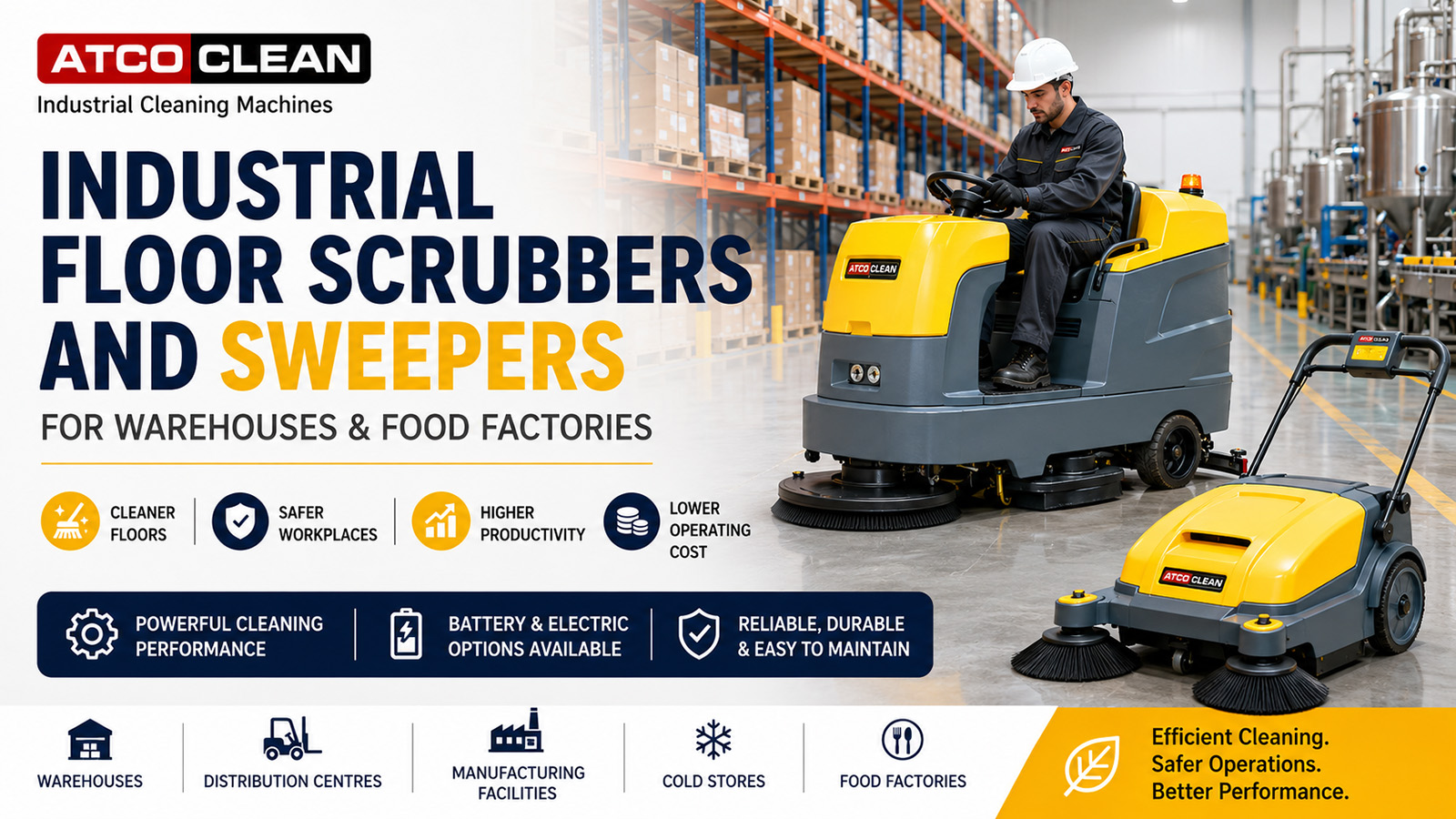
A warehouse can look organised from a distance and still lose time every day because of its floors. Dust gathers near racking legs, forklift tyre marks build up around turning points, and pieces of carton or stretch film collect near dispatch areas. In a food factory, oil, flour, sugar, water, and product residue can make the floor difficult to keep clean throughout the shift.
When cleaning depends mainly on brooms and mops, the result often changes from one shift to another. Busy aisles are skipped, wet areas remain closed for longer, and dirt returns quickly because it has not been removed properly.
Industrial floor scrubbers and sweepers make the cleaning process faster and more consistent. However, the machine must suit the floor, the type of dirt, the working area, and the time available for cleaning. A machine that appears productive on paper can still be a poor choice if it is too large for the aisles, too slow to refill, or difficult to maintain.
Practical point: A smaller machine that can move freely through the site may clean more useful floor area than a larger machine that keeps stopping, turning, or waiting for access.
What Is the Difference Between a Sweeper and a Scrubber?
An industrial sweeper is used for dry dirt and loose debris. It collects dust, sand, carton pieces, pallet splinters, flour residue, plastic film, and similar material. Side brushes pull dirt away from walls and edges, while the main brush moves it into a collection hopper.
A floor scrubber is used when the floor needs washing. It applies water and cleaning solution, scrubs the surface with brushes or pads, and then collects the dirty water using a squeegee and vacuum system.
In simple terms, a sweeper removes loose dirt, while a scrubber removes stuck dirt, oil, marks, and residue.
Many warehouses need both. Sweeping before scrubbing usually gives a better result because loose debris can block the recovery system, damage squeegee blades, or spread across the floor during scrubbing. Combination machines can sweep and scrub in one pass, but they are not suitable for every site or every type of debris.
Warehouses and Food Factories Have Different Cleaning Needs
Warehouse floors are mainly affected by forklift traffic, pallet movement, dust from loading bays, packaging waste, tyre marks, and dirt brought in from external yards. The busiest areas are usually dispatch lanes, receiving zones, aisle crossings, and battery-charging areas.
Food factory floors are more demanding. They may be exposed to grease, oil, flour, sugar, ingredients, water, cleaning chemicals, and temperature changes. Some production areas need frequent washing, while dry storage areas need dust control without adding moisture.
The floor finish also matters. Smooth concrete, epoxy flooring, anti-slip surfaces, tiles, and textured production floors do not respond in the same way. A hard brush may remove dirt quickly but damage a sensitive coating. A soft pad may protect the floor but fail to clean heavily marked areas.
Cold stores bring another challenge. Condensation can make the floor slippery, and low temperatures can reduce battery performance. Good water recovery is important because excess moisture can quickly become a safety problem.
In the UAE, Saudi Arabia, Oman, and other Gulf markets, fine dust entering through loading doors is common. This dust settles along walls, under racking, and around equipment. If it is not controlled, it can affect floor coatings, forklift tyres, sensors, and visibility around working areas.
Walk-Behind or Ride-On?
Walk-behind scrubbers and sweepers are useful in smaller warehouses, narrow aisles, production areas, retail stores, and spaces with many obstacles. They are easier to control in tight areas and usually need less storage space.
The limitation is operator effort. If the cleaning route is long, the operator spends more time walking, turning, refilling, and emptying. Fatigue can reduce speed and cleaning quality by the end of the shift.
Ride-on machines are better suited to large warehouses, logistics centres, distribution hubs, and open factory floors. They cover more ground and reduce physical strain, but they need enough room to turn safely.
One common buying mistake is choosing a machine based only on the total size of the building. A large facility may still have very little open floor once racking, pallets, production lines, safety barriers, and staging areas are taken into account.
- Measure the narrowest aisle and doorway
- Check turning space near racking and machinery
- Mark areas blocked during normal shifts
- Review ramps, drains, dock plates, and uneven floor sections
- Confirm where the machine will be filled, emptied, charged, and parked
What Should Be Checked Before Choosing a Machine?
Type of dirt: Fine dust, sand, food residue, oil, packaging waste, and tyre marks all need different cleaning methods. The machine must match the dirt found on the floor, not just the size of the site.
Cleaning width: A wider machine may cover more floor in a straight line, but that advantage is lost if it struggles to turn or pass through narrow areas.
Tank and hopper capacity: Small tanks and hoppers mean more stops. Large ones reduce stopping time but add weight and may make the machine harder to handle.
Battery runtime: The machine must complete the planned cleaning route without stopping halfway through. Charging time, charger location, spare batteries, and operator habits all affect daily use.
Water recovery: The floor should be left as dry as possible. Worn squeegees, poor vacuum performance, sharp turns, and uneven floors can leave water behind and create a slip risk.
Visibility: The operator must be able to see pedestrians, forklift traffic, racking legs, pallets, and blind corners. A large machine with poor visibility can create more risk than it removes.
Costs That Are Easy to Miss
The purchase price is only part of the real cost. Brushes, pads, squeegees, filters, batteries, tyres, detergents, water, service visits, and machine downtime all add up over time.
Non-cleaning time is another hidden cost. Operators may spend a large part of the shift travelling to a water point, waiting for access to an aisle, clearing plastic from a brush, emptying a hopper, or charging the battery.
This is why brochure productivity figures should be treated carefully. A machine may be rated for a large area per hour, but actual output will be lower when turning, stopping, refilling, and blocked routes are included.
Maintenance access also affects cost. Daily tasks such as cleaning tanks, checking filters, inspecting brushes, adjusting squeegees, and clearing hoses should be simple. When these checks are difficult, they are often delayed until the machine stops working properly.
Maintenance warning: A worn squeegee or blocked filter may look like a small issue, but it can leave water or dust behind, increase cleaning time, and create a safety problem in an active aisle.
Safety and Hygiene During Daily Use
Cleaning machines work in the same space as forklifts, pallet trucks, pedestrians, production staff, and loading teams. The cleaning route should therefore be planned like any other traffic route.
Operators should know where they can turn, reverse, refill, empty, and park without blocking emergency exits, fire equipment, loading bays, or pedestrian walkways.
In food factories, the machine must also fit the hygiene plan. Approved chemicals, correct dilution, wastewater handling, cleaning-zone separation, and machine cleaning after use are all important.
Training should cover more than driving. Operators should know how to complete pre-use checks, choose the correct brush or pad, charge the battery safely, report faults, and respond when the machine leaves water or dirt behind.
Practical Evaluation Checklist
Before making a final decision, the operations, maintenance, and procurement teams should review the site together. The machine must fit the floor, the shift, the traffic flow, and the maintenance plan.
- What dirt or residue must be removed every day?
- Which areas need sweeping, scrubbing, or both?
- How much cleaning time is available between shifts?
- Can the machine pass through the narrowest working area?
- Where will water be filled and dirty water discharged?
- Where will the machine be charged and parked?
- Who will complete daily checks and routine maintenance?
- Are brushes, filters, batteries, squeegees, and service support readily available?
ATCOCLEAN may be considered when industrial cleaning machines are being evaluated as part of a wider warehouse equipment plan. The final choice, however, should come from site measurements, a practical cleaning trial, operator feedback, maintenance requirements, and expected operating cost.
The most useful question is not, “Which machine is the biggest?” It is, “Which machine can clean our actual site safely, properly, and without creating new delays during the working day?”


GET A QUOTE
Tell us about your business requirement, one of our technical expert will be in touch with you soon..!
NEW PRODUCTS ALERTS