Electric Stackers and Order Pickers for E-Commerce and Retail Warehouses
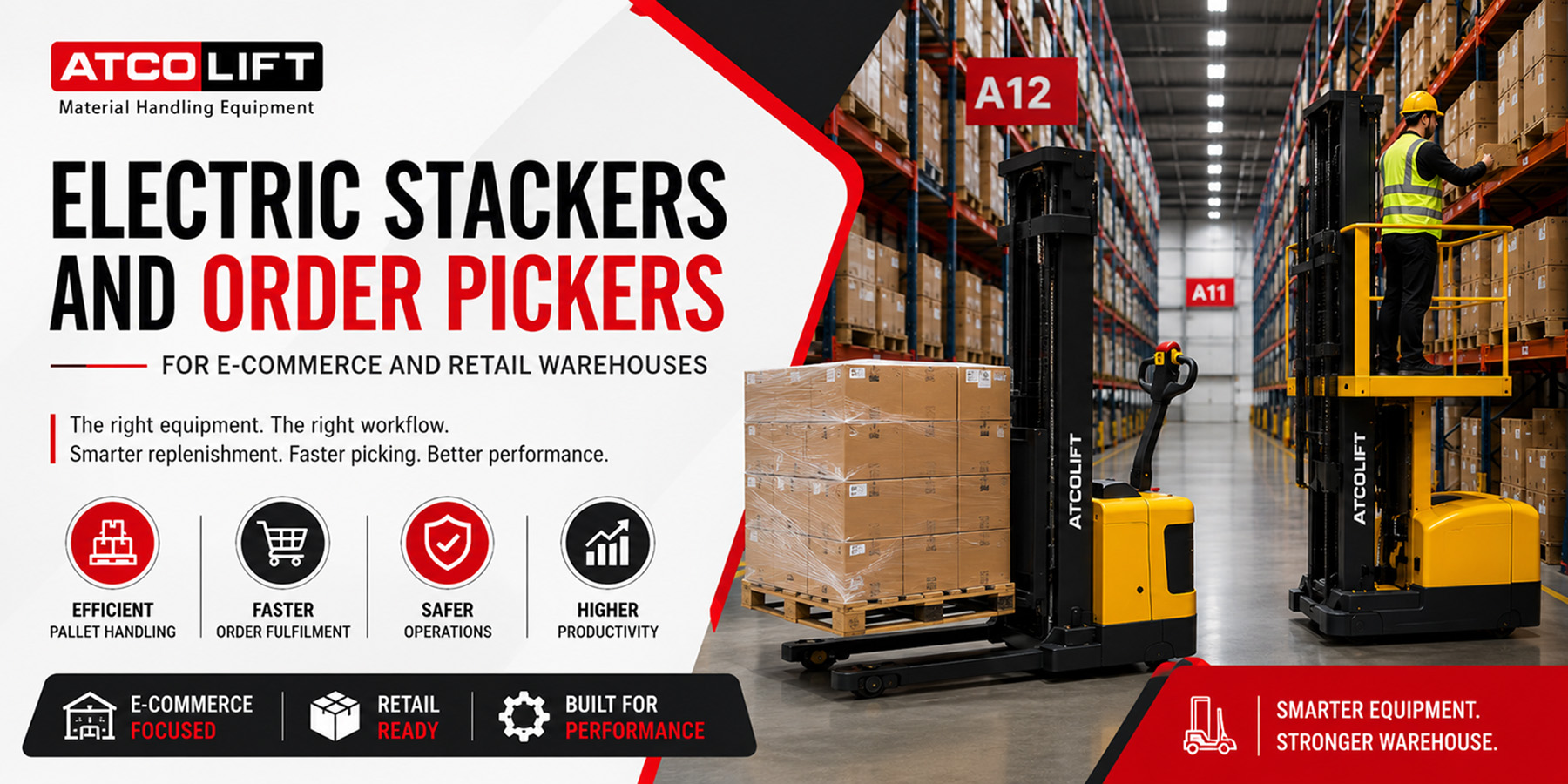
A busy e-commerce warehouse often faces two different challenges at the same time. Pallets must be replenished quickly to keep picking locations stocked, while customer orders need to be collected accurately and dispatched within tight delivery windows. When the same equipment is expected to handle both tasks, operators spend more time waiting, aisles become congested, and productivity starts to fall.
Many warehouse managers initially assume that adding another forklift will solve the problem. In practice, the issue is often equipment suitability rather than equipment quantity. Electric stackers and order pickers perform different roles, and understanding where each machine works best can improve warehouse flow, safety, and operating efficiency.
Different Machines for Different Warehouse Tasks
Although both machines support material handling, they are designed for different stages of warehouse activity.
An electric stacker is mainly used for transporting, lifting, and stacking palletised goods. It can support pallet replenishment, move inventory between storage zones, and handle goods in areas where a larger forklift may be unnecessary or difficult to operate. Its compact size and electric drive make it suitable for indoor warehouses with regular stop-and-go movement.
An Order pickers is designed for selecting individual cartons or products rather than moving complete pallets. The operator platform rises to the required storage level, allowing items to be picked directly from shelving or racking. This is especially useful in e-commerce fulfilment centres, retail distribution facilities, spare-parts warehouses, and operations managing many stock-keeping units.
Normally selected for:
- Moving palletised goods
- Replenishing forward-picking locations
- Stacking pallets in racking
- Working in compact indoor areas
- Supporting short-distance pallet movement
Normally selected for:
- High-volume order fulfilment
- Carton and individual-item picking
- Multi-level shelf access
- Large product catalogues
- Retail and e-commerce distribution
Why Bottlenecks Develop During Peak Operations
During a busy shift, pallet replenishment and order fulfilment often compete for the same aisles and working space. Picking teams need clear access to storage locations, while stacker operators need room to replenish stock. If these movements are not planned properly, one activity starts blocking the other.
A typical bottleneck occurs when an order picker reaches an empty location because the replenishment pallet has not arrived. At the same time, the stacker operator may be waiting outside the aisle because picking activity is still in progress. Both operators are available, but neither process is moving efficiently.
These small interruptions may appear harmless, but they accumulate across the day. The result can be longer order cycles, missed dispatch cut-off times, unnecessary equipment travel, overtime, and pressure on packing and loading teams.
Practical Warehouse Scenario
In a retail distribution warehouse, fast-moving items may need to be replenished several times during a shift. If pallet movement and order picking use the same narrow aisle at the same time, both tasks slow down. Separating the activities by equipment type, timing, or aisle zone can reduce waiting and improve flow.
Common Equipment Selection Mistakes
One of the most common mistakes is selecting equipment mainly by purchase price, lift height, or rated capacity. These specifications matter, but they do not explain whether the machine fits the actual workflow.
For example, a warehouse may purchase additional electric stackers expecting faster order fulfilment. Pallet replenishment may improve, but operators may still walk long distances and manually collect individual items because stackers are not designed for productive order picking. Labour cost remains high, and picking speed changes very little.
The opposite problem also occurs. A warehouse may invest in Order pickers but provide too little replenishment equipment. Picking operators then reach empty locations and wait for reserve stock to be transferred from pallet storage.
Factors That Affect Safety, Productivity, and Cost
Equipment performance depends on more than lifting capability. Warehouse layout, rack design, operator training, battery planning, maintenance access, and traffic control all influence how well a machine performs over a full shift.
Aisle width must be checked using the actual machine dimensions, load size, turning requirement, and safety clearance. A stacker that technically enters an aisle may still need too much manoeuvring space when carrying a long or unstable pallet.
Order-picking height also needs careful review. The selected machine should safely reach the required shelf level while giving the operator practical access to cartons. Picking height, platform height, shelf depth, product weight, and guardrail arrangement should be considered together.
Battery strategy is another important factor. Warehouses operating long or multiple shifts must plan charging windows, battery capacity, charger location, and emergency availability. In the UAE, Saudi Arabia, Oman, and other GCC markets, high ambient temperatures can also affect battery performance and charging conditions if the equipment or charging area is not managed correctly.
Floor quality is equally important. Uneven surfaces, dock transitions, damaged joints, or debris can reduce stability, increase vibration, and accelerate wheel wear. A machine selected for smooth indoor flooring may not perform well in a mixed warehouse and loading-bay environment.
Hidden Costs Beyond the Purchase Price
The equipment price is only one part of the total operating cost. Poor selection can create expenses that are less visible during procurement.
- Extra operator walking and repeated travel
- Unnecessary battery charging cycles
- Product, pallet, or racking damage
- Higher wheel and component wear
- Waiting time between replenishment and picking
- Overtime caused by missed dispatch schedules
Operator fatigue is another hidden cost. Repeated mounting, walking, reaching, and manual handling can reduce picking consistency and increase the chance of mistakes later in the shift. The most suitable equipment should improve the complete work cycle, not only one lifting task.
What to Check Before Selecting a Stacker or Order pickers
A practical evaluation should start with the movement of goods through the warehouse—from receiving and reserve storage to replenishment, picking, packing, and dispatch.
- Are complete pallets or individual items handled more frequently?
- How often does replenishment interrupt picking activity?
- What are the narrowest aisle and turning-space measurements?
- What are the maximum pallet weight and load-centre requirements?
- What is the highest safe picking or stacking level?
- How many operating hours must the battery support?
- Are the floor conditions suitable for the selected machine?
- Can maintenance be completed without disrupting peak operations?
- Will future warehouse growth change the equipment requirement?
Many e-commerce and retail warehouses benefit from using both electric stackers and order pickers. The stacker keeps forward-picking locations supplied, while the Order picker supports fast and accurate item collection. The machines do not replace each other; they support different parts of the same fulfilment process.
Before adding equipment, the more useful question is not simply, “How high can this machine lift?” It is, “Where does time stop moving in our warehouse, and which machine is designed to remove that delay?” That question usually leads to a better operational decision than comparing specifications alone.



GET A QUOTE
Tell us about your business requirement, one of our technical expert will be in touch with you soon..!
NEW PRODUCTS ALERTS