Hand Sanitizer and Liquid Soap Filling Lines: From Bottle to Carton
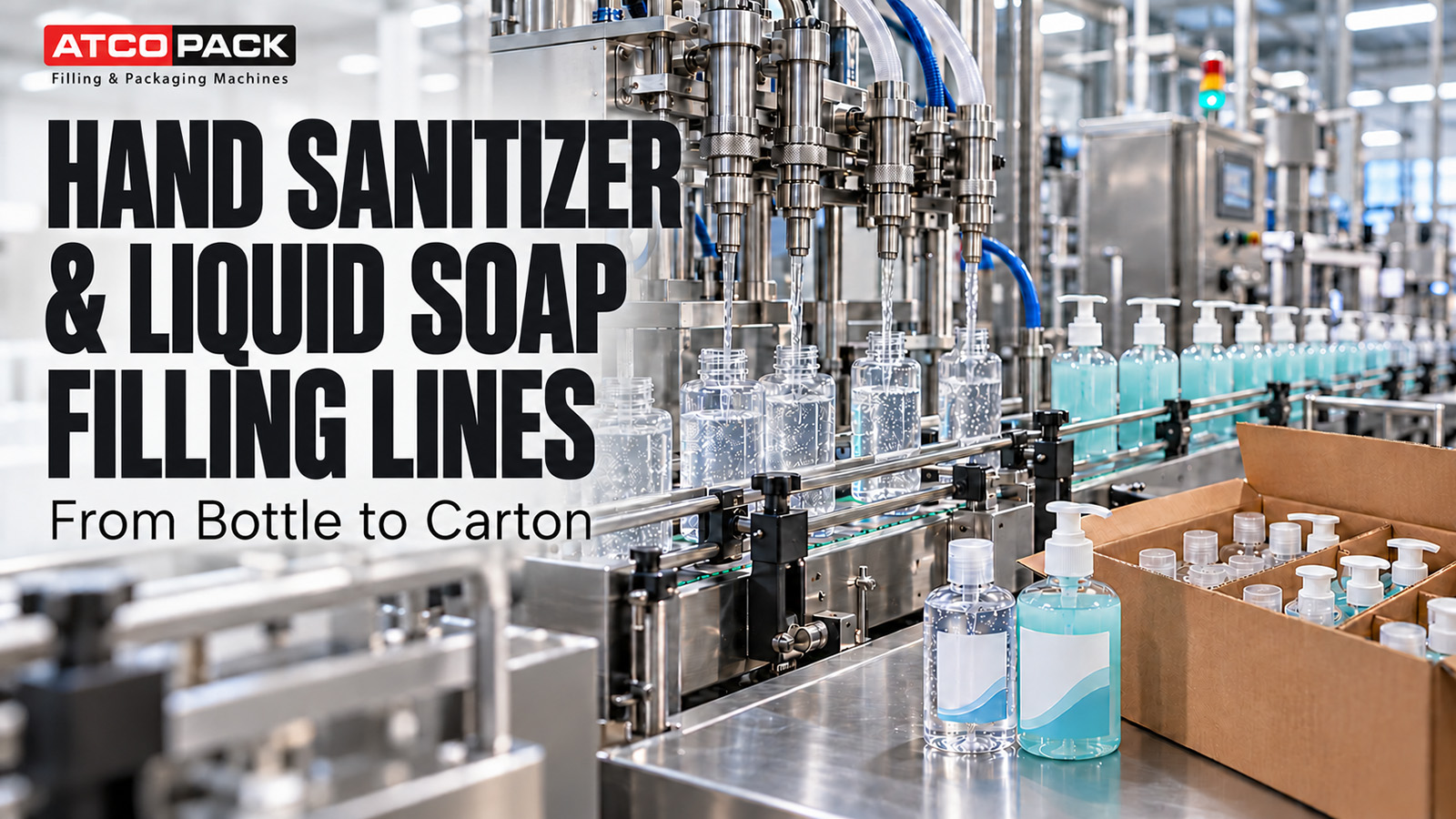
The filler is running, bottles are moving, and operators are working continuously. Yet finished cartons are falling behind schedule. Soap residue needs wiping from bottle shoulders, pump closures require adjustment, and bottles keep collecting before the packing station.
This is where hand sanitizer and liquid soap filling lines need to be assessed as a complete process. Bottle feeding, filling, closing, labeling, coding and carton packing must work together. A reliable machine at one station cannot compensate for repeated interruptions elsewhere.
Start with the Product and Complete Packaging Format
A hand sanitizer and liquid soap filling line transfers prepared product into bottles, applies closures, adds labels and identification codes, and prepares accepted packs for dispatch. Depending on the packaging format, it may include individual cartoning, shipping-case packing or both.
Although these products may use similar containers, their behaviour during filling can differ considerably. Sanitizer may be a thin liquid or a thickened gel. Liquid soap can foam, flow slowly or leave a string of product when the nozzle withdraws.
These characteristics influence dosing equipment, nozzle design and cycle time. Test the actual formulation at its expected filling temperature. A demonstration with water cannot establish how a thicker or foaming product will perform during production.
Packaging details need the same attention. Bottle shape, neck finish, rigidity and stability affect handling. Pump dip tubes can complicate insertion, while lightweight containers may deform under excessive gripping pressure.
Define the bottle, closure, label, coding position and carton arrangement together. An individual retail carton and a shipping case require different equipment and handling methods, so “carton packing” should be clearly specified before quotations are compared.
Control Foam, Dripping and Fill Consistency
Foaming can begin before the product reaches the filling nozzle. Air introduced during transfer, turbulent flow and splashing inside the bottle can all contribute. Foam then occupies space needed by the liquid, increasing the risk of overflow and delayed settling.
Bottom-up filling can help by reducing the distance the product falls. A diving nozzle enters the bottle and rises during filling. Its travel, flow rate and withdrawal timing need adjustment to suit the product and container; changing the nozzle alone may not resolve an upstream air-entry problem.
Piston or suitable pump-based dosing may be considered for thicker soaps and gels. The choice should reflect the formulation, fill range, required accuracy and cleaning procedure. Product-contact seals and hoses also need compatibility checks.
Dripping creates costs beyond the lost product. Residue on bottle shoulders adds wiping work and can affect label adhesion. Product around the neck may interfere with closure performance. Check nozzle shut-off, pressure and withdrawal settings before accepting manual cleaning as a normal production task.
Verify fill quantity using a defined checking method. Similar liquid levels do not necessarily mean equal volumes because bottle dimensions can vary. Where weight checks are used to assess a volume declaration, account for container tare and the relevant product density.
Balance Closing, Labeling and Carton Packing
A common procurement mistake is comparing filling machines by their maximum speed while giving less attention to closure application and packing. If those operations cannot keep pace, bottles accumulate and the filler stops repeatedly.
Closure faults deserve early investigation. Cross-threaded caps, poorly seated pump collars and damaged components can cause leaks or rework. Applying more tightening force can damage the pack rather than correct the underlying alignment problem.
Establish closing settings with the actual bottle and closure combination. Check sealing, opening performance and pump operation where relevant. Confirm that pumps leave the line in the intended shipping position.
Labeling depends on consistent bottle presentation. Wet surfaces, unstable transfers and irregular spacing can create wrinkles or misalignment. Inspect how bottles arrive at the labeler before repeatedly adjusting the application mechanism.
A soap line running at 30 bottles per minute over 420 scheduled production minutes has a theoretical output of 12,600 bottles. If repeated interruptions consume 60 minutes, production opportunity falls by 1,800 bottles before rejects or reduced-speed operation are counted.
At 12 bottles per shipping case, the packing operation must handle 2.5 cases per minute. That gives an average of 24 seconds per case across case assembly, counting, loading and sealing.
These are illustrative planning figures, not industry benchmarks or guaranteed equipment performance.
Record why each interruption occurs. Closure replenishment, tipped bottles, label changes and packing congestion require different corrective actions. Increasing filler speed will not solve all of them.
Plan Cleaning, Changeovers and Maintenance Access
A line that performs well during a long batch may struggle with several short runs. Fragrance changes require cleaning. Bottle changes involve guides and settings. Label and carton changes require material clearance to prevent mixed packaging.
Include these activities when calculating daily capacity. Accessible product paths, clearly identified change parts and documented settings help make changeovers more repeatable. Cleaning procedures should address the formulation and include a suitable method for verifying cleanliness.
Maintenance teams should review access before installation. A worn seal or faulty sensor can cause a lengthy stoppage if technicians cannot reach it or identify a replacement. Check routine spare parts, adjustment instructions and fault-recovery procedures.
For factories in the UAE, Saudi Arabia and Oman, use actual room temperatures and utility conditions in the specification. Assess label adhesion and carton performance across expected storage and loading conditions, including movement from conditioned areas into warmer zones.
Automation can reduce repetitive handling, but operators still replenish components, verify quality and recover from faults. Staffing plans must allow for these tasks.
Evaluate the Complete Line with Production Materials
An acceptance trial should follow the product through the complete packaging process. Use representative formulations, bottles, closures, labels and cartons, including difficult formats that will form part of normal production.
When evaluating a proposal from ATCOPACK or another equipment supplier, agree on measurable acceptance conditions before the demonstration:
- Output: Sustained accepted packs using the specified formulation and packaging format.
- Quality: Fill consistency, closure integrity, label placement and readable coding.
- Operation: Staffing, component replenishment and recovery from routine interruptions.
- Changeovers: Demonstrated cleaning, format adjustment and maintenance access.
Record accepted units, rejects, downtime and operator interventions. Include replenishment and a representative changeover where practical. A short uninterrupted demonstration provides limited evidence about performance across a full shift.
Confirm label artwork, batch identification and destination-market requirements separately. Applying a label accurately does not establish that its content is correct.
Before committing to the line, ask: Can the intended team repeatedly deliver the required accepted cartons per shift with the actual products, packaging variations and available cleaning time?


GET A QUOTE
Tell us about your business requirement, one of our technical expert will be in touch with you soon..!
NEW PRODUCTS ALERTS