Electric Stackers (Rider)
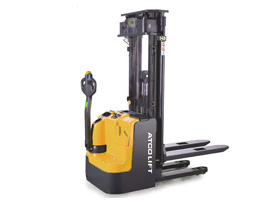
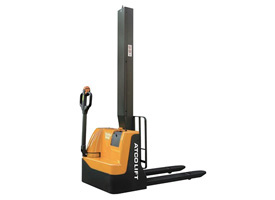
Electric Stackers (Rider) are battery-powered material handling machines designed for lifting, stacking, and internal pallet movement where higher throughput and operator efficiency are required. Commonly used across warehouses, factories, and logistics facilities, these units support frequent load transfer between storage zones and racking aisles. Typical handling capacities range from 1200 kg to 2000 kg, with mast configurations supporting stacking heights up to 5500 mm. Within the UAE, GCC, and wider MEA region, Electric Stackers help streamline indoor material flow while maintaining controlled operation in confined working areas.

In facilities across Dubai and Abu Dhabi, rider stackers are commonly deployed in distribution centers, cold storage corridors, and manufacturing warehouses where consistent lift performance and predictable handling are essential. Load capacities are typically available between 1.2 to 2.0 tonnes, matched with lift ranges of 3.5 to 5.5 meters, enabling safe pallet placement at multi-level racking. Compact wheelbase geometry supports maneuvering in standard aisle widths without compromising stability under load.
Integration into UAE logistics workflows is straightforward, particularly where battery-operated equipment is preferred for indoor compliance, reduced noise, and controlled operating conditions. The design prioritizes repeatable lifting cycles, controlled acceleration, and operator familiarity, supporting sustained daily operation in demanding environments.
Technical Specifications
| Product Code | ALPS1235N | ALPS1654N | ALPS2045N | ALMB1545ZTX | ALMB2055ZTX | ALMFA1545ZTX |
| Catalogue | Catalogue | Catalogue | ||||
| Power (battery, diesel, petrol, gas, manual) | Battery | |||||
| Operator type | Pedestrian/Stand-on | |||||
| Load Capacity / rated load Q(t) | 1.2 | 1.6 | 2.0 | 1.5 | 1.5 | 2 |
| Load centre distance C(mm) | 600 | |||||
| Load distance ,centre of drive axle to fork x(mm) | 647 | |||||
| Wheelbase y(mm) | 1167 | 1215 | 1327 | 1390 | 1390 | 1390 |
| Service weight (Kg) | 1080 | 1380 | 1620 | 1450 | 1450 | 1550 |
| Axle loading, laden front/rear (Kg) | 860/1420 | 1040/1940 | 1210/2410 | |||
| Axle loading, unladen front/rear (Kg) | 780/320 | 940/440 | 1090/540 | |||
| Tires | Polyurethane (PU) | |||||
| Tire size, front ΦxW (mm) | Φ230×70 | |||||
| Tire size, rear ΦxW (mm) | Φ85×75 | |||||
| Additional wheels(dimensions) ΦxW (mm) | Φ150x54 | |||||
| Wheels, number front/rear(x=driven wheels) | 1x+1/4 | |||||
| Track, front b10(mm) | 510 | |||||
| Track, rear b11(mm) | 390/505 | |||||
| Lowered mast height h1(mm) | 2308 | 2410 | 2228 | |||
| Free Lift height h2(mm) | 1760 | 1820 | 1520 | 1550 | 1550 | 1970 |
| Lift height h3(mm) | 3500 | 5400 | 4500 | 4500 | 4500 | 5500 |
| Extended mast height h4(mm) | 4088 | 5088 | 5208 | 5000 | 5500 | 6040 |
| Height of tiller in drive position min./ max. h14(mm) | 950/1350 | |||||
| Height, lowered h13(mm) | 90 | |||||
| Overall length l1(mm) | 1855 | 1896 | 2025 | |||
| Length to face of forks l2(mm) | 705 | 746 | 875 | |||
| Overall width b1(mm) | 790 | 850/1000 | ||||
| Fork dimensions s/e/l(mm) | 60/180/1150 | |||||
| Distance between fork-arms b5(mm) | 570/685 | |||||
| Machine Dimension (LxWxH) (mm) | 1855 * 790 * 2308 | 1896 * 790 * 2410 | 2025 * 790 * 2228 | |||
| Packing Dimension (LxWxH) (mm) | 1955 * 910 * 2558 | 1950 * 910 * 2600 | 2125 * 920 * 2308 | |||
| Net Weight (kg) | 1080 | 1380 | 1620 | |||
| Gross Weight (kg) | 1100 | 1400 | 1640 | |||
| Ground clearance, centre of wheelbase m2(mm) | 28 | 28 | 23 | 30 | 30 | 30 |
| Aisle width for pallets 1000X1200 crossways Ast(mm) | 2285 | 2385 | 2455 | 2490 | 2490 | 2490 |
| Aisle width for pallets 800X1200 lengthways Ast(mm) | 2250 | 2290 | 2420 | 2450 | 2450 | 2450 |
| Turning radius Wa(mm) | 1380 | 1420 | 1550 | 1655 | 1655 | 1655 |
| Travel speed, load/unloaded (km/h) | 7.0/8.0 | 7.0/8.0 | 6.0/7.0 | 5.0/6.0 | 5.0/6.0 | 5.0/6.0 |
| Lift speed, load/unloaded (m/s) | 0.09/0.14 | 0.13/0.20 | 0.13/0.20 | |||
| Lowering speed, load/unloaded (m/s) | 0.25/0.20 | 0.28/0.23 | 0.28/0.23 | |||
| Max. gradeability, load/unloaded (%) | 6/12 | 6/12 | 6/10 | |||
| Service brake | Electromagnetic | |||||
| Battery voltage, nominal capacity K5 (V/Ah) | 24/180 | 24/270 | 24/350 | 24/210 | 24/210 | 24/210 |
| Energy consumption acc: to VDI cycle (kWh/h) | 0.95 | 1.34 | 1.70 | |||
| Type of drive control | AC- speed control | |||||
| Sound level at driver`s ear acc. to EN 12053 dB(A) | <70> | |||||
Key Features
- Rider platform configuration for extended travel and repetitive pallet transfer
- Battery-operated drive suitable for indoor warehouse environments
- Load handling capacity options from 1200 kg up to 2000 kg
- Mast configurations supporting lift heights between 3500 mm and 5500 mm
- Compact chassis design for operation within standard warehouse aisles
- Pedestrian and stand-on operating modes depending on configuration
- Polyurethane wheel assemblies for smooth industrial flooring
- Stable load center geometry aligned with palletized goods handling
Electric Stackers (Rider)
Brochure | Quotation | Availability
Fill the form with valid details to receive the information.
Product Videos

Frequently Asked Questions
Rider electric stackers are commonly used in UAE distribution centers and industrial warehouses where pallet movement distances are longer. Facilities in Dubai and Abu Dhabi often deploy them for internal transport between receiving, racking, and dispatch zones, especially where pedestrian stackers reduce productivity during repetitive handling cycles.
These stackers are suitable for high-density layouts due to their compact chassis and controlled mast movement. In UAE warehouses with narrow aisle planning, they support stable pallet placement up to mid and high rack levels while maintaining predictable turning behavior on finished concrete floors.
Operators typically evaluate rated capacities between 1200 kg and 2000 kg, along with lift heights up to around 5500 mm. Actual usable capacity depends on load center, pallet condition, and racking design, which are important considerations in UAE logistics and manufacturing facilities.
Yes, they are commonly used in multi-shift warehouse environments when paired with appropriate battery capacity and charging routines. In GCC and Middle East operations, maintenance teams focus on battery health, brake response, and mast inspection to support consistent daily usage.
Routine inspection of wheels, braking systems, hydraulic components, and battery connectors is essential. UAE facilities often schedule preventive checks due to extended operating hours, ensuring reliability in logistics centers exposed to dust ingress and frequent pallet handling.


We Supply To
Customer Testimonials
GET A QUOTE
Tell us about your business requirement, one of our technical expert will be in touch with you soon..!
NEW PRODUCTS ALERTS