Walkie vs Rider Stackers: Choosing the Right Electric Stacker
Loaded pallets are waiting beside receiving. The operator returns on foot with an electric stacker, collects the next load, and heads back towards storage. Another delivery arrives before the staging area is clear.
The immediate response may be to request a faster machine. Yet the delay could come from repeated walking, difficult pallet positioning, blocked aisles, or waiting at pedestrian crossings. Each problem requires a different decision.
Choosing between walkie and rider stackers means understanding where time and effort go during a complete handling cycle. The right electric stacker must suit the travel route, pallet design, rack arrangement, and workload across the shift.
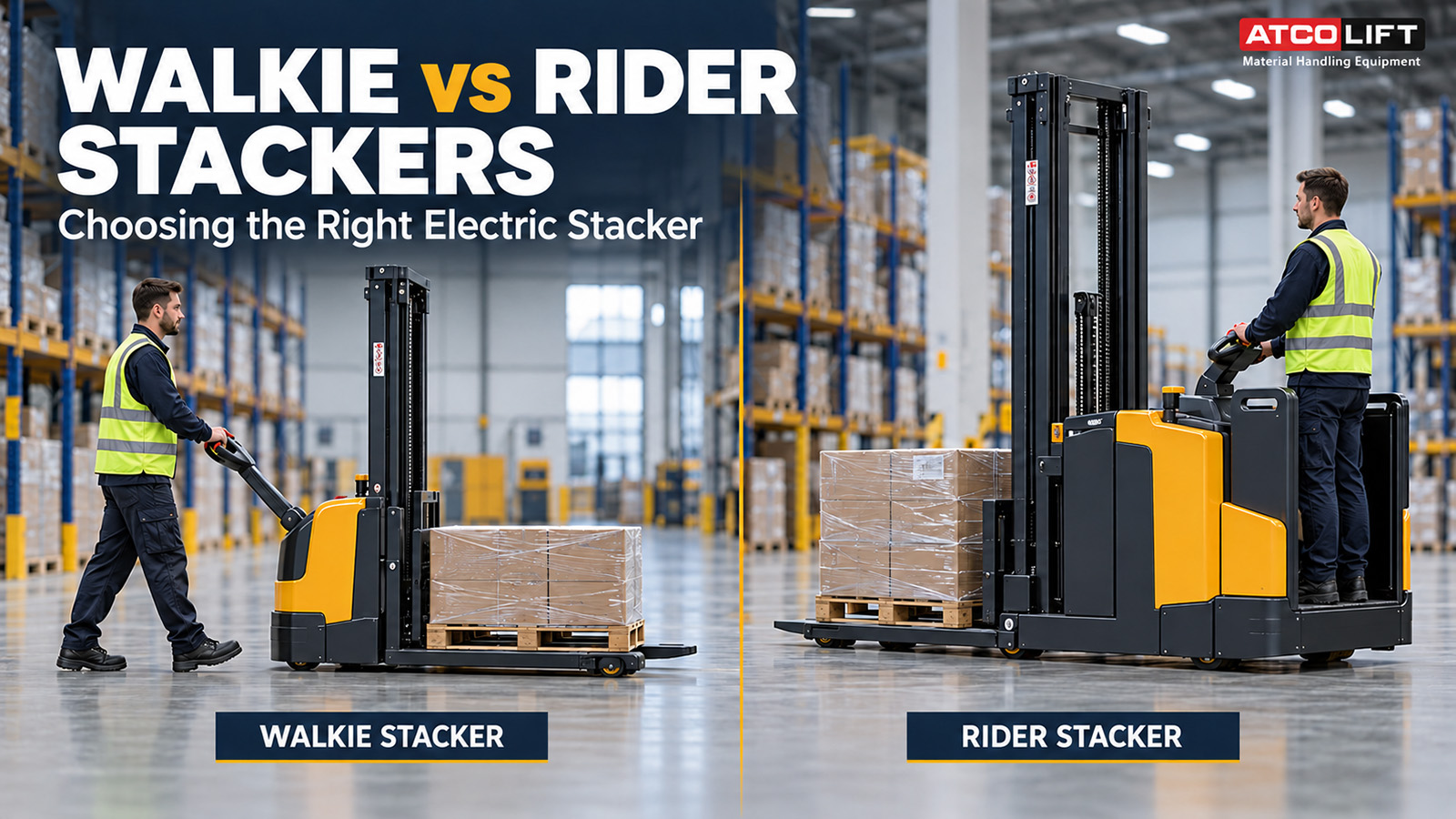
A walkie stacker generally suits short pallet movements and nearby replenishment. A rider stacker deserves consideration when repeated journeys make walking a substantial part of the job.
Confirm both against actual pallet compatibility, working clearance, capacity at height, and battery availability.
1. How walkie and rider stackers work
A walkie stacker is a pedestrian-operated machine, usually controlled through a tiller. On a fully electric model, both travel and lifting are powered. The operator walks with the truck and controls its movement rather than manually pushing the loaded pallet.
A rider stacker allows the operator to travel on a platform or within a dedicated operator compartment. Some models have a folding platform and permit both pedestrian and ride-on operation. Others use a fixed operator position.
This changes how the machine fits the working day. Walking can be practical when storage locations are close together. Riding becomes more relevant when operators repeatedly travel between receiving, storage, production, and dispatch.
However, operator position does not determine lifting capability. A rider stacker does not automatically lift heavier loads or reach higher racks. Capacity, lift height, stability, and pallet access depend on the specific truck configuration.
Walkie vs rider stackers: practical selection differences
| Selection factor | Walkie stacker | Rider stacker |
|---|---|---|
| Operator position | The operator walks with the machine. | The operator travels on a platform or in a compartment. |
| Typical working pattern | Short transfers and local replenishment. | Repeated travel combined with stacking duties. |
| Space to assess | Truck movement, tiller sweep, and operator clearance. | Truck movement and the platform or compartment in its operating configuration. |
| Operator workload | Walking distance, handling frequency, and control position. | Standing comfort, vibration, and mounting frequency. |
| Load suitability | Check pallet compatibility and allowable capacity at the required lift height and load centre. | Check pallet compatibility and allowable capacity at the required lift height and load centre. |
2. Find the delay before choosing a faster machine
Consider a distribution centre where receiving and storage are connected by a 60-metre route. This is an example, not a distance at which a rider stacker automatically becomes necessary.
Each pallet requires collection, loaded travel, positioning, lifting, and an empty return. If walking accounts for much of that cycle, a rider model may reduce travel time and physical workload.
Now consider the same route with pallets obstructing the rack approaches and frequent queues at a crossing. A higher travel speed offers limited benefit because the operator still spends much of the cycle waiting.
In a smaller parts warehouse, pallets may move only a few metres between staging and nearby racks. Precise positioning may take longer than travelling. A suitable walkie stacker can fit this pattern well, while repeated mounting and dismounting may add unnecessary steps.
The common selection mistake is comparing maximum travel speeds before measuring the task. Advertised speed does not show how many pallets the machine can safely handle under actual warehouse conditions.
Observe a busy period and separate travel, lifting, alignment, and waiting time. Compare shortlisted machines on the same loaded route. Record completed cycles and operator feedback, including any difficulty at rack ends or congested approaches.
3. Match the stacker to the pallet, rack, and aisle
A machine that travels comfortably down an aisle may still lack room to turn and place a pallet. Assess the manufacturer's right-angle stacking aisle requirement for the intended pallet dimensions and orientation.
Include rack protection, load overhang, and safe operating clearances. For a walkie stacker, allow space for the operator and tiller movement. For a rider model, assess the platform or compartment in the configuration that will actually be used.
Pallet design is equally important. Support arms and load wheels must work with the pallet openings and bottom boards. Two pallets with similar outside dimensions can require different handling arrangements.
Also distinguish between support-arm, straddle, and counterbalanced configurations. The choice between walking and riding does not resolve an underlying mismatch between the truck and pallet.
Check allowable capacity at the highest required rack position. The nominal capacity alone is insufficient: lift height and load centre affect what the truck can safely handle. Use the specific machine's capacity plate or approved load chart.
Doorways and overhead services need attention too. Check the collapsed mast height for travel and the full lifting envelope at storage locations. Include floor joints, thresholds, rack bases, and any gradients in the site assessment.
An empty demonstration pallet cannot establish loaded visibility, handling behaviour, or placement clearance. Include the heaviest and most awkward loads within the proposed operating limits.
4. Compare operator safety and availability across the shift
Neither format is automatically safer. Each creates different operating considerations that must be assessed against the warehouse layout.
With a walkie stacker, examine confined areas where an operator could become trapped between the truck or tiller and a fixed object. With a rider stacker, assess pedestrian crossings, turning visibility, operator protection, and safe access to the platform or compartment.
Operators need training and familiarisation for the selected machine and site. Follow the operating manual for travel position, load height, gradients, and permitted surfaces. Traffic controls and clear routes remain essential.
Fatigue also deserves a practical trial. Riding reduces walking, but standing comfort, floor vibration, and repeated mounting can affect the operator. Walking may be manageable for local replenishment but demanding when routes become longer or movement frequency increases.
An overlooked cost is lost availability. If charging interrupts peak receiving, pallets can accumulate even when the stacker's handling performance is suitable. Compare battery capacity, approved charging arrangements, charger requirements, and backup coverage against the busiest shift.
For facilities in the UAE, Saudi Arabia, and Oman, check equipment suitability for hot receiving areas, cold stores, and temperature transitions. Confirm operating and charging limits rather than assuming a standard specification suits every environment.
Pre-use checks and maintenance should follow the manufacturer's instructions. Pay attention to wheels, forks, lifting components, brakes, steering, controls, and battery connections as applicable. Safety-critical defects require the machine to be removed from service until assessed and corrected.
5. Turn the site trial into a purchase decision
A useful equipment trial answers specific operating questions. Can the machine collect the actual pallet, negotiate the tightest working area, place the load at the required height, and remain available during peak demand?
Ask each supplier to demonstrate the same tasks and confirm compatibility in writing. This gives procurement, operations, maintenance, and operators a common basis for comparing proposals.
Load and storage
Verify pallet entry, load dimensions, load centre, and allowable capacity at the highest required position.
Working clearance
Demonstrate turning, stacking, operator space, and overhead clearance.
Shift performance
Compare complete handling cycles, operator workload, and charging requirements.
Maintenance and cost
Assess servicing, battery costs, parts availability, and coverage during downtime.
Safe operation
Confirm training, traffic controls, inspection requirements, and environmental suitability.
A mixed fleet may make sense when local replenishment and longer transport cycles have different requirements. If most work involves horizontal movement, assess whether separating transport from stacking would prevent one shared machine becoming a bottleneck.
Before approving the purchase, identify the task that currently limits pallet flow. Will the proposed stacker remove that constraint during the busiest shift, or simply reach the same queue sooner?


GET A QUOTE
Tell us about your business requirement, one of our technical expert will be in touch with you soon..!
NEW PRODUCTS ALERTS