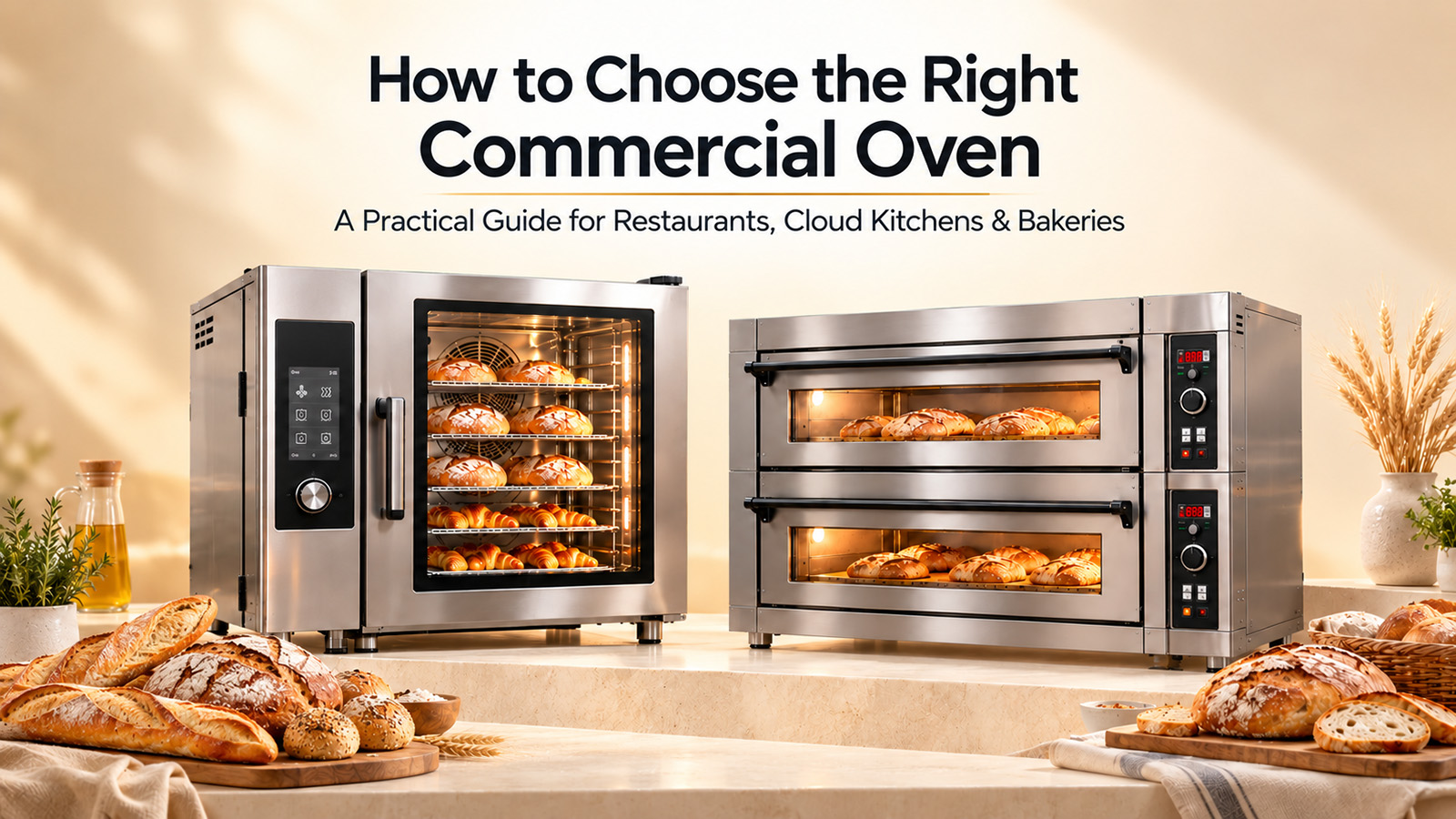
How to Choose a Commercial Oven for a Restaurant, Cloud Kitchen or Bakery
The chicken is ready to roast, baked pasta orders are building up,
and vegetables need finishing before dispatch. Each job needs the
oven, but the temperatures and cooking times do not match. Staff
keep changing settings and opening the door. Orders leave late
even though some shelves remain empty.
A bakery faces a similar problem when bread production overlaps
with pastries requiring a different baking profile. The issue may
be insufficient capacity, but it can also be the wrong oven type
or too many processes depending on one chamber.
What Should Determine Your Choice?
Choose a commercial oven around your menu, peak production
schedule and required cooking results. Then verify usable
capacity, utilities, ventilation, cleaning, operating costs
and local service support. Compare purchase prices after
these requirements are clear.
1. Calculate Demand During the Busiest Production Period
Start with the food rather than the catalogue. Record products,
portion sizes, tray dimensions, cooking conditions and required
finishing times. Daily meal volume provides context; the busiest
production window reveals whether the oven can keep up.
A restaurant cooking throughout the day has different needs from
a catering kitchen preparing most of its output before a fixed
dispatch deadline. In a hotel, breakfast replenishment and banquet
preparation may compete for the same equipment.
For a cloud kitchen, separate advance preparation from cooking
after an order arrives. Roasting ingredients before service may
be manageable. Baking individual dishes during the delivery rush
creates a conflict if the chamber is still occupied by bulk
preparation.
Include loading, cooking, unloading and recovery in each batch
cycle. For example, a batch occupying the oven for 25 minutes
allows only two complete consecutive batches within an hour.
Changing temperature or cooking mode can extend the schedule.
These are planning examples; establish actual timings through
recipe trials.
Check the next step too. More oven output will not improve dispatch
if there is insufficient space for resting, cooling, holding or
packing finished food.
2. Match the Oven Type to the Cooking Result
Commercial ovens differ in heat transfer, airflow and moisture
control. Select the cooking process first, then compare models
within the appropriate category.
On mobile, swipe across the table to view all columns.
| Oven Type | Typical Application | What to Verify |
|---|---|---|
| Convection | Fan-assisted roasting and tray baking. | Airflow settings, full-load consistency and performance with delicate products. |
| Combi | Hot-air cooking, steaming and combined heat-and-moisture processes. | Cooking modes, water treatment, drainage, cleaning and training requirements. |
| Deck | Bread, pizza and products requiring particular base and crust characteristics. | Baking surface, chamber height, top and bottom heat control, and loading method. |
| Rack | Trolley-based bakery batches. | Full-rack performance, trolley compatibility and movement space. |
| Conveyor | Repeatable products suited to a controlled cooking journey. | Belt capacity, product spacing, cooking profile and loading workflow. |
A bakery focused on hearth-style bread may prioritise deck baking.
A restaurant with a varied menu may value combi functionality.
A pizza-led delivery kitchen may prioritise repeatable conveyor
output.
Steam injection in a bakery oven does not automatically provide
the steam-cooking capability of a combi oven. Confirm the specific
model's functions and intended applications.
Two independent chambers can help when products require incompatible
conditions. Balance that flexibility against installation, cleaning
and maintenance costs; one larger chamber cannot run two different
temperature settings simultaneously.
3. Test Usable Capacity and Cooking Consistency
A common selection mistake is treating shelf positions as guaranteed
output. Ten shelf positions do not necessarily accommodate ten
trays of your product at the spacing needed for consistent cooking.
Deep roasting pans, expanding dough and tall products need different
clearances. Crowded loading can restrict airflow. Confirm tray
compatibility as well: bakery trays and gastronorm pans are not
automatically interchangeable.
Request a demonstration using representative recipes, ingredients
and intended loads. Check colour, texture, cooking time and results
across shelf positions. Note whether trays need rotating and whether
that extra handling is realistic during service.
Assess bakery products after suitable cooling, and restaurant dishes
at their actual serving or dispatch point. A product that looks
right when unloaded may lose quality during holding or delivery.
Controls must suit the people using them. Stored recipes can support
repeatability, but staff still need consistent portions, starting
temperatures and loading patterns. Include shift supervisors in the
trial, rather than relying only on a demonstration operator.
4. Confirm Installation, Cleaning and Ownership Costs
Measure door opening, operator space, hot-tray landing areas and
maintenance access, as well as the equipment footprint. Check
doorways, corridors and lifts along the delivery route.
Have qualified installers verify electrical capacity or gas
compatibility. Neither fuel is automatically cheaper: compare
local tariffs, installation work and expected usage. For
steam-capable models, check water quality, treatment, pressure
and drainage against the exact manufacturer's requirements.
In kitchens across the UAE, Saudi Arabia and Oman, heat management
deserves early attention. Have the ventilation designer assess
extraction, replacement air and applicable installation requirements.
An electric oven still releases heat; confirm extraction needs
for its use and approved installation.
Arrange raw-food loading, cooked-food unloading and dirty-tray return
to avoid conflicting movements. Provide a suitable nearby landing
surface so staff do not carry heavy hot trays across a congested
aisle.
Build cleaning into the shift schedule. Automatic cleaning still
requires correct consumables, staff checks and routine attention
to accessible components. Follow model-specific instructions for
seals, glass, drains, cooling and cleaning chemicals.
Food safety depends on a validated cooking process appropriate to
the food. Chamber temperature does not confirm the temperature
at the centre of the product. Where probes are used, correct
positioning, cleaning and verification matter.
Hidden Cost: Dependence on One Oven
If most of the menu depends on one unit, downtime can interrupt
service across several dishes. Confirm technician availability,
essential spare-parts lead times, warranty conditions and a
workable backup cooking plan.
Compare purchase, installation, accessories, energy, water,
cleaning consumables and planned servicing together. Rated power
alone does not establish daily consumption. Preheating, idle time,
loading and operating hours affect actual use.
5. Approve the Oven Against a Written Operating Brief
Use the same brief for every shortlisted model. Ask the chef,
kitchen manager, facilities team and procurement team to review
these points together.
Commercial Oven Selection Checklist
Peak Output
Can it complete the production schedule using realistic batch cycles?
Can it complete the production schedule using realistic batch cycles?
Cooking Quality
Has performance been checked with representative products and loads?
Has performance been checked with representative products and loads?
Daily Operation
Do trays, shelf clearances and controls suit the team?
Do trays, shelf clearances and controls suit the team?
Site Readiness
Are utilities, ventilation, drainage and access confirmed?
Are utilities, ventilation, drainage and access confirmed?
Cleaning and Costs
Are labour, consumables, accessories and servicing included?
Are labour, consumables, accessories and servicing included?
Reliability
Is local support available, with a practical downtime plan?
Is local support available, with a practical downtime plan?
Before approving a larger oven, identify the actual constraint:
insufficient batch space, incompatible cooking conditions,
slow recovery or poor scheduling. Walk through the busiest hour
with the proposed equipment. Which dish occupies the chamber,
what must cook next, and where will the hot trays go when both
orders are due together?


GET A QUOTE
Tell us about your business requirement, one of our technical expert will be in touch with you soon..!
PROCEED
NEW PRODUCTS ALERTS