Bakery Equipment for Supermarkets: Ovens & Packaging
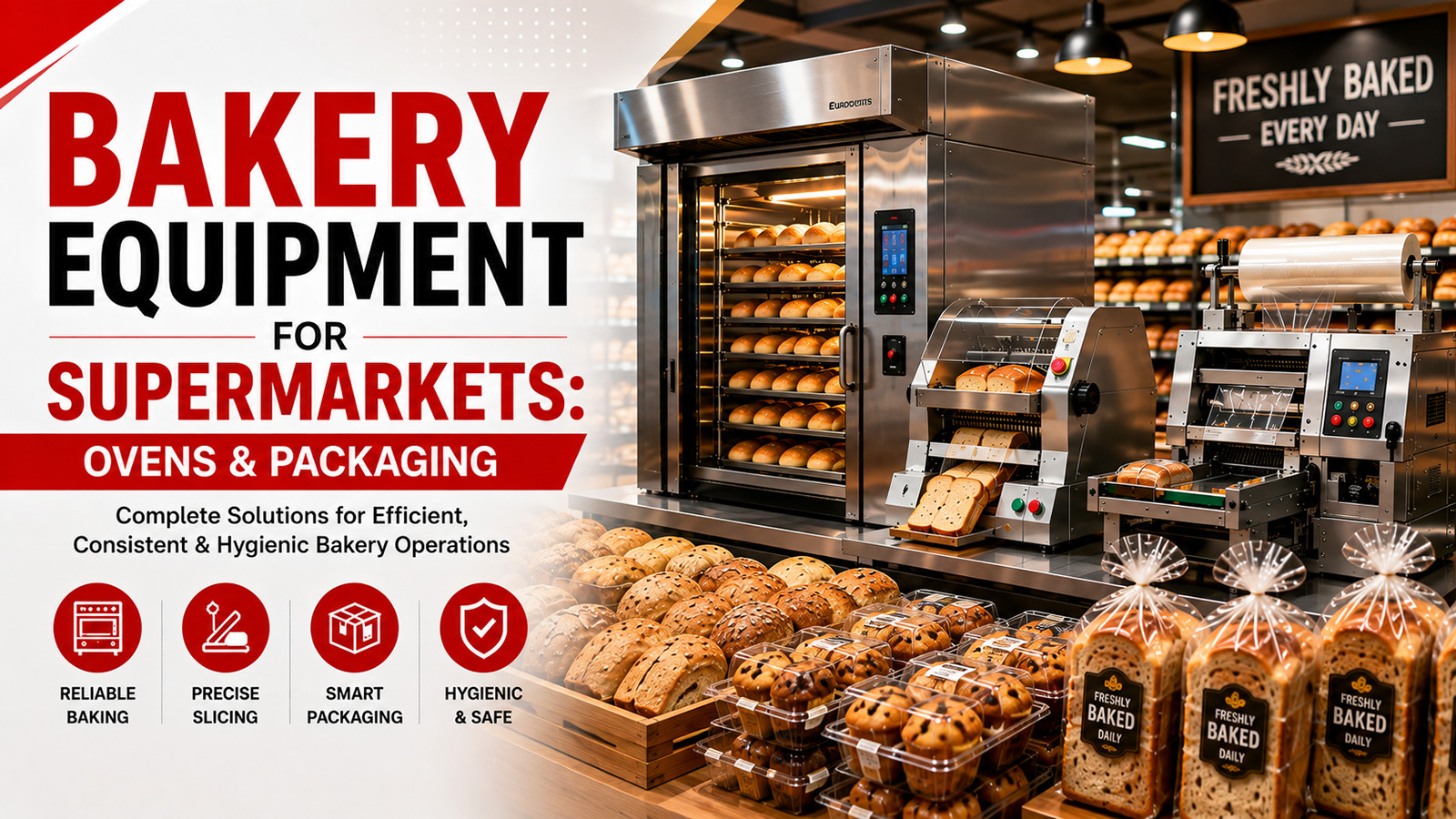
A supermarket bakery can have a capable oven and experienced staff but still struggle to keep fresh products moving to the shelves during busy periods. The problem often appears when several batches need to be baked, cooled, sliced and packaged within a short production window.
The oven may finish a rack while the cooling area is still occupied. Bread may be ready for slicing while staff are clearing the previous batch. Packaging can fall behind, leaving finished products waiting even though baking is running on schedule. What looks like an equipment-capacity problem may actually be a workflow problem.
Selecting bakery equipment for supermarkets therefore requires more than comparing oven capacities or packaging speeds. The equipment needs to work as a connected production system, from preparation and baking through cooling, slicing, packaging and transfer to the retail display.
Match Bakery Equipment to the Actual Production Flow
Equipment selection should start with the products being made and how they move through the bakery during a normal working day.
A supermarket baking frozen or par-baked products has different requirements from a bakery preparing dough from raw ingredients. Bread, rolls, croissants, pastries, cakes and cookies can also require different proofing conditions, baking programmes, cooling periods and packaging methods.
Peak production is particularly important. Equipment sized only around average daily volume may become a bottleneck before morning, evening or weekend shopping periods. At the other extreme, unnecessarily large equipment can occupy valuable floor space and increase energy and capital costs without improving usable output.
- Ingredient, chilled or frozen product storage
- Dough preparation or product handling
- Proofing where required
- Baking
- Cooling
- Slicing or finishing
- Packaging and labelling
- Transfer to bakery display
Each stage should have enough capacity to support the next. Increasing oven output, for example, gives little operational benefit if there is insufficient cooling or packaging capacity to handle the additional products.
Choose Ovens for Consistent Output, Not Capacity Alone
The oven is one of the most important pieces of supermarket bakery equipment because it influences production capacity, product consistency, scheduling and energy use.
Rack ovens can be useful for bakeries producing repeated batches of bread, rolls, pastries and similar products. Multiple trays move together on a rack, which can make product handling between proofing, baking and cooling more organised during higher-volume production.
However, tray or rack capacity should not be the only selection factor. Product mix, batch frequency, temperature range, steam requirements, airflow, controls, available utilities, ventilation and cleaning access all affect how well an oven performs in daily use.
Consistency deserves particular attention. A customer buying the same bread at different times expects a similar colour, texture and finish. Poor temperature control, incorrect airflow, inconsistent loading or excessive dependence on operator judgement can produce noticeable differences between batches.
Programmable controls and repeatable baking settings can help staff reproduce established baking conditions across different shifts. They do not replace correct preparation or operator training, but they can reduce unnecessary variation.
Common selection mistake: Buying a larger oven because higher capacity appears to offer greater productivity. If the bakery cannot prepare, cool and package that output efficiently, the additional oven capacity may simply move the bottleneck somewhere else.
Cooling is a good example. A rack leaving the oven requires safe space while products release heat and reach the appropriate condition for the next process. Too little cooling space can lead to congested aisles, excessive rack movement and pressure to move products forward too quickly.
Heat load also matters in UAE, Saudi Arabia, Oman and other Gulf markets. Bakery ovens can add considerable heat to an already demanding working environment. Oven positioning, extraction, ventilation, air-conditioning load and staff comfort should therefore be considered during bakery planning rather than after equipment installation.
Plan Slicing and Packaging Around Peak Bakery Output
Baking receives much of the attention during equipment planning, but the production process does not finish when products leave the oven.
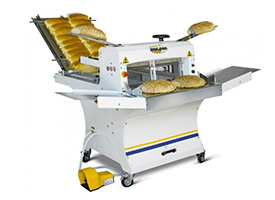
For supermarkets selling packaged sliced bread, a commercial bread slicer can improve slice consistency and reduce repetitive manual work. The correct machine should suit the loaf dimensions, bread types, required slice thickness and realistic production volume.
Speed alone can be misleading. A high-output slicer provides limited benefit if products must wait for an employee to organise them or if the packaging station immediately becomes overloaded.
Packaging can become an even larger bottleneck during peak production. Several oven batches may finish within a relatively short period, creating a sudden volume of products that need to be handled, packed and labelled before going to display.
When packaging capacity is too low, staff may be moved away from preparation or other bakery tasks to clear the backlog. Finished products remain on worktables longer, the area becomes congested and the possibility of handling or labelling mistakes can increase.
Packaging requirements also vary by product. Bread may use bags with suitable closure or sealing methods, while pastries, cakes and cookies may require trays, containers or other protective formats. The packaging process should therefore be flexible enough for the bakery's actual product mix.
Automation should be based on production need rather than assumed to be the better option. A bakery producing many different products in moderate quantities may benefit from a flexible semi-manual arrangement. Higher and more repetitive volumes can make additional packaging automation practical.
Operational check: Packaging should be evaluated against the bakery's busiest realistic production period, not only its average daily output.
Hygiene, Cleaning and Maintenance Affect Daily Productivity
Food safety and equipment productivity are closely connected to cleaning and maintenance.
Flour, crumbs, grease and product residue can accumulate around bakery equipment. Food-contact surfaces and areas beneath or around machines should therefore be accessible enough for routine cleaning and inspection.
Equipment placement is just as important as equipment design. Installing machines very close together may appear to save floor space, but narrow gaps can become difficult to clean. The same layout can make service panels inaccessible when technicians need to inspect or repair equipment.
This creates a hidden operating cost. A machine may fit perfectly into the available floor plan but require neighbouring equipment to be moved whenever maintenance is needed. A relatively simple repair can then result in unnecessary downtime and disruption to surrounding production.
Critical equipment should also be considered from a downtime perspective. If the main oven stops, much of the bakery's production may stop with it. A slicer failure may increase manual handling, while packaging equipment downtime can create a growing queue of finished products even when the oven continues operating.
Preventive maintenance, cleaning access, spare parts availability and realistic service access should therefore form part of the purchasing decision rather than being considered only after a breakdown.
What Should Buyers Check Before Selecting Bakery Equipment?
Before approving equipment for a new supermarket bakery or an upgrade, it is useful to review the complete production process during peak demand rather than evaluating each machine separately.
- Does the equipment capacity match the actual product range and peak production requirement?
- Are preparation, proofing, baking, cooling, slicing and packaging capacities reasonably balanced?
- Is there sufficient space for hot racks and cooling without blocking staff movement?
- Can slicing and packaging handle the oven's peak output?
- Are food-contact surfaces and surrounding areas practical to clean?
- Can technicians access important components for maintenance and repairs?
- Have electricity, water, drainage, extraction, ventilation and heat load been considered?
- Can different staff shifts achieve consistent results without excessive operator dependency?
- Are energy consumption and expected equipment utilisation appropriate for the production volume?
- Can the bakery layout adapt if the product range or production volume changes?
Balanced Flow Matters More Than Maximum Capacity
The most productive supermarket bakery is not necessarily the one with the largest oven, fastest slicer or highest level of packaging automation. Productivity comes from balancing each stage so that products can move from preparation to baking, cooling, slicing, packaging and display without unnecessary waiting or repeated handling.
That balance also affects labour. When equipment capacities and work areas are properly matched, staff spend less time moving racks unnecessarily, clearing backlogs or compensating for poorly positioned equipment. Cleaning and maintenance can also become easier to manage without disrupting surrounding work.
Final operational question: Before selecting an oven, slicer, packaging machine or other bakery equipment, ask: Can the process immediately before this machine supply it efficiently, and can the process immediately after it handle its full working output?
If the answer is yes on both sides, the equipment is more likely to improve the complete supermarket bakery operation instead of simply moving the production bottleneck to another area.



GET A QUOTE
Tell us about your business requirement, one of our technical expert will be in touch with you soon..!
NEW PRODUCTS ALERTS