5 Food Packaging Trends for 2027: From Smart Labels to Line Monitoring
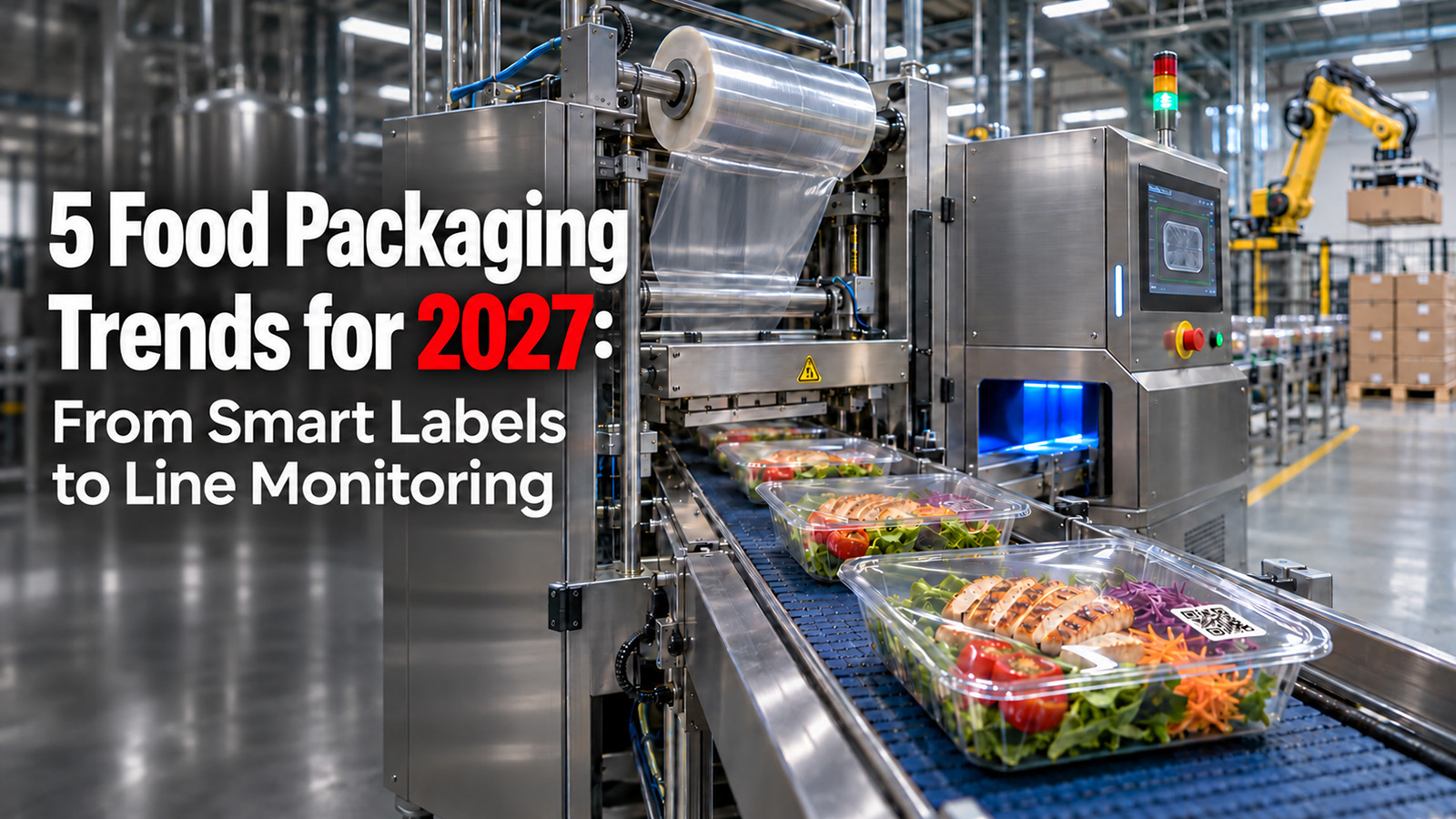
A chilled-meal line can hit its target speed and still miss the dispatch cut-off. A tray-sealer film change runs long, the X-ray unit starts rejecting good packs after a recipe change, and cases back up every time the palletiser swaps a full pallet. Each interruption is short. Together, they can cost a shift more output than a slow machine.
The five food packaging trends to watch in 2027 are smart labels for traceability, reduced film use in modified atmosphere packaging (MAP), AI-assisted X-ray inspection, high-speed robotic palletising and connected line monitoring. The counterintuitive part is that an upgrade can add capacity without increasing machine speed. If the line loses output during changeovers, rejects or minor stops, recovering that time may be the better investment.
1. Smart Labels for Batch Traceability
Smart labels connect a pack to a digital record. A QR code can link to product information or carry lot data where the coding system supports it. A near-field communication (NFC) tag lets someone tap the pack with a compatible device. A product-level link can serve the same page for every pack. Batch traceability requires a way to identify the specific lot and retrieve its production record.
A useful trial starts at a product changeover. Scan the last pack from the outgoing batch and the first from the incoming batch. Does each code resolve to the right lot? Then check readability on finished packs, where curvature, glare or condensation may affect scanning. For orders going to retailers in the UAE, Saudi Arabia or Oman, confirm which code formats and data fields the customer can read. GS1’s 2027 goal focuses on retail readiness to scan 2D barcodes at checkout. Confirm the transition schedule with each retailer before changing printed artwork.
2. Reduced Film Use in Modified Atmosphere Packaging
Modified atmosphere packaging changes the gas composition inside a sealed pack to help preserve the product. The film’s barrier properties and the seal help maintain that atmosphere. A thinner film saves material on each pack, but it may behave differently when it feeds through the machine or seals onto a tray. More start-up waste or leaking packs can erase the saving.
Trial the candidate film on your own trays and products at normal line speed. Compare seal integrity, gas composition inside the pack and film use per saleable pack against the current specification. Include start-up and changeover scrap in the calculation. Have the quality team validate shelf life under the intended storage and distribution conditions before approving a switch. For chilled deliveries in hot weather, use temperature records from loading and transfer points to inform the trial conditions.
3. AI-Assisted X-Ray Inspection
X-ray inspection looks for differences in how materials absorb X-rays. AI-assisted image analysis can help distinguish a suspect feature from normal product variation. That matters on a mixed ready meal, where overlapping ingredients can produce a more variable image than a uniform block of cheese. The product, packaging and target contaminant all affect what the system can detect.
A common buying mistake is to carry a detection result from a supplier’s demonstration pack into the specification for every product on the line. Use your hardest-to-inspect formats and run them at the production speed you need. Agree on three checks before the trial:
The trial gives quality and production teams a shared basis for assessing detection performance and the amount of saleable product that may be diverted for checks.
4. High-Speed Robotic Palletising
A robotic palletiser can reduce reliance on manual case stacking. Its sustained output depends on the whole cell, including case infeed, pallet exchange and any downstream wait at the stretch wrapper. When the palletising cell pauses and the buffer fills, the stop can travel back to the case packer and eventually to the sealer.
Take a line delivering 24 cases per minute. A 30-second pallet exchange sends 12 cases into the buffer while the cell is paused. That is the starting point for sizing accumulation in this example. Allow for cases already on the conveyor and for short peaks in arrivals. The cell also needs spare capacity after restart to clear the backlog. When comparing proposals, measure the sustained case rate across several pallet exchanges using your actual case sizes and the slowest stacking pattern.
5. Connected Line Monitoring for Recurring Stops
Connected line monitoring puts machine events, production counts and rejects on a shared timeline. A case packer jam can leave the sealer blocked because its discharge is full and the palletiser waiting because no cases arrive. If a report counts each stoppage separately, maintenance may spend time investigating three machines. Synchronized timestamps help the team see which machine stopped first and check what happened on the floor.
Start with a small set of stop reasons and one agreed point for counting saleable output. If recurring short stops consume 18 minutes out of 450 planned production minutes, they account for 4% of planned time. Track how many of those minutes come from the same cause across several shifts. That gives maintenance a repeatable baseline and helps procurement describe the problem a proposed upgrade must solve.
Before approving an upgrade, write the acceptance test around the loss you see today. If cases back up during pallet exchanges, specify the product mix, expected case rate and number of exchanges the line must complete without blocking the case packer. Can the supplier demonstrate that result with your cases, your pallet pattern and the operators who will run the line?
The five food packaging trends to watch in 2027 are smart labels for traceability, reduced film use in modified atmosphere packaging (MAP), AI-assisted X-ray inspection, high-speed robotic palletising and connected line monitoring. The counterintuitive part is that an upgrade can add capacity without increasing machine speed. If the line loses output during changeovers, rejects or minor stops, recovering that time may be the better investment.
1. Smart Labels for Batch Traceability
Smart labels connect a pack to a digital record. A QR code can link to product information or carry lot data where the coding system supports it. A near-field communication (NFC) tag lets someone tap the pack with a compatible device. A product-level link can serve the same page for every pack. Batch traceability requires a way to identify the specific lot and retrieve its production record.
A useful trial starts at a product changeover. Scan the last pack from the outgoing batch and the first from the incoming batch. Does each code resolve to the right lot? Then check readability on finished packs, where curvature, glare or condensation may affect scanning. For orders going to retailers in the UAE, Saudi Arabia or Oman, confirm which code formats and data fields the customer can read. GS1’s 2027 goal focuses on retail readiness to scan 2D barcodes at checkout. Confirm the transition schedule with each retailer before changing printed artwork.
2. Reduced Film Use in Modified Atmosphere Packaging
Modified atmosphere packaging changes the gas composition inside a sealed pack to help preserve the product. The film’s barrier properties and the seal help maintain that atmosphere. A thinner film saves material on each pack, but it may behave differently when it feeds through the machine or seals onto a tray. More start-up waste or leaking packs can erase the saving.
Trial the candidate film on your own trays and products at normal line speed. Compare seal integrity, gas composition inside the pack and film use per saleable pack against the current specification. Include start-up and changeover scrap in the calculation. Have the quality team validate shelf life under the intended storage and distribution conditions before approving a switch. For chilled deliveries in hot weather, use temperature records from loading and transfer points to inform the trial conditions.
3. AI-Assisted X-Ray Inspection
X-ray inspection looks for differences in how materials absorb X-rays. AI-assisted image analysis can help distinguish a suspect feature from normal product variation. That matters on a mixed ready meal, where overlapping ingredients can produce a more variable image than a uniform block of cheese. The product, packaging and target contaminant all affect what the system can detect.
A common buying mistake is to carry a detection result from a supplier’s demonstration pack into the specification for every product on the line. Use your hardest-to-inspect formats and run them at the production speed you need. Agree on three checks before the trial:
- Detection: Confirm the target contaminant sizes and test positions for each challenging pack format.
- False rejects: Record how many conforming packs are rejected during a representative run.
- Reject handling: Verify that flagged test packs are physically removed from the line.
The trial gives quality and production teams a shared basis for assessing detection performance and the amount of saleable product that may be diverted for checks.
4. High-Speed Robotic Palletising
A robotic palletiser can reduce reliance on manual case stacking. Its sustained output depends on the whole cell, including case infeed, pallet exchange and any downstream wait at the stretch wrapper. When the palletising cell pauses and the buffer fills, the stop can travel back to the case packer and eventually to the sealer.
Take a line delivering 24 cases per minute. A 30-second pallet exchange sends 12 cases into the buffer while the cell is paused. That is the starting point for sizing accumulation in this example. Allow for cases already on the conveyor and for short peaks in arrivals. The cell also needs spare capacity after restart to clear the backlog. When comparing proposals, measure the sustained case rate across several pallet exchanges using your actual case sizes and the slowest stacking pattern.
5. Connected Line Monitoring for Recurring Stops
Connected line monitoring puts machine events, production counts and rejects on a shared timeline. A case packer jam can leave the sealer blocked because its discharge is full and the palletiser waiting because no cases arrive. If a report counts each stoppage separately, maintenance may spend time investigating three machines. Synchronized timestamps help the team see which machine stopped first and check what happened on the floor.
Start with a small set of stop reasons and one agreed point for counting saleable output. If recurring short stops consume 18 minutes out of 450 planned production minutes, they account for 4% of planned time. Track how many of those minutes come from the same cause across several shifts. That gives maintenance a repeatable baseline and helps procurement describe the problem a proposed upgrade must solve.
Before approving an upgrade, write the acceptance test around the loss you see today. If cases back up during pallet exchanges, specify the product mix, expected case rate and number of exchanges the line must complete without blocking the case packer. Can the supplier demonstrate that result with your cases, your pallet pattern and the operators who will run the line?


GET A QUOTE
Tell us about your business requirement, one of our technical expert will be in touch with you soon..!
PROCEED
NEW PRODUCTS ALERTS