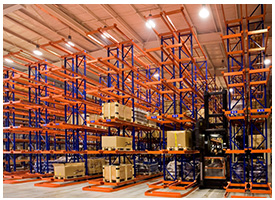
Pallet Flow (Gravity) Racking System
The Pallet Flow (Gravity) Racking System is a high-density storage solution that uses inclined roller tracks to move pallets automatically from loading to picking positions. It is commonly applied in warehouses, logistics centers, and temperature-controlled facilities across the UAE and the wider GCC. The system supports FIFO stock rotation and continuous pallet availability. Typical designs handle pallet loads between 800 kg and 2,500 kg, with lane depths extending multiple pallets deep, making Pallet Flow Racking suitable for Middle East and MEA distribution environments.
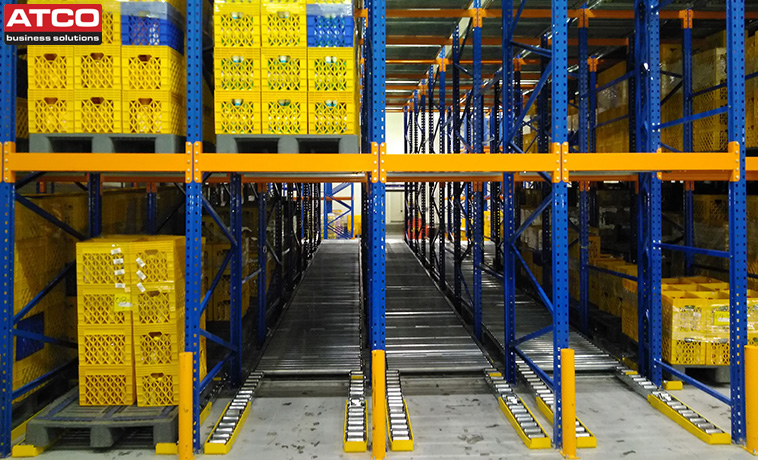
Lane inclination and roller resistance are carefully calculated to ensure smooth pallet movement without impact. Typical installations range from 6 m to 12 m in height, depending on building clearance and pallet weight. Lane depths are defined by throughput and SKU volume, often supporting 4 to 12 pallets per lane. The system integrates well with structured warehouse workflows where FIFO compliance, reduced aisle count, and predictable handling are critical. Pallet Flow Racking is suited to UAE operations that require consistent output, controlled movement, and efficient use of available floor and vertical space.
Key Features
- Gravity-driven pallet movement using roller tracks
- FIFO stock rotation with separated loading and picking faces
- High-density storage with reduced aisle requirement
- Lane depths configurable for volume throughput
- Roller speed control for stable pallet flow
- Designed for uniform pallet dimensions
- Brake rollers to manage pallet acceleration
- End stops and separators for operational safety
Pallet Flow (Gravity) Racking System
Brochure | Quotation | Availability
Fill the form with valid details to receive the information.
Frequently Asked Questions
Pallet flow racking is chosen when FIFO rotation and high throughput are mandatory. UAE warehouses handling food, pharmaceuticals, or time-sensitive inventory use it to avoid manual stock rotation. Facilities in Dubai or Abu Dhabi benefit where continuous pallet availability and reduced aisle congestion are operational priorities.
The system separates loading and picking aisles, preventing forklifts from entering storage lanes. In UAE logistics environments, this reduces cross-traffic, improves safety, and shortens travel distance. Forklifts only operate at the rack face, while gravity handles pallet movement within the lanes.
Pallets must be consistent in size, weight distribution, and base condition. In UAE operations, damaged pallets or uneven loads can disrupt flow. Engineers typically specify controlled pallet weights, roller pitch, and braking resistance to ensure smooth movement under Middle East operating conditions.
Yes, it is commonly used in UAE cold stores where FIFO compliance is essential. Roller tracks and frames are selected to perform reliably in low temperatures, supporting food and beverage operations that require predictable rotation and reduced handling inside temperature-controlled environments.
Routine inspection focuses on roller wear, brake function, and lane alignment. In high-throughput UAE warehouses, maintenance teams also monitor debris buildup on rollers to prevent resistance changes that could affect pallet speed and sequencing.
Saudi facilities handling large daily volumes rely on pallet flow racking to maintain continuous FIFO movement. Distribution centers in Riyadh and Dammam use it to support uninterrupted picking while replenishment occurs separately, improving throughput stability during extended operating shifts.
In Saudi factories, pallet flow racking acts as a buffer between production and dispatch. Pallets feed forward automatically as stock is consumed, ensuring steady material supply without forklift intervention inside the rack lanes, which aligns well with batch-based manufacturing operations.
Lane depth is selected based on pallet turnover and replenishment frequency. Saudi engineers balance deeper lanes for density against recovery time during SKU changeovers, ensuring gravity flow remains efficient without creating access delays in high-volume environments.
Speed controllers and brake rollers are installed at calculated intervals. In Saudi warehouses, these components prevent pallet acceleration under heavy loads, protecting operators and maintaining consistent spacing at the picking face during continuous operation.
Regular checks include brake roller condition, end-stop integrity, and frame anchoring. In large Saudi logistics hubs, scheduled inspections help ensure pallets stop correctly at the discharge end and do not impact operators or equipment.
We Supply To
Customer Testimonials
GET A QUOTE
Tell us about your business requirement, one of our technical expert will be in touch with you soon..!
NEW PRODUCTS ALERTS