Tea & Herbal Infusion Packaging: Tea Bag and Sachet Machines
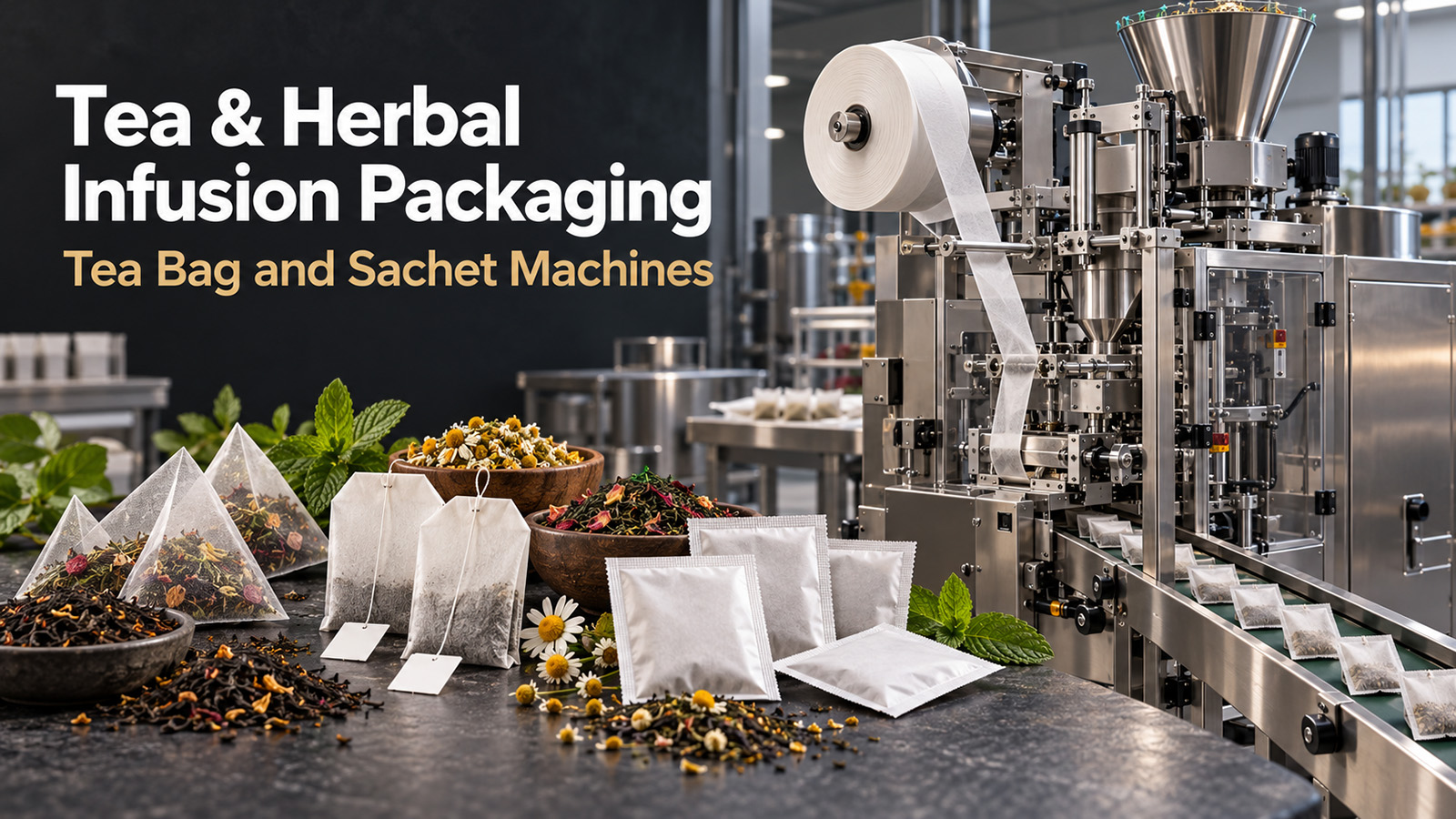
A tea packaging line runs smoothly on black tea, then starts stopping after a change to a mint and chamomile blend. Bag weights become uneven. Small particles collect around the sealing area. Operators adjust the dosing system, but the same problems return after the hopper is refilled.
The machine has not necessarily developed a fault. The new product may flow, settle and compress differently from the previous one.
A useful distinction: a machine can deliver consistent pack weights while producing an inconsistent herbal blend. Each bag may contain the correct total weight, yet different proportions of leaves, flowers and heavier ingredients. Weight control alone does not confirm blend consistency.
For tea and herbal infusion packaging, reliable production depends on matching the product, dosing method, filter material and outer packaging. Machine speed becomes useful only after these elements work together.
Understand what the machine is actually packaging A tea bag machine produces a porous filter bag that holds the ingredients during brewing. Depending on its design, it may also attach a string and tag, enclose the bag in an individual envelope, and feed finished bags into cartons.
“Sachet machine” needs a clearer definition during procurement. It may refer to equipment making an outer envelope around a tea bag, or equipment filling loose tea, herbs or instant beverage powder directly into a sealed pouch. These are different applications.
The filter bag allows water to reach the ingredients. The outer envelope can provide protection against moisture, oxygen and aroma loss, depending on its material and seal construction. A paper envelope should not automatically be treated as equivalent to a sealed barrier laminate.
Common filter formats include flat single-chamber bags, double-chamber bags and pyramid bags. Larger leaf pieces may benefit from additional space, but bag shape alone does not determine brewing performance. Filter permeability, ingredient size and fill quantity also matter.
The closing method varies too. Some machines heat-seal suitable filter paper; others mechanically close the bag or use ultrasonic sealing with compatible filter materials. Materials must be approved for the specific machine and intended food-contact application.
Why tea and herbal blends cause different filling problems Cut black tea may flow relatively evenly through a dosing chamber. A herbal mixture containing light leaves, flower heads and dense fruit pieces behaves differently. Pieces can bridge above an outlet, settle unevenly or separate during handling.
A volumetric doser measures a fixed volume rather than directly measuring every dose by weight. If bulk density changes, the same chamber can deliver a different weight. Hopper level, settling and product condition can therefore influence filling consistency.
Weighing systems can help control dose weight, but they cannot automatically correct ingredient separation. Where blend composition is critical, production teams may need controlled mixing, shorter holding times or separate ingredient dosing. The appropriate arrangement should be established through product trials.
Dust creates another failure path. Fine particles may enter sealing areas, interfere with sensors or increase cleaning frequency. Long stems and oversized pieces can obstruct outlets or become trapped across a bag closure.
The practical starting point is a product specification: particle-size range, fines content, bulk density, moisture condition and acceptable variation. Without this information, repeated machine adjustment can become a substitute for controlling the incoming material.
Practical scenario: consider a line packing a mint, chamomile and dried ginger blend. Early samples meet the target weight, but later bags contain more ginger. The team should investigate separation during transfer and hopper discharge before changing the weighing settings.
Rated speed does not equal saleable output A common buyer mistake is comparing machines mainly by bags per minute. Published capacities differ substantially: examples include compact ultrasonic machines rated up to 50 bags per minute and industrial double-chamber systems rated up to 380 bags per minute. These figures describe different equipment and formats, so they are not direct performance comparisons.
The useful measure is accepted output from the complete line.
For illustration, a machine running at 60 bags per minute has a theoretical eight-hour output of 28,800 bags. If cleaning, changeovers and stoppages leave it running for 75% of the shift, and 98% of produced bags are accepted, saleable output is approximately 21,168 bags. These are planning assumptions, not an industry benchmark.
Repeated short stops are easy to underestimate. An operator clearing trapped leaves several times an hour may lose substantial production without recording one major breakdown. Recording stop causes reveals whether the constraint is dosing, filter feeding, sealing, envelope handling or downstream packing.
Giveaway also accumulates quietly. An average overfill of 0.1 gram across 100,000 bags consumes an additional 10 kilograms of product. The correct response is better dose control within an established specification.
Automation also changes labour requirements rather than removing every task. Material replenishment, sampling, cleaning, carton handling and fault response remain. Staffing should be assessed across the full packing process.
Control materials, changeovers and factory conditions Packaging material is part of the operating process. Roll width, tension, sealability and print registration can affect stability. A replacement roll that looks similar may still require different settings or fail to run reliably.
For heat sealing, temperature, pressure and contact time must suit the material. For ultrasonic sealing, material compatibility and the condition of the sealing components matter. Neither method compensates for ingredients trapped in the closure.
In UAE, Saudi Arabia and Oman operations, assess the actual packing-room and storage conditions. Heat and humidity exposure can affect product condition and packaging performance. Air conditioning alone does not establish suitable control; material storage, transfer and compressed-air quality also need attention.
Changeovers deserve the same discipline as production. Strongly aromatic ingredients such as mint or cinnamon can carry over into the next blend if residues remain in hoppers, dosing parts or discharge paths. Cleaning access therefore has a direct effect on quality and scheduling.
Document settings by product and pack format. Include dosing adjustments, operating speed, sealing parameters, material identification and sampling checks. Maintenance teams also need clear access to wear parts and a practical spare-parts plan.
Evaluate the line using the products you intend to run A meaningful trial should include the most difficult blend, not only the easiest tea. Run the intended filter and envelope materials, observe replenishment, and check performance after the machine has been operating for a sustained period.
Useful acceptance checks include:
For GCC distribution or export, evaluate the finished pack through its expected storage and transport conditions. Shelf-life claims and packaging suitability require validation; the presence of an outer envelope is not proof of adequate protection.
Whether a technical discussion involves ATCOPACK or another equipment supplier, bring representative product samples, pack specifications and a realistic production schedule.
Before approving the machine, ask: can it maintain the required weight, blend consistency and pack integrity with our hardest product over a normal production shift?
The machine has not necessarily developed a fault. The new product may flow, settle and compress differently from the previous one.
A useful distinction: a machine can deliver consistent pack weights while producing an inconsistent herbal blend. Each bag may contain the correct total weight, yet different proportions of leaves, flowers and heavier ingredients. Weight control alone does not confirm blend consistency.
For tea and herbal infusion packaging, reliable production depends on matching the product, dosing method, filter material and outer packaging. Machine speed becomes useful only after these elements work together.
Understand what the machine is actually packaging A tea bag machine produces a porous filter bag that holds the ingredients during brewing. Depending on its design, it may also attach a string and tag, enclose the bag in an individual envelope, and feed finished bags into cartons.
“Sachet machine” needs a clearer definition during procurement. It may refer to equipment making an outer envelope around a tea bag, or equipment filling loose tea, herbs or instant beverage powder directly into a sealed pouch. These are different applications.
The filter bag allows water to reach the ingredients. The outer envelope can provide protection against moisture, oxygen and aroma loss, depending on its material and seal construction. A paper envelope should not automatically be treated as equivalent to a sealed barrier laminate.
Common filter formats include flat single-chamber bags, double-chamber bags and pyramid bags. Larger leaf pieces may benefit from additional space, but bag shape alone does not determine brewing performance. Filter permeability, ingredient size and fill quantity also matter.
The closing method varies too. Some machines heat-seal suitable filter paper; others mechanically close the bag or use ultrasonic sealing with compatible filter materials. Materials must be approved for the specific machine and intended food-contact application.
Why tea and herbal blends cause different filling problems Cut black tea may flow relatively evenly through a dosing chamber. A herbal mixture containing light leaves, flower heads and dense fruit pieces behaves differently. Pieces can bridge above an outlet, settle unevenly or separate during handling.
A volumetric doser measures a fixed volume rather than directly measuring every dose by weight. If bulk density changes, the same chamber can deliver a different weight. Hopper level, settling and product condition can therefore influence filling consistency.
Weighing systems can help control dose weight, but they cannot automatically correct ingredient separation. Where blend composition is critical, production teams may need controlled mixing, shorter holding times or separate ingredient dosing. The appropriate arrangement should be established through product trials.
Dust creates another failure path. Fine particles may enter sealing areas, interfere with sensors or increase cleaning frequency. Long stems and oversized pieces can obstruct outlets or become trapped across a bag closure.
The practical starting point is a product specification: particle-size range, fines content, bulk density, moisture condition and acceptable variation. Without this information, repeated machine adjustment can become a substitute for controlling the incoming material.
Practical scenario: consider a line packing a mint, chamomile and dried ginger blend. Early samples meet the target weight, but later bags contain more ginger. The team should investigate separation during transfer and hopper discharge before changing the weighing settings.
Rated speed does not equal saleable output A common buyer mistake is comparing machines mainly by bags per minute. Published capacities differ substantially: examples include compact ultrasonic machines rated up to 50 bags per minute and industrial double-chamber systems rated up to 380 bags per minute. These figures describe different equipment and formats, so they are not direct performance comparisons.
The useful measure is accepted output from the complete line.
For illustration, a machine running at 60 bags per minute has a theoretical eight-hour output of 28,800 bags. If cleaning, changeovers and stoppages leave it running for 75% of the shift, and 98% of produced bags are accepted, saleable output is approximately 21,168 bags. These are planning assumptions, not an industry benchmark.
Repeated short stops are easy to underestimate. An operator clearing trapped leaves several times an hour may lose substantial production without recording one major breakdown. Recording stop causes reveals whether the constraint is dosing, filter feeding, sealing, envelope handling or downstream packing.
Giveaway also accumulates quietly. An average overfill of 0.1 gram across 100,000 bags consumes an additional 10 kilograms of product. The correct response is better dose control within an established specification.
Automation also changes labour requirements rather than removing every task. Material replenishment, sampling, cleaning, carton handling and fault response remain. Staffing should be assessed across the full packing process.
Control materials, changeovers and factory conditions Packaging material is part of the operating process. Roll width, tension, sealability and print registration can affect stability. A replacement roll that looks similar may still require different settings or fail to run reliably.
For heat sealing, temperature, pressure and contact time must suit the material. For ultrasonic sealing, material compatibility and the condition of the sealing components matter. Neither method compensates for ingredients trapped in the closure.
In UAE, Saudi Arabia and Oman operations, assess the actual packing-room and storage conditions. Heat and humidity exposure can affect product condition and packaging performance. Air conditioning alone does not establish suitable control; material storage, transfer and compressed-air quality also need attention.
Changeovers deserve the same discipline as production. Strongly aromatic ingredients such as mint or cinnamon can carry over into the next blend if residues remain in hoppers, dosing parts or discharge paths. Cleaning access therefore has a direct effect on quality and scheduling.
Document settings by product and pack format. Include dosing adjustments, operating speed, sealing parameters, material identification and sampling checks. Maintenance teams also need clear access to wear parts and a practical spare-parts plan.
Evaluate the line using the products you intend to run A meaningful trial should include the most difficult blend, not only the easiest tea. Run the intended filter and envelope materials, observe replenishment, and check performance after the machine has been operating for a sustained period.
Useful acceptance checks include:
- Fill-weight variation and ingredient distribution throughout the trial.
- Bag closure integrity, envelope seals and brewing performance.
- Accepted output, reject causes and operator interventions.
- Changeover time, cleaning access and restart stability.
For GCC distribution or export, evaluate the finished pack through its expected storage and transport conditions. Shelf-life claims and packaging suitability require validation; the presence of an outer envelope is not proof of adequate protection.
Whether a technical discussion involves ATCOPACK or another equipment supplier, bring representative product samples, pack specifications and a realistic production schedule.
Before approving the machine, ask: can it maintain the required weight, blend consistency and pack integrity with our hardest product over a normal production shift?


GET A QUOTE
Tell us about your business requirement, one of our technical expert will be in touch with you soon..!
PROCEED
NEW PRODUCTS ALERTS