Bottle Capping & Can Seaming Machines: Types & Applications
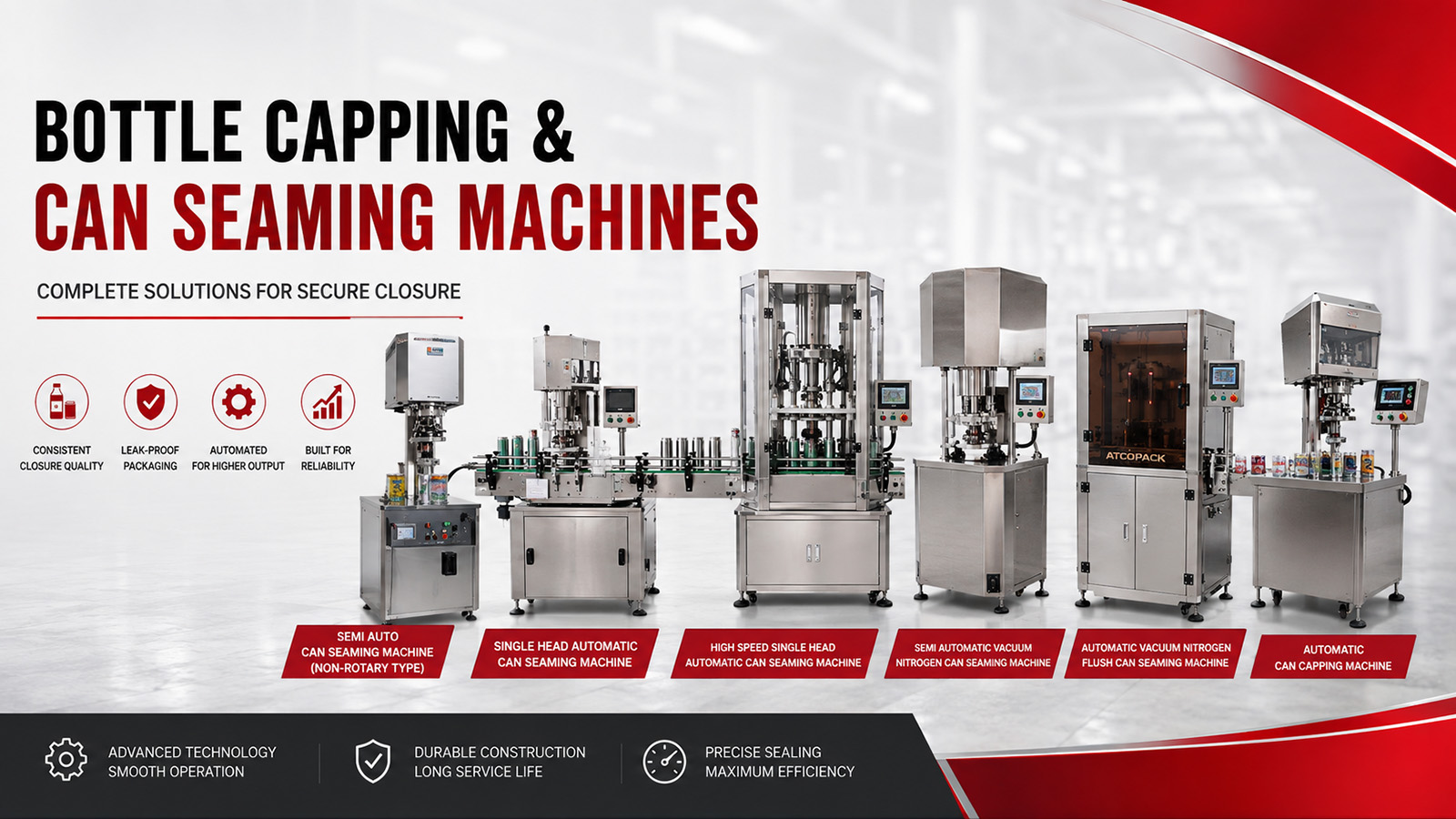
A filling line can be running at the correct speed, filling every container accurately, and still produce rejected or leaking packs because of one small area at the end of the process: the closure.
A cap that is too loose may leak during transport. Too much tightening force can damage the cap, thread, or container. A poorly formed can seam can affect package integrity. Even when the closure looks correct from the outside, inconsistent application can create problems later during storage, distribution, or customer use.
This is why capping and can seaming should not be treated simply as the final mechanical action after filling. The closure process is an important quality-control point in a packaging line.
Understanding the different capping and seaming technologies makes it easier to select equipment based on the container, closure, product, and production requirement rather than machine speed alone.
What Is the Difference Between Capping and Can Seaming?
Bottle capping and can seaming both close filled containers, but they work in different ways.
A capping machine applies or secures a separate closure to a bottle, jar, or similar container. Depending on the closure, the machine may screw, press, crimp, or otherwise secure the cap. Some packaging lines also add an induction seal beneath the cap to provide an additional barrier or tamper-evident feature.
A can seaming machine works differently. It mechanically joins the can end to the can body by forming and compressing the metal layers into a controlled seam. The quality of this seam depends on correct machine setup, tooling condition, and consistent handling of the can and lid.
This distinction matters during procurement. A company packaging sauce into glass jars, for example, has very different closure requirements from a beverage producer filling aluminium cans. The correct machine starts with the package design, not with the machine catalogue.
Main Types of Bottle Capping and Closing Systems
There is no single capping technology suitable for every bottle or product. Closure design, container material, production speed, and required seal characteristics determine which method makes sense.
- Screw capping: Used for threaded closures on many bottles and containers. Consistent application torque is important because under-tightening can cause leakage while excessive torque can damage threads, deform closures, or make the pack difficult to open.
- Press-on capping: Used where the closure is pushed vertically onto the container rather than threaded. Accurate cap positioning and controlled pressure are important for repeatable application.
- Induction sealing: Uses electromagnetic induction to heat a compatible foil liner and bond it to the container opening. It is commonly used when additional sealing, tamper evidence, or product protection is required. Induction sealing normally works as part of the closure process rather than replacing the cap itself.
- Vacuum capping: Commonly associated with suitable jars and rigid containers where air is removed before or during closure application. The package, closure, and product process must all be compatible with the required vacuum level.
- Nitrogen flushing: Nitrogen may be introduced into the container or headspace before final closure to reduce residual oxygen. It is particularly relevant where oxidation or product stability is a concern.
For example, a manufacturer may need a screw cap for physical closure and an induction foil for additional sealing. Another product may require nitrogen flushing immediately before the cap is applied. The complete process therefore needs to be considered rather than selecting each machine independently.
How Can Seaming Works and Why Seam Quality Matters
Can seaming creates a mechanical joint between the can body and the end. In a typical double-seaming process, the metal components are progressively formed and compressed using seaming rolls and associated tooling.
The operation happens quickly, but the quality depends on small mechanical details. Worn rolls, incorrect settings, dimensional variation, contamination around the seam area, or poor lid presentation can affect the finished seam.
In this situation, improving the seaming process is more valuable than simply increasing final inspection. Inspection catches defects; process control helps prevent them.
Depending on can format and machine configuration, industrial seamers can operate from relatively modest outputs to hundreds of cans per minute. The useful figure, however, is not simply the maximum rated output. Buyers should compare the required sustained production rate, container format, changeover time, and acceptable reject level under normal operating conditions.
Where Capping and Seaming Machines Are Used
Closure systems appear across many industries because almost every filled product needs some form of secure packaging.
Food processors use them for sauces, edible oils, condiments, jams, preserved foods, and canned products. Beverage plants require controlled closing for water, juices, dairy drinks, and carbonated or non-carbonated products. Similar technologies are used for cosmetics, personal care products, household chemicals, and other liquid or semi-liquid products.
The product itself can influence the closing process. Foaming liquids, hot-filled products, oxygen-sensitive foods, and products that leave residue around the container opening may require different handling before closure.
This becomes particularly important when a new capping or seaming machine is being integrated into an existing filling line. A machine capable of 120 containers per minute adds little value if the upstream filler consistently produces only 70, or if downstream labelling becomes unstable above 60.
ATCOPACK packaging projects often involve multiple stages of a line, which highlights an important engineering principle: filling, closing, inspection, labelling, and downstream handling should be evaluated as one connected process rather than as isolated machines.
Common Mistakes When Selecting a Capping or Seaming Machine
One common buyer mistake is starting with the question, "How many bottles per minute can this machine run?" Output is important, but it should not be the first specification considered.
The better starting point is the package itself.
- What bottle, jar, or can formats will be processed?
- What closure types and dimensions are involved?
- What sustained output is actually required?
- How frequently will products or container sizes change?
- Does the product require vacuum, nitrogen flushing, induction sealing, or another additional process?
- How will closure quality be checked during production?
Changeover deserves particular attention. A factory running one bottle and one cap continuously has different priorities from a contract packer handling several container formats every week. In the second case, a machine with a slightly lower maximum speed but easier, repeatable changeovers may deliver better overall production efficiency.
Maintenance access matters for the same reason. Production teams eventually need to clean, inspect, adjust, and replace wear components. If routine maintenance requires lengthy dismantling or specialist intervention, relatively small mechanical issues can turn into avoidable downtime.
These considerations can become especially relevant in UAE, Saudi Arabia, Oman, and other Gulf manufacturing environments, where production expansion, labour optimisation, and increasing automation can place greater pressure on equipment reliability. Ambient conditions, storage practices, and operating environment should also be considered where they can affect packaging materials, products, or machine components.
Choosing the Right System for the Production Line
Machine selection should begin with samples and operating requirements rather than assumptions. Container drawings or physical samples, cap specifications, product characteristics, required output, and upstream/downstream equipment all help define the correct closure process.
For screw caps, repeatable torque and reliable cap feeding may be major priorities. For induction-sealed containers, cap and liner compatibility become important. For vacuum applications, container strength and process requirements need attention. For nitrogen-flushed products, the timing between flushing and final closure can influence the effectiveness of the process. With cans, seam geometry, tooling condition, and inspection procedures are central to package integrity.
Automation level should also match the real production requirement. Semi-automatic equipment can make sense for lower volumes, frequent product changes, or operations where manual loading remains practical. Fully automatic systems become more attractive as sustained output increases and consistent container handling becomes necessary.
The strongest procurement decision is therefore rarely based on the machine with the highest speed or the longest specification sheet. It comes from matching the closure technology to the container, product, required output, changeover pattern, quality controls, and maintenance capability of the factory.



GET A QUOTE
Tell us about your business requirement, one of our technical expert will be in touch with you soon..!
NEW PRODUCTS ALERTS