Selecting Vegetable and Fruit Processing Lines for Efficient Washing, Cutting, Peeling & Drying
A busy hotel kitchen preparing breakfast for hundreds of guests often faces the same challenge before service begins. Large volumes of vegetables and fruits must be washed, peeled, cut and prepared within a limited time window. When preparation depends heavily on manual labor, delays can quickly spread across the entire operation.
Staff become overloaded, preparation quality varies between shifts, and hygiene risks increase as ingredients move through multiple handling stages. What begins as a small delay in the preparation area can affect cooking schedules, buffet replenishment, banquet production, catering dispatch and even food presentation.
The same situation is common in catering facilities, central kitchens, cloud kitchens, institutional kitchens and large restaurant groups. As food production volumes increase, the preparation area often becomes a bottleneck that affects speed, consistency, food safety and operating cost.
Selecting vegetable and fruit processing lines for efficient washing, cutting, peeling and drying is therefore not simply an equipment purchase decision. It is a workflow decision that can influence labor planning, hygiene control, production capacity and long-term kitchen reliability.
Fresh produce usually passes through several stages before reaching the cooking line, salad section, bakery preparation area, cold kitchen, packaging table or storage zone. Ingredients must be washed to remove dirt and surface contaminants, peeled where necessary, cut into the required size, and in many cases dried before further processing.
When these stages are separated across different workstations without proper planning, kitchens experience delays and unnecessary movement of products and staff. Employees may spend more time moving crates, trays and containers than actually preparing ingredients.
In high-volume operations, this problem becomes more visible during morning preparation, banquet production, catering dispatch or delivery-focused kitchen shifts. A single slow stage can hold back the entire kitchen workflow.
- Slow preparation during peak production periods
- Inconsistent cutting sizes affecting cooking results
- Excessive labor dependency for repetitive preparation tasks
- Cross-contamination risks between raw ingredients and clean preparation areas
- High water consumption during washing operations
- Excess moisture affecting storage life and food quality
- Staff fatigue during long prep shifts
Many operators initially try to solve these problems by adding more staff. However, labor increases do not always solve workflow inefficiencies. In many cases, the process itself requires improvement before the staffing structure can work properly.
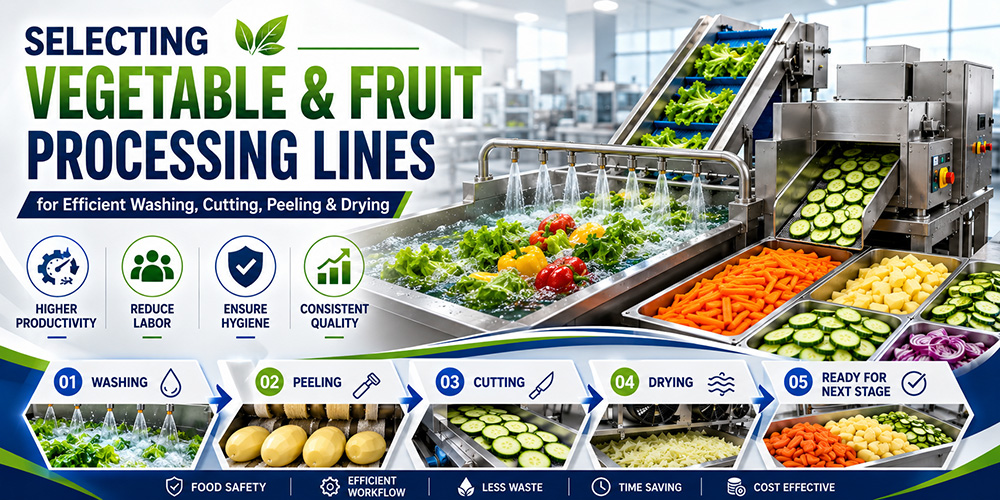
A processing line is designed to move ingredients through a controlled sequence of preparation stages. Instead of relying on multiple disconnected activities, produce follows a structured flow from receiving through preparation.
The process usually begins with washing equipment that removes soil, debris and surface contaminants. Depending on the product, washing systems may use bubble washing, spray washing, water circulation, gentle agitation or basket-based handling to support cleaning efficiency.
After washing, peeling equipment can reduce manual preparation requirements for vegetables such as potatoes, onions, carrots and similar products. Automated peeling helps maintain a more consistent output across large batches while reducing repetitive handwork.
Cutting equipment then processes ingredients into slices, cubes, strips, wedges or other required dimensions according to the menu or production requirement. Consistent cutting improves cooking uniformity, presentation quality, portion control and batch repeatability.
Drying systems remove excess surface moisture before ingredients move into cooking, packaging, refrigeration or storage areas. This stage is often overlooked, but it can have a strong effect on shelf life, texture, storage quality and food safety.
One of the most frequent mistakes occurs when buyers focus only on hourly capacity. A kitchen manager may select a washing machine capable of handling large volumes but overlook the capacity of downstream peeling, cutting or drying equipment.
As a result, ingredients accumulate between stages, creating congestion and slowing production. The preparation team may still need to stop, wait, rehandle ingredients or manually support the weaker section of the line.
A processing line should function as a balanced workflow rather than a collection of individual machines. For example, if washing equipment processes a higher volume than the cutting equipment can handle, the full operation eventually performs at the lower capacity.
Evaluating workflow balance is often more important than evaluating one impressive machine specification. The right question is not only how much one machine can process, but how smoothly the entire preparation flow works from start to finish.
Food safety expectations continue to become more demanding across hotels, restaurants, catering operations and food production facilities. Fresh produce handling requires careful attention because ingredients often arrive with soil, moisture and natural surface contamination.
Improperly cleaned vegetables and fruits can introduce contaminants into preparation areas. Excessive manual handling also increases the possibility of cross-contamination, especially when clean and unclean zones are not clearly separated.
Well-planned processing lines help reduce these risks by creating a more controlled preparation environment. Equipment with smooth surfaces, accessible parts, proper drainage and easy-clean construction can simplify daily sanitation.
In hot kitchen environments common across the UAE, Saudi Arabia, Oman and the wider GCC, minimizing preparation delays becomes even more important. Ingredients exposed to room temperatures for extended periods may lose freshness faster and create additional food safety pressure.
Cleaning access should be reviewed before purchase, not after installation. If staff cannot clean belts, hoppers, blades, trays, tanks and drainage areas properly, the equipment may create hygiene problems even when production capacity looks suitable.
Many operators focus mainly on labor cost when evaluating fruit and vegetable preparation. However, several hidden costs often have a greater long-term impact.
Inconsistent cutting can affect cooking times and food presentation. Excessive product waste during peeling can increase ingredient cost. Poor drying may shorten storage life. Equipment downtime during peak production periods can disrupt the entire kitchen schedule.
A catering facility preparing hundreds or thousands of meals daily may experience significant operational consequences from small inefficiencies repeated every day. A few extra minutes per batch can become a major time loss across a full production week.
Water and energy consumption also deserve attention. Equipment that requires excessive utility usage may increase operating expenses over time, even if the initial purchase price appears attractive.
Maintenance planning is another practical concern. Blades, belts, pumps, tanks, motors, filters and safety components should be easy to inspect and service. If routine maintenance is difficult, downtime becomes more likely during the busiest production periods.
Before choosing vegetable and fruit processing equipment, decision-makers should evaluate both current and future operational requirements. The selection should match the menu, production volume, available space, hygiene expectations and staff capability.
- Daily production volume and peak-hour preparation load
- Types of fruits and vegetables processed regularly
- Required cutting styles, portion sizes and output consistency
- Available preparation area space and operator movement
- Cleaning access, drainage and sanitation workflow
- Water and energy consumption during daily use
- Maintenance requirements and spare part availability
- Integration with existing cold rooms, prep tables, cooking lines and packing areas
- Staff training needs and safe operation procedures
- Expected production growth over the next few years
For central kitchens serving multiple outlets, scalability becomes especially important. A system that supports future expansion can reduce the need for major workflow changes later.
Cloud kitchens and delivery-focused food operations may need compact processing layouts that support fast dispatch and limited back-of-house space. Hotel and banquet kitchens may need higher batch capacity with strong hygiene control. Restaurant groups may need repeatable cutting quality across multiple menu items.
The rapid growth of hospitality, catering, food delivery and central kitchen operations across the Middle East has made preparation efficiency more important than ever. As production demands increase, fruit and vegetable processing often becomes one of the key areas where workflow planning directly affects kitchen performance.


GET A QUOTE
Tell us about your business requirement, one of our technical expert will be in touch with you soon..!
NEW PRODUCTS ALERTS