How Spiral Mixers, Deck Ovens, and Rack Ovens Work Together for Efficient Bakery Production
A bakery may have experienced bakers, reliable ingredient suppliers, and steady customer demand, yet still struggle to meet production schedules. Dough waits too long before baking, ovens sit partially loaded, staff rush through batches, and product consistency begins to fluctuate during peak hours.
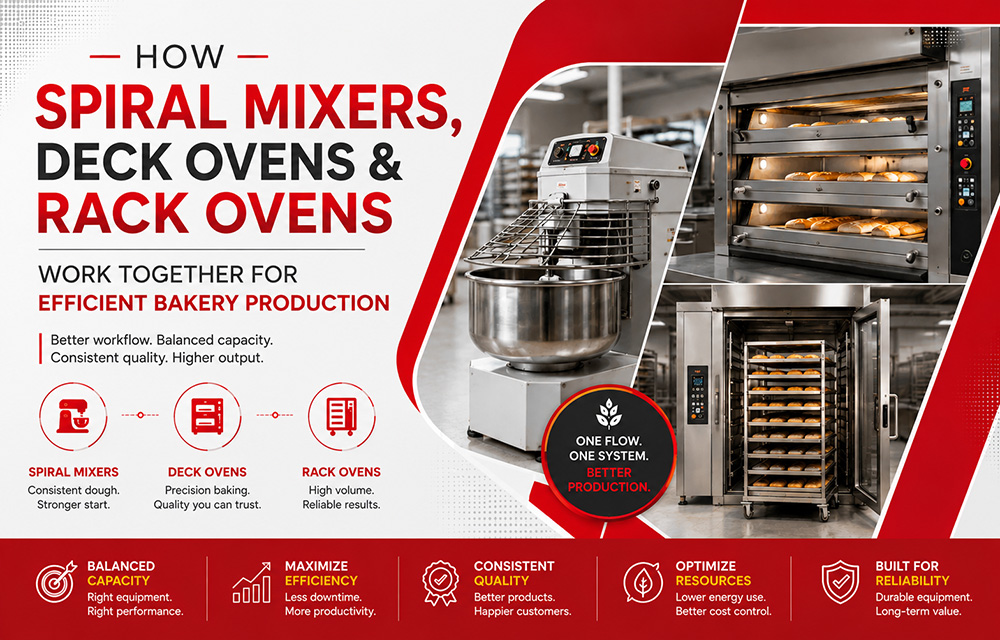
This situation is common in commercial bakeries, hotel pastry kitchens, central production facilities, supermarket bakeries, and catering operations. The problem often is not a single machine. More often, it is the lack of balance between spiral mixers, deck ovens, and rack ovens.
Many bakery operators evaluate these machines separately during procurement. In reality, they function as one continuous production system. When one stage moves faster or slower than the others, bottlenecks develop, labor efficiency drops, and operating costs increase.
Where Bakery Production Usually Slows Down
A common example can be seen in a growing bakery supplying bread, pastries, and flatbreads to supermarkets, cafés, and retail outlets.
Management decides to increase output by installing a larger rack oven. On paper, the decision appears logical because baking capacity increases significantly. However, the spiral mixer can only prepare enough dough for half the oven capacity during each production cycle.
The result is predictable. The oven spends part of the day operating below capacity, staff wait for dough preparation, and the expected production gains never fully materialize.
The opposite situation can also occur. A bakery invests in a high-capacity mixer but lacks sufficient oven capacity. Dough begins queuing before baking, fermentation times become inconsistent, and production schedules become difficult to control.
Both situations create unnecessary costs while reducing operational efficiency.
How Spiral Mixers Influence the Entire Production Line
The production process begins with dough preparation. Everything that follows depends on the consistency of the dough leaving the mixer.
Spiral mixers are specifically designed for bakery operations. The rotating bowl and spiral mixing action help develop gluten structure efficiently while minimizing excessive heat generation during mixing.
This is particularly relevant in GCC environments where higher ambient temperatures can already influence dough behavior and fermentation consistency.
When dough quality varies between batches, the effects quickly spread throughout the production process. Proofing times become less predictable, baking performance changes, and final product quality becomes inconsistent.
A properly selected spiral mixer helps maintain stable dough characteristics while supporting predictable production planning.
More importantly, mixer capacity directly affects oven utilization. If dough preparation cannot maintain the required output, even the most advanced oven will spend valuable time waiting for product.
How Deck Ovens Support Quality and Production Control
Once dough has been mixed, fermented, and prepared, the next stage becomes equally important.
Deck ovens are often selected when product quality, baking precision, and flexibility are priorities. Artisan breads, specialty loaves, premium pastries, and pizza products frequently benefit from the independent chamber control offered by deck ovens.
Each deck can operate at different temperatures, allowing bakers to manage multiple product types simultaneously. This flexibility becomes useful for bakeries producing a varied product range throughout the day.
However, production efficiency is influenced by more than tray capacity.
Many operators focus heavily on the number of trays an oven can accommodate while overlooking factors such as heat recovery performance, steam generation capability, loading efficiency, and baking cycle times.
For example, a bakery may have sufficient oven space but experience delays because baking cycles take longer than anticipated or because product loading and unloading interrupt workflow.
Deck ovens therefore act as the operational link between dough preparation and finished product quality.
How Rack Ovens Support High-Volume Bakery Production
Rack ovens are commonly used in bakeries where production volume becomes the primary operational requirement.
Unlike deck ovens, which often require more direct product handling, rack ovens allow entire racks to be loaded and baked as a single unit. This reduces manual handling and simplifies production flow.
For bakeries supplying supermarkets, hotel groups, catering operations, or multiple retail locations, this can significantly improve labor efficiency.
One of the key advantages of rack ovens is their ability to deliver consistent airflow throughout the baking chamber. Proper air circulation helps maintain uniform baking results across multiple trays.
This consistency becomes increasingly valuable when producing hundreds or thousands of products daily.
Rack standardization also supports predictable production planning. Operators can load products in a repeatable format, reducing variability between batches and simplifying staff training.
However, rack ovens must be carefully matched to upstream production capacity. A large rack oven may appear attractive from a growth perspective, but if dough preparation cannot support the required throughput, energy consumption increases while equipment utilization remains low.
The goal is not simply to maximize oven size. The goal is to create a balanced production flow from mixing through baking.
Why Capacity Planning Matters More Than Equipment Size
One of the most expensive mistakes in bakery expansion projects is focusing on individual machine specifications rather than overall workflow.
Efficient bakeries do not necessarily have the largest mixers or ovens. Instead, they have equipment capacities that complement one another.
A production line works best when mixing, proofing, baking, cooling, and packaging stages operate at compatible speeds.
When one stage consistently outpaces another, delays begin to accumulate throughout the facility. Staff spend more time managing workflow problems, product consistency becomes harder to maintain, and equipment investments fail to deliver expected returns.
- Daily production volume
- Product mix and batch size
- Shift pattern and labor availability
- Proofing, baking, cooling, and packing flow
- Future expansion requirements
This is why bakery planning should start with production objectives rather than individual machine sizes.
Reliability and Hygiene: The Operational Factors Often Overlooked
Production efficiency depends not only on capacity but also on reliability.
A mixer breakdown during dough preparation or an oven failure during peak production can disrupt deliveries, increase labor pressure, and create serious operational challenges.
Maintenance access should therefore be considered during equipment evaluation. Machines that are difficult to service often result in longer downtime and higher maintenance costs.
Hygiene is equally important.
Flour dust accumulation, dough residue, grease buildup, and inadequate cleaning access can affect both equipment performance and food safety compliance over time.
In high-volume bakery environments, cleaning procedures must fit naturally into daily operations. Equipment that is difficult to clean often requires additional labor while increasing sanitation risks.
For bakery operators throughout the UAE, Saudi Arabia, Oman, and the wider GCC, where food safety expectations continue to rise, maintenance planning and hygiene management should be viewed as operational necessities rather than afterthoughts.
Final Thought:
When evaluating bakery equipment, the most valuable question may not be which mixer or oven offers the largest capacity. A better question is whether your spiral mixers, deck ovens, and rack ovens are balanced to support the same production goals — or whether one stage of the process is quietly limiting the performance of the entire bakery operation.



GET A QUOTE
Tell us about your business requirement, one of our technical expert will be in touch with you soon..!
NEW PRODUCTS ALERTS