Self-Adhesive, Sleeve & Print-Apply Labelling Machines for Food, Beverage & Pharma
A labelling machine labelling machine may seem like a small part of a packaging line, but a few millimetres of label movement, one unreadable barcode, or a missed carton label can interrupt production, create rework, and delay dispatch. The correct machine is therefore not selected by speed alone. It must match the container, label material, required information, inspection method, line layout, and operating environment.
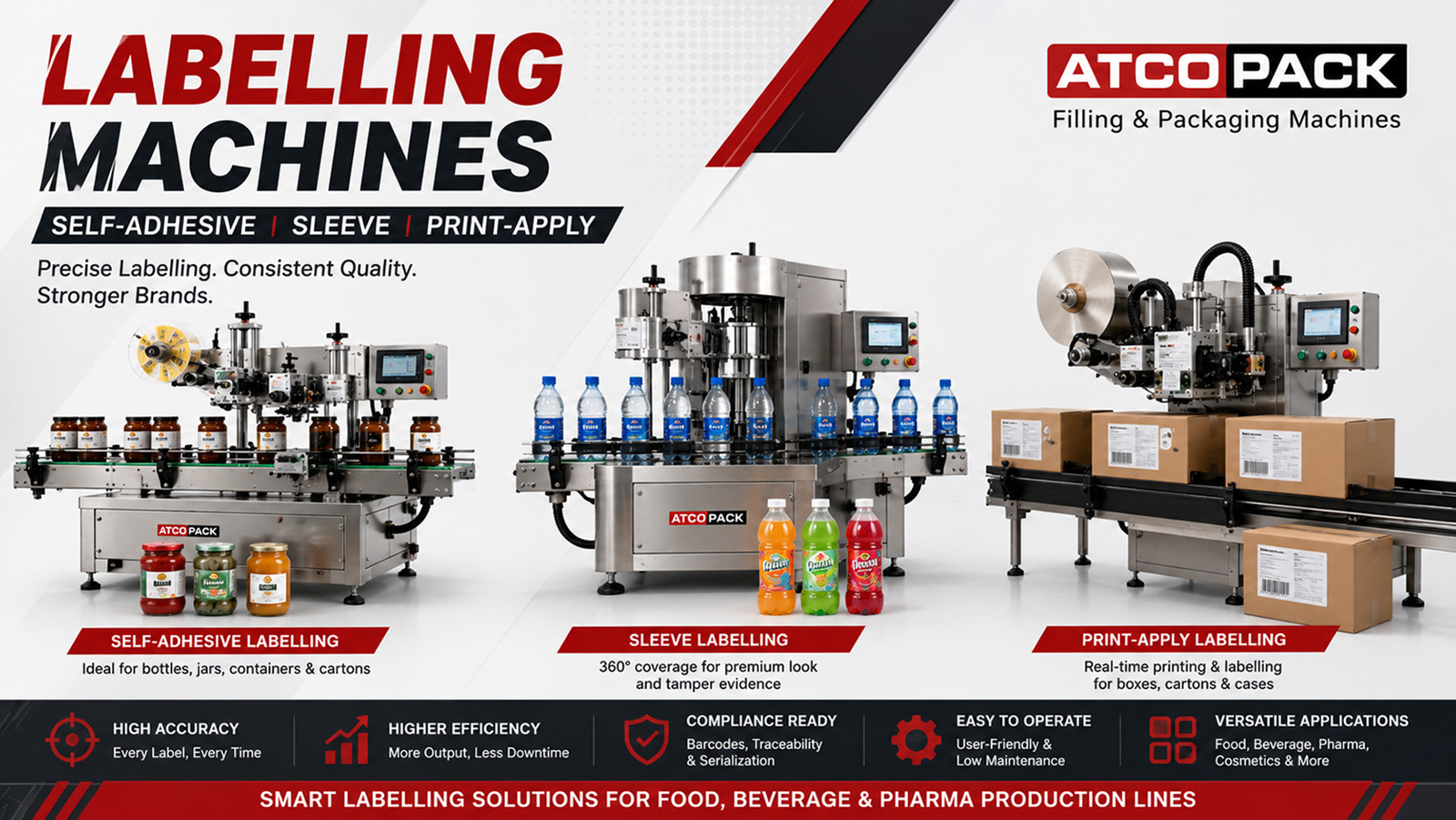
Food, beverage, and pharmaceutical plants commonly use three broad technologies: self-adhesive labelling, sleeve labelling, and print-apply labelling. Each serves a different production need. Self-adhesive equipment applies pre-cut pressure-sensitive labels. Sleeve systems place a film sleeve around a container, often followed by controlled shrinking. Print-apply systems print variable information on demand and immediately apply the label to a product, carton, case, or pallet.
Why Labelling Becomes an Operational Problem
Labelling problems rarely begin with the applicator alone. They often start earlier in the line. Containers may arrive with inconsistent spacing. Bottles can be wet after rinsing or filling. Flexible packs may not present a flat surface. Cartons may vary in position, height, or compression. A label that performs correctly during a short trial may begin to lift, wrinkle, skew, or tear once the line reaches normal production conditions.
The operational impact can be larger than expected. An unreadable barcode may stop warehouse receiving. Incorrect batch information can require product segregation. A misplaced pharmaceutical label can trigger a quality investigation. In export production, an incorrect language panel, missing importer detail, or poor code contrast may hold an entire shipment.
The hidden cost is not only the rejected label. It also includes operator checks, maintenance time, unused packaging material, production records, cleaning, line restarting, and the risk of mixing corrected and uncorrected products.
How the Three Main Labelling Technologies Differ
A self-adhesive labelling machine removes a pressure-sensitive label from its backing liner and transfers it to the product. It is widely used for bottles, jars, tubs, pouches, cartons, and flat packs. Depending on the machine arrangement, it can apply front-and-back labels, wraparound labels, top labels, bottom labels, or tamper-evident seals.
Its main strength is flexibility. Different label shapes and product formats can often be handled on the same platform with suitable guides, applicator settings, and change parts. It also avoids the heat process required by many shrink-sleeve applications.
Common weak points are product presentation and label handling. Poor web tension, worn rollers, incorrect sensor settings, dusty products, condensation, and unstable conveyor spacing can all affect placement accuracy. A label adhesive that works well in an air-conditioned test area may behave differently on a cold beverage bottle or in a warm packing room.
Sleeve labelling places a tubular film over part or all of a container. Shrink sleeves then pass through a steam or hot-air tunnel so the film conforms to the container shape. This provides a large printable area and can suit shaped bottles, full-body decoration, multipacks, and tamper-evident neck bands.
Sleeve systems are useful when decoration must cover complex container geometry or when a conventional label cannot sit smoothly on the available surface. They can also combine branding and tamper evidence in one format.
The applicator and shrink tunnel must be treated as one process. Film specification, perforation, container material, tunnel temperature, steam quality, airflow, conveyor speed, and sleeve position all affect the final result. Increasing heat to remove one wrinkle may create distortion elsewhere. Stable shrinking normally comes from balanced process settings rather than maximum temperature.
A print-apply labelling system prints information immediately before applying the label. It is commonly used for cartons, shipping cases, trays, sacks, and pallets where data changes from one item or batch to another. Typical information includes barcodes, batch numbers, product codes, dates, destinations, serial numbers, and logistics data.
This technology reduces the need to store many pre-printed label versions. It also supports line-level traceability because the printed data can be linked to production orders, warehouse systems, scanners, or inspection devices.
Its reliability depends on more than print quality. The system must receive the correct data, detect the pack, print the label, verify the print where required, and place it in a position that remains readable during handling. Poor carton control, incorrect label gaps, ribbon problems, weak network communication, or unstable compressed air can cause stoppages or missing labels.
Comparing the Right Technology for the Application
| Production Need | Self-Adhesive | Sleeve | Print-Apply |
|---|---|---|---|
| Primary use | Product and pack decoration | Full or partial container coverage | Variable data and logistics identification |
| Typical packs | Bottles, jars, tubs, pouches, and cartons | Bottles, cups, shaped containers, and multipacks | Cases, cartons, trays, sacks, and pallets |
| Main control point | Accurate product handling and label tension | Sleeve position and controlled shrinking | Data accuracy, print quality, and application position |
| Changeover concern | Guides, label rolls, sensors, and applicator settings | Film, former, cutter, and tunnel recipe | Label format, print data, applicator reach, and product detection |
In practice, these technologies are not always alternatives. A beverage bottle may use a sleeve for decoration, a small self-adhesive label for local regulatory information, and a print-apply label on the shipping case. The useful question is not, “Which machine is best?” It is, “Which identification task must be completed at each packaging level?”
Common Failure Points and the Buyer Mistake to Avoid
One common buyer mistake is selecting a labeller from its quoted maximum speed without checking the full operating window. A machine may be capable of high output under ideal conditions, but the actual line may include lightweight bottles, irregular cartons, frequent product changes, short label rolls, varying operator skill, or limited accumulation space.
Practical Production Scenario
Consider a sauce line running several bottle sizes. The selected labeller can reach the required containers per minute, but each changeover requires manual repositioning of several guides and sensors. Operators spend 25 minutes setting up, followed by another 15 minutes correcting label position.
With three product changes in one shift, two hours can be lost to setup and adjustment. The higher rated speed provides little benefit because the machine is not producing during those periods.
A more useful evaluation measures the total number of accepted packs produced during the shift. This includes startup, changeovers, label-roll replacement, cleaning, minor stops, rejected packs, and restart losses.
- Product control: Can the conveyor maintain consistent spacing and orientation?
- Surface condition: Is the pack dry, clean, stable, and suitable for the selected adhesive or sleeve?
- Data control: Who creates, approves, and transfers variable label information?
- Inspection: Is presence detection enough, or is barcode, text, position, or artwork verification required?
- Changeover: Are settings recipe-driven, tool-free, indexed, or dependent on operator judgement?
Output rates vary widely. Compact or semi-automatic equipment may suit short batches, while integrated rotary or high-speed systems can process hundreds of containers per minute. The useful figure is the validated rate for the actual pack, label, and line conditions—not the highest figure shown in a general brochure.
Practical Considerations for GCC Production Environments
Plants in the UAE, Saudi Arabia, Oman, and the wider GCC often handle a mix of domestic and export orders. This creates frequent label changes for language, destination, importer information, barcode standards, and promotional requirements. The labelling process should therefore make version control visible and difficult to bypass.
Heat is another practical factor. High ambient temperatures can affect adhesives, electronics, compressed-air quality, and stored label materials. Cold-filled or chilled products may create condensation, while shrink tunnels add heat and humidity around the line. The layout should allow ventilation, safe access, drainage where required, and sufficient separation from sensitive equipment.
Labour availability also matters. Automation can reduce repetitive manual labelling, but it does not remove the need for trained operators. A complex system with poor access or unclear fault messages may simply shift labour from label application to troubleshooting. Clear controls, saved recipes, visible threading paths, and easy cleaning usually create more value than unnecessary functions.
During production-line discussions, ATCOPACK may consider the labeller alongside fillers, cappers, coders, conveyors, checkweighers, inspection systems, case packers, and pallet-handling equipment. This wider view matters because a labeller cannot compensate for unstable product flow arriving from upstream machinery.
What to Evaluate Before Selecting a Labelling Machine
Begin with physical samples, not only drawings. Test the actual container, cap, label, adhesive, film, carton, and expected product condition. Where possible, include the lightest and heaviest packs, the smallest and largest labels, and any container with an unusual shape or flexible surface.
Next, define the required result. A decorative label may be judged by visual alignment. A logistics label may be judged by barcode readability after wrapping and transport. A pharmaceutical label may require presence, position, code verification, serialization, reject confirmation, and secure production records. These are different acceptance criteria and should not be combined into one vague requirement such as “accurate labelling.”
- Confirm normal, minimum, and future line speeds.
- Record every product and label format, including planned additions.
- Measure available conveyor length, operator access, and accumulation space.
- Define utilities, environmental limits, cleaning requirements, and protection rating.
- Agree inspection, rejection, data exchange, and production-reporting requirements.
- Review spare parts, consumables, training, and local maintenance capability.
Maintenance access deserves particular attention. Operators should be able to replace label rolls, ribbons, blades, or wear parts without working around unsafe obstructions. Sensors and rollers should be visible and reachable for cleaning. The machine should also provide enough fault information to distinguish between a missing product, a label-web break, a low consumable level, a printer fault, or a communication problem.
Finally, calculate cost around usable production. Include consumables, rejected labels, compressed air, tunnel energy, cleaning, spare parts, changeover time, operator involvement, and planned maintenance. A lower purchase price can be misleading when the machine requires longer stops, more manual adjustment, or expensive proprietary materials.
That question is more useful than comparing catalogue speeds alone. A suitable labelling machine should support stable product flow, predictable quality, straightforward maintenance, and clear control of label data. When those conditions are verified using real samples and realistic line behaviour, the labeller becomes a dependable part of production rather than a frequent source of small but costly interruptions.



GET A QUOTE
Tell us about your business requirement, one of our technical expert will be in touch with you soon..!
NEW PRODUCTS ALERTS