Commercial Meat Processing Equipment for Butchers, Hypermarkets & Modern Food Facilities
During a busy morning shift in a hypermarket meat section, the team may be cutting primal pieces, preparing mince, slicing steaks, weighing portions, packing display trays and handling customer requests at the same time. In a hotel kitchen, the same pressure may appear before a banquet, when large volumes of meat must be portioned, marinated, stored and moved to the cooking line without delay.
The problem often does not start with the chef, butcher or operator. It starts with equipment that does not match the workload, a layout that forces too much movement, or a preparation flow that keeps raw meat outside chilled conditions longer than necessary.
Commercial meat processing equipment is not only about cutting or grinding. It affects preparation speed, food safety, portion control, staff dependency, cleaning time, maintenance planning and operating cost. For butchers, hypermarkets, central kitchens, restaurants, hotels and modern food facilities, the right setup helps the team work faster without losing control over hygiene or consistency.
Understanding the Meat Processing Workflow
Most meat processing operations follow a similar movement: receiving, cold storage, trimming, cutting, mincing or mixing, portioning, packing and then display or dispatch. Delays happen when these stages do not connect smoothly.
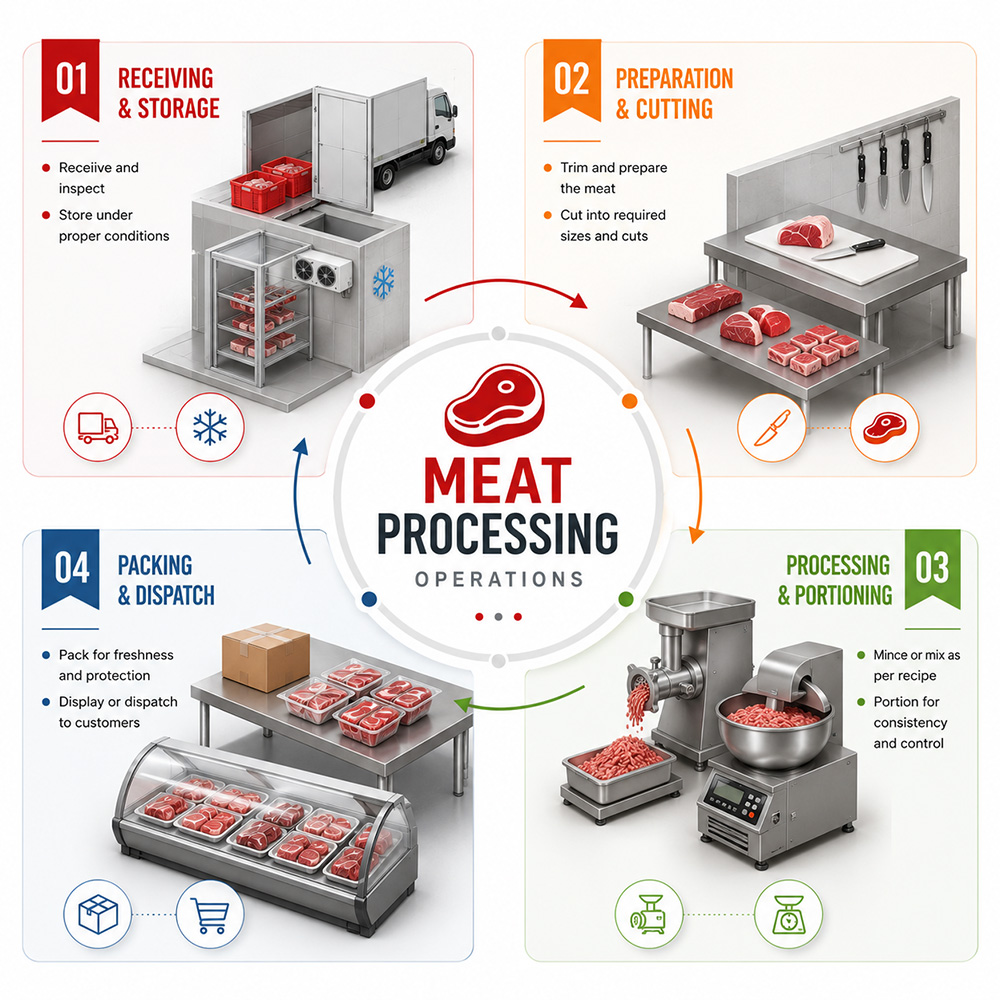
A machine may perform well on its own, but the section can still fail if trays, tables, staff, waste bins and cold storage are not arranged around the actual production flow. A bone saw may be placed far from the receiving table. A mincer may sit without enough landing space. A packing table may be away from chilled holding. These small gaps become serious during peak production.
In the UAE, Saudi Arabia, Oman and other GCC markets, high ambient temperatures make this even more important. Meat handling areas need short movement, controlled holding, clean surfaces and quick processing because delays can affect product condition, hygiene discipline and service timing.
Essential Meat Processing Equipment and Their Applications
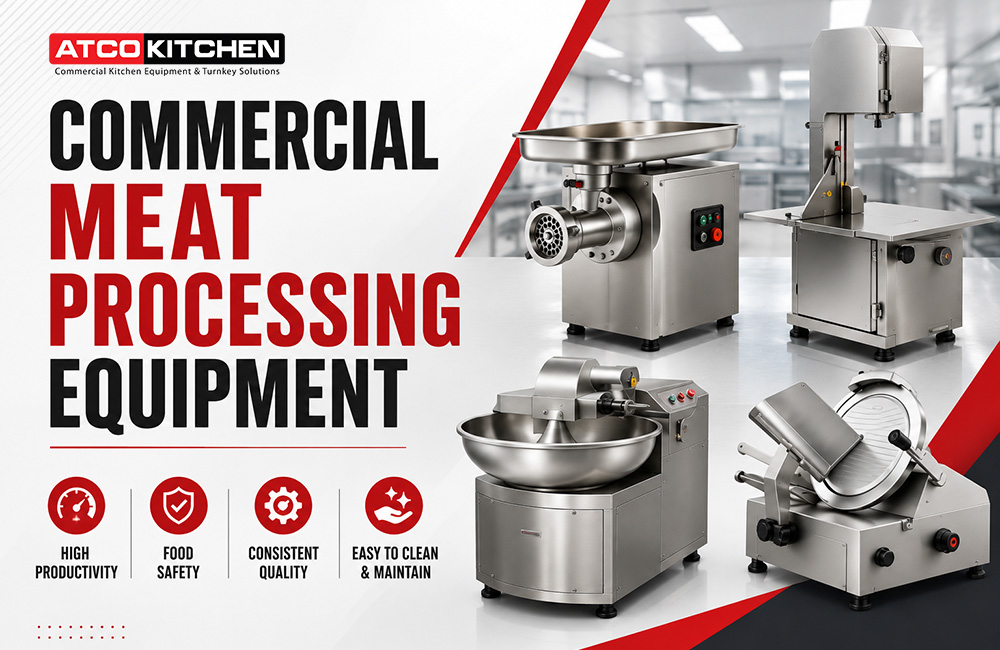
A commercial meat preparation section may include meat mincers, meat grinders, bone saw machines, meat slicers, bowl cutters, meat mixers, sausage fillers, patty formers, tenderizers, vacuum packing machines, stainless steel preparation tables, refrigerated counters, meat rails, storage racks, weighing scales and hygiene accessories.
Not every facility needs every machine. A small butcher shop may need reliable cutting, mincing, slicing, weighing and display preparation. A hypermarket may need higher output, better portion control, chilled packing flow and easier cleaning between batches. A central kitchen may need equipment that supports recipe consistency, batch preparation, marination, forming and packing.
- Meat mincers and grinders: Used for minced meat, kebabs, burgers, sausages and prepared food products. They support faster production and more consistent texture.
- Bone saw machines: Used for bone-in cuts and frozen meat portions. They improve cutting accuracy, operator safety and product control.
- Meat slicers: Used for uniform slices in retail counters, foodservice preparation and portion-controlled menus.
- Meat mixers: Used for seasoning, marination and recipe consistency across larger batches.
- Bowl cutters: Used for fine texture preparation, emulsions and processed meat products where uniform consistency is important.
- Patty formers: Used for burger patties and shaped products where consistent weight, size and appearance matter.
- Vacuum packing machines: Used to support portioning, storage, shelf presentation and controlled product handling.
The best equipment combination depends on product type, daily volume, staff skill level, available space, cleaning schedule, maintenance support and the way meat moves from storage to preparation and then to packing or cooking.
How Equipment Improves Productivity and Consistency
In manual meat preparation, output often depends on the most skilled person in the section. When that person is absent, overloaded or working under pressure, cutting quality, portion size, mince texture and batch consistency may change.
Suitable equipment helps reduce this dependency. A slicer supports uniform thickness. A mincer supports repeatable grind quality. A mixer helps distribute seasoning evenly. A patty former supports consistent weight and shape. These improvements can reduce food waste, portion variation and customer complaints.
Consistency also supports cost control. Oversized portions, uneven cuts, poor trimming and rejected batches quietly reduce margin. For hotels, restaurants, supermarkets and central kitchens, better control in the meat preparation section can improve both kitchen discipline and profitability.
Capacity Should Match Real Production, Not Only Machine Size
A common mistake is selecting equipment only by motor power, bowl size, blade size or price. These details matter, but they do not show how the machine will perform during a real working day.
A mincer may have enough capacity on paper, but if it is hard to clean between batches, staff may avoid using it properly. A slicer may cut well, but if there is no table space for trays and packing, the operator becomes the bottleneck. A mixer may handle large batches, but if the kitchen produces smaller recipes throughout the day, oversized equipment can waste time, space and energy.
Meat processing equipment should be evaluated by asking how it performs during peak demand, how quickly it can be cleaned, how safely staff can operate it and how well it fits the room layout.
- Production volume: Check peak-hour demand, not only average daily output.
- Product type: Match the equipment with fresh meat, frozen meat, bone-in cuts, mince, slices, patties, sausages or marinated products.
- Cleaning access: Review how easily parts can be removed, washed, sanitized and fitted back.
- Workflow fit: Plan enough table space before and after each machine.
- Operator safety: Check guards, controls, stability, access height and safe feeding points.
- Maintenance support: Consider spare parts, service access, blade replacement and downtime impact.
One of the most common mistakes is selecting meat processing equipment based only on the lowest purchase price. The lowest-priced machine may become expensive if it slows production, needs frequent repair, takes too long to clean or cannot handle peak demand.
Another mistake is oversizing equipment without understanding actual production needs. A large machine can create handling problems in a small preparation room. It may also increase cleaning time, energy use and staff effort when the kitchen produces smaller batches throughout the day.
Some operators also ignore spare parts, blade replacement, service access and operator training. These issues usually appear later, when the machine is already part of the daily workflow and downtime becomes costly.
Hygiene and Cleaning Affect Daily Productivity
Meat processing areas carry higher hygiene pressure than many other kitchen sections. Raw meat preparation involves moisture, fat, blood residue, bone dust and frequent contact with work surfaces. If equipment is difficult to clean, sanitation becomes slower and less consistent.
Smooth stainless steel surfaces, removable parts, accessible cutting zones, washable trays, proper drainage and simple reassembly help staff maintain better hygiene during daily routines. In a busy facility, cleaning is not a separate issue from productivity. When sanitation takes too long, production stops. When it is rushed, food safety risk increases.
The cleaning process should be considered before equipment is purchased. A machine that looks efficient during operation may create hidden labour cost if it takes too long to strip, wash, sanitize, inspect and restart.
Layout, Cold Holding and Staff Movement
Good equipment cannot fully solve a poor layout. Meat should move in a clean and logical direction: from receiving to chilled storage, then to preparation, processing, packing, holding and dispatch or display. When the flow crosses back on itself, staff movement increases and hygiene control becomes harder.
Preparation tables should be close to the relevant machine. Chilled holding should be close enough to reduce waiting time. Waste handling should not interfere with clean product movement. Handwash points, sanitizing stations, knives, trays and weighing scales should be placed where staff need them naturally.
The goal is not to fill the room with equipment. The goal is to create a section where staff can work safely, clean quickly, maintain temperature discipline and produce consistent output during the busiest hours.
GCC Food Facility Considerations
Food businesses across the UAE, Saudi Arabia, Oman and wider GCC often manage high-volume production with strong pressure on hygiene, speed and temperature control. Hotel banquet kitchens, catering operations, supermarket meat counters, cloud kitchens and central kitchens may all need meat preparation systems that can handle repeated batches with consistent results.
High ambient temperatures make cold-chain discipline more important. Equipment placement, chilled holding, preparation timing and cleaning routines should all be planned together. In busy operations, even a short delay between processing and packing can affect workflow and product handling discipline.
Hidden Costs Often Missed During Procurement
The purchase price of meat processing equipment is only one part of the decision. Hidden costs can appear through extra labour, longer cleaning time, frequent blade replacement, machine downtime, energy use, poor portion control and wasted product.
Another overlooked cost is training. If equipment is complicated or unsafe for regular staff, only one or two people may operate it confidently. This creates a production risk during leave days, staff changes or peak shifts.
Procurement teams should compare equipment by lifecycle value, not only initial cost. A machine that supports faster cleaning, safer use, better consistency and easier servicing may protect the operation better than a lower-priced option that slows down the section.
- Does the equipment match the busiest production period, not only normal demand?
- Is there enough working space before and after each machine?
- Can the team clean and sanitize the equipment without unnecessary delay?
- Does the layout reduce raw meat exposure outside chilled conditions?
- Can different staff members operate the equipment safely after training?
- Are spare parts, blades, service access and maintenance routines practical for the location?
- Does the full meat preparation flow support receiving, storage, processing, packing and cleaning?
What equipment is commonly used in a commercial meat processing room?
Common equipment includes meat mincers, grinders, bone saws, slicers, mixers, bowl cutters, patty formers, vacuum packing machines, stainless steel preparation tables and refrigerated holding units.
How do hypermarkets process meat efficiently?
Hypermarkets usually need a connected workflow between chilled storage, cutting, mincing, weighing, packing and display. Equipment capacity, layout and cleaning access must support continuous replenishment during busy hours.
What is the difference between a meat mincer and a meat grinder?
In many commercial kitchen discussions, both terms are used for equipment that reduces meat into smaller particles. The exact naming may vary by market, machine design and application, but the operational focus is consistent texture, safe handling and suitable capacity.
How does meat processing equipment affect food safety?
Equipment affects food safety through cleaning access, food contact surfaces, processing speed, temperature discipline and reduced manual handling. Poorly planned equipment can increase sanitation time and cross-contamination risk.
What should buyers check before selecting meat processing equipment?
Buyers should check production volume, product type, available space, cleaning access, operator safety, maintenance support, spare parts and how the machine fits the complete preparation workflow.
Commercial meat processing equipment should be selected by studying the full working day, not only the machine catalogue. The real test happens during peak preparation, when staff are moving fast, orders are building, chilled storage is opening often and cleaning still has to be done properly.
Before finalising a meat preparation section, the practical question is simple: will this equipment help the team process meat faster, cleaner, safer and more consistently when the kitchen is under pressure?



GET A QUOTE
Tell us about your business requirement, one of our technical expert will be in touch with you soon..!
NEW PRODUCTS ALERTS