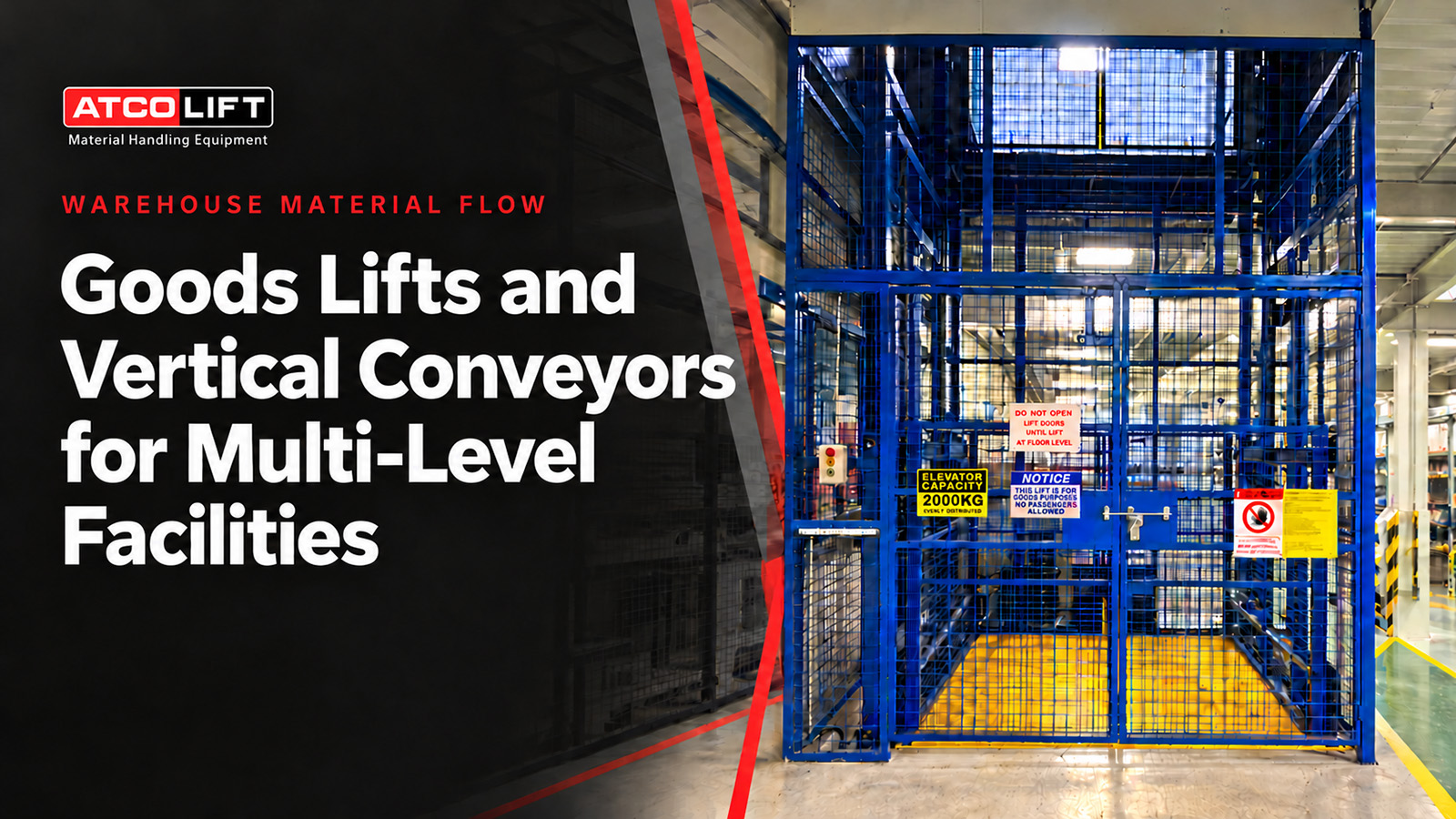
When goods move between floors, the transfer can become a bottleneck for production, storage or dispatch. This guide explains how goods lifts and vertical conveyors work, what to assess before selecting one, and how to plan for safe, dependable material flow.
A pallet of components is ready for production on an upper floor, but it is still waiting near goods-in. The forklift that could move it is needed elsewhere, and the team upstairs has no clear arrival time. During a busy shift, a few delayed transfers can hold up several connected tasks.
This is a common challenge in multi-level warehouses and factories. Moving goods between floors can involve extra forklift travel, repeated handling, queues at loading points or manual movement that tires operators. Goods lifts and vertical conveyors can provide a dedicated route, but the right choice depends on the loads, movement pattern and layout at every level.
Where delays begin in multi-level operations
The problem is often more than the distance between floors. A transfer may slow down because goods arrive faster than they can be loaded, the upper-floor exit has limited staging space, or operators must wait for a forklift to collect each load. A system that connects two floors but does not match the surrounding workflow can simply move the queue to a different location.
Managers may also estimate demand using an average shift. That can miss the short periods when several production orders, replenishment tasks or dispatch loads need to move at once. A system sized around average demand may struggle during peaks; one selected for a peak that rarely occurs may add unnecessary cost and occupy valuable floor space.
Before choosing equipment, map the full journey. Include where a load starts, how it reaches the transfer point, how it enters the equipment and where it goes after arriving. This shows whether the main constraint is vertical transport, forklift availability, staging space or the connection to the next process.
How goods lifts and vertical conveyors differ
A goods lift moves a load between defined levels using a platform or carrier. Depending on its design, it may suit pallets, containers, equipment or other unit loads. Loads may be transferred onto the lift by an operator, forklift or connected handling system.
A vertical conveyor moves goods between elevations using a conveying mechanism. The equipment may be configured for cartons, totes or other loads, depending on its design. Some arrangements form part of a repeated flow between processes; others handle transfers in a more controlled sequence.
These descriptions are a starting point, not a substitute for checking the proposed equipment. Names and configurations vary between suppliers. Ask how the specific system loads and unloads, what types of loads it accepts, and whether it is intended to operate with the flow rate and handling method at your site.
Neither option is automatically better. A goods lift may fit a process with planned transfers of larger unit loads, while a vertical conveyor may suit a repeated movement pattern involving compatible loads. The right arrangement depends on the equipment design and the operation around it.
What to assess before selecting a system
Start with the goods. Record the heaviest and largest loads, along with their packaging, pallet or carrier. Note whether loads are stable, irregular or difficult to position. Capacity is important, but the dimensions and presentation of a load also affect how safely and reliably it can be transferred.
Next, describe the required flow. How many loads move between floors during a normal period and during the busiest part of the shift? Are transfers planned, triggered by production demand or required continuously? Include waiting and loading time, not just the equipment’s stated travel time.
Review the building and each loading point. Check available floor space, ceiling clearance, access routes, structural requirements and the area needed for operators or forklifts to approach. On a retrofit project, also consider how installation work may affect warehouse or factory operations.
Then consider how the system connects to the rest of the facility. It may need to work alongside racking, production equipment, packing stations, conveyors or warehouse software. If a forklift must load the equipment, confirm that the approach space and traffic routes are practical. If goods arrive on another conveyor, check that transfer heights and load orientation are compatible.
- Loads: weight, dimensions, stability and carrier type.
- Building: floors served, travel distance, clearances and access routes.
- Flow: normal and peak transfer frequency, loading time and staging space.
- Integration: connections to forklifts, racking, conveyors, production or warehouse software.
- Uptime: operator tasks, inspection needs and maintenance access.
Safety, uptime and the cost of a poor fit
A poorly matched system can create indirect costs even when it moves goods as specified. Loads may wait at its entry point, operators may make extra trips, or forklifts may be diverted from picking and replenishment. If the equipment becomes a single point of delay for production or dispatch, maintenance access and support arrangements matter from the start.
Safety planning should cover loading and unloading, access control, guarding, emergency procedures, operator training and the condition of the surrounding floor area. Clearly define who may operate the system and how faults, jams or unsafe loads are handled. Goods-only equipment should not be used to carry people; confirm the intended use and applicable local requirements with the supplier and qualified safety personnel.
Maintenance planning is equally practical. Ask what inspections the manufacturer recommends, which parts need regular attention, how service access is provided and what happens if the system stops during a busy shift. In facilities operating through hot periods, assess the actual conditions around the equipment, especially if any part of the transfer route is exposed to heat, dust or outdoor conditions.
A common selection mistake is comparing systems mainly by rated capacity or purchase price. Those figures do not show whether the equipment can handle the real load mix, peak transfer pattern, building constraints or connections to other work areas. Consider installation, building modifications, training, integration, maintenance and possible downtime as part of the project cost.
A practical decision before procurement
Before requesting a final specification, document one representative busy period. Track how many loads need to move, how long they wait, what equipment and staff are involved, and where congestion forms. This evidence helps distinguish a vertical transport problem from a wider workflow issue.
Then ask suppliers to assess the proposed system against the same load details and operating assumptions. Confirm what is included in the design, what site preparation is required, how loading and unloading will work, and what maintenance the operation must plan for.
The key question is not simply how quickly a load can travel between floors. It is whether the complete transfer—from the point of origin to the next usable work area—will keep pace with the operation without creating a new queue or an unsafe handover.