Deck vs Convection vs Rotary Ovens: Which Is Right for Your Bakery?
During the morning rush, a bakery rarely has the luxury of waiting for an oven. Bread may be coming out for breakfast service while croissants are ready after proofing, cakes are queued for the next cycle, and another batch is already being mixed. When oven capacity, baking method or loading style does not match this production flow, trays begin to wait and staff start changing the schedule just to keep up.
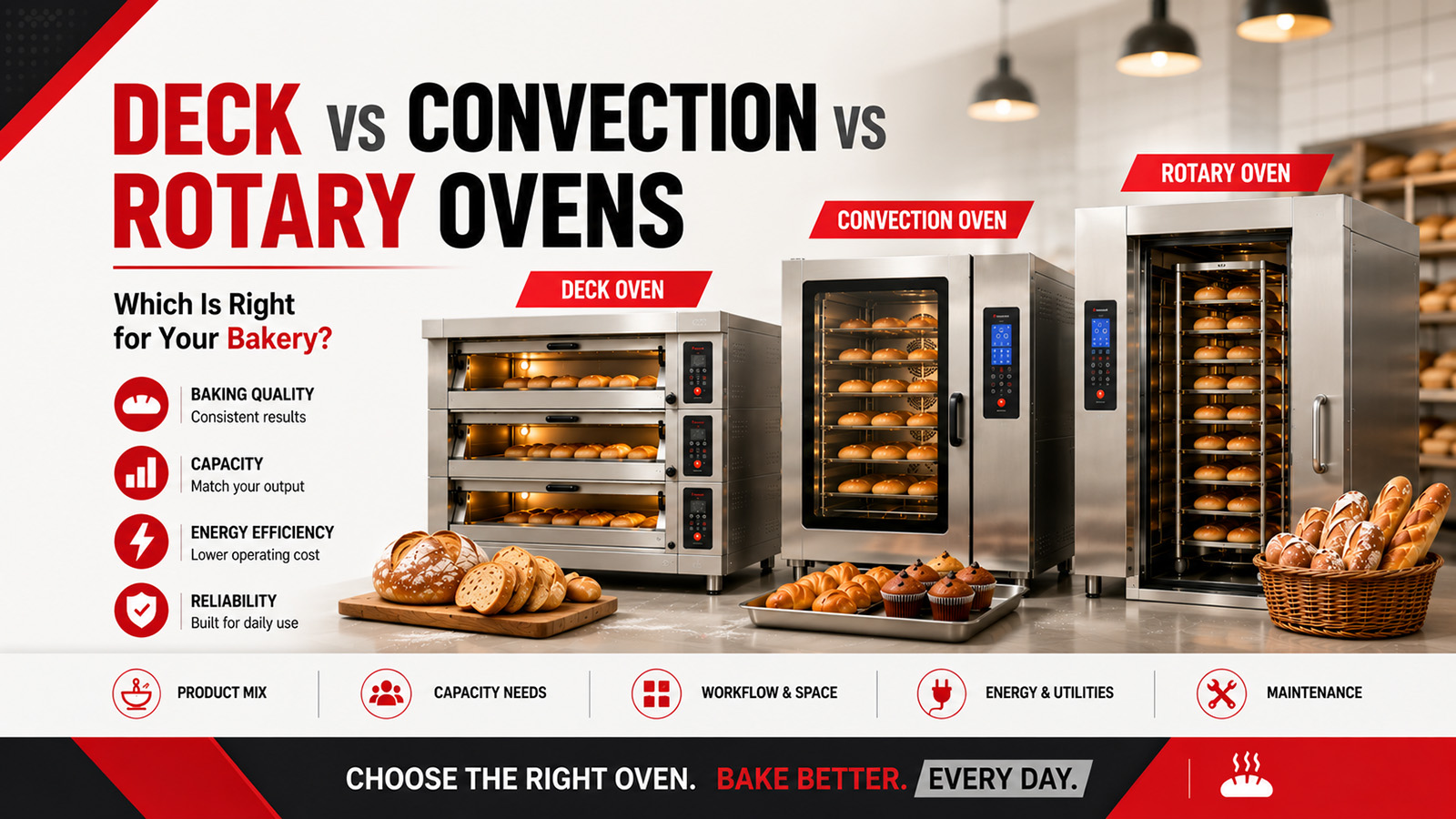
That is why comparing deck ovens , convection ovens and rotary ovens is not simply a question of which machine has the highest capacity. Each oven moves heat differently, handles products differently and creates a different workflow around loading, unloading and batch changes.
For a hotel bakery, retail bakery, central kitchen or catering facility, the better oven is the one that can repeatedly produce the required product quality while fitting the actual pace of the bakery.
Practical point: Start with the product and production schedule. Oven capacity should come after you understand what must be baked, how often and in what batch size.
Three Ovens, Three Different Baking Approaches
A deck oven uses individual baking chambers or decks. The product receives strong radiant heat from the chamber and conductive heat from the baking surface. This controlled environment is valuable for breads and products where base heat, crust development and baking character matter.
A convection oven uses a fan to circulate heated air around trays. This makes it practical for many pastries, cookies, muffins, cakes and other tray-based products. It is especially useful when a bakery handles smaller batches and changes products frequently.
A rotary oven, often called a rack oven, takes a complete bakery rack into the chamber. The rack rotates while heated air moves around the trays. It is designed for larger, repetitive batches where production volume and rack handling are important.
The difference sounds straightforward, but problems occur when buyers select an oven by tray count alone. A machine may have enough theoretical capacity and still be a poor fit for the products being made.
A convection oven uses a fan to circulate heated air around trays. This makes it practical for many pastries, cookies, muffins, cakes and other tray-based products. It is especially useful when a bakery handles smaller batches and changes products frequently.
A rotary oven, often called a rack oven, takes a complete bakery rack into the chamber. The rack rotates while heated air moves around the trays. It is designed for larger, repetitive batches where production volume and rack handling are important.
Deck Oven
Strong choice for breads, crust development and controlled deck baking.
Strong choice for breads, crust development and controlled deck baking.
Convection Oven
Flexible choice for pastries, cakes and varied tray-based batches.
Flexible choice for pastries, cakes and varied tray-based batches.
Rotary Oven
Production-focused choice for full racks and repeated high-volume batches.
Production-focused choice for full racks and repeated high-volume batches.
Start With What the Bakery Actually Produces
The first question should be “What do we bake most?”, not “How many trays does the oven hold?”
An artisan bakery producing sourdough and crusty loaves has very different heat and steam requirements from a hotel pastry section producing croissants, cookies, muffins and cakes throughout the day.
A deck oven can be particularly valuable where the baking surface and chamber conditions influence the final bread. Independent decks may also allow different temperature settings, depending on the oven configuration.
Convection ovens suit operations where flexibility matters. A restaurant or hotel pastry kitchen may run several relatively small batches rather than one large continuous product line.
Rotary ovens become more attractive when the bakery repeatedly fills racks with similar products. Moving a complete rack from proofing to baking can reduce individual tray handling and support a more continuous production rhythm.
An artisan bakery producing sourdough and crusty loaves has very different heat and steam requirements from a hotel pastry section producing croissants, cookies, muffins and cakes throughout the day.
A deck oven can be particularly valuable where the baking surface and chamber conditions influence the final bread. Independent decks may also allow different temperature settings, depending on the oven configuration.
Convection ovens suit operations where flexibility matters. A restaurant or hotel pastry kitchen may run several relatively small batches rather than one large continuous product line.
Rotary ovens become more attractive when the bakery repeatedly fills racks with similar products. Moving a complete rack from proofing to baking can reduce individual tray handling and support a more continuous production rhythm.
Common selection mistake: Buying a large rotary oven for “future capacity” when current mixing and proofing equipment cannot produce enough dough to keep it efficiently loaded.
The Oven Must Fit the Whole Bakery Workflow
Bakery production is a chain. Ingredients move through weighing, mixing, dividing, shaping, proofing, baking, cooling and sometimes slicing or packing. Increasing capacity at only one stage does not automatically increase total output.
Consider a bakery with enough mixing and proofing capacity for 20 trays at a time but an oven that can accept only a small portion of them. Proofed dough starts waiting for oven space. The longer it waits, the harder it becomes to maintain the intended proofing condition and consistent finished product.
Now reverse the situation. A high-capacity rotary oven is installed, but the mixer and proofer cannot prepare full racks quickly enough. The bakery may operate a large oven with partial loads, reducing the operational benefit of its capacity.
Hotel bakeries face another challenge: product changeover. Breakfast bread may be followed by pastries, banquet products and afternoon preparation. In this environment, the ability to manage different products and temperatures can be more useful than simply having the largest chamber.
Consider a bakery with enough mixing and proofing capacity for 20 trays at a time but an oven that can accept only a small portion of them. Proofed dough starts waiting for oven space. The longer it waits, the harder it becomes to maintain the intended proofing condition and consistent finished product.
Now reverse the situation. A high-capacity rotary oven is installed, but the mixer and proofer cannot prepare full racks quickly enough. The bakery may operate a large oven with partial loads, reducing the operational benefit of its capacity.
Hotel bakeries face another challenge: product changeover. Breakfast bread may be followed by pastries, banquet products and afternoon preparation. In this environment, the ability to manage different products and temperatures can be more useful than simply having the largest chamber.
- Mixing: Can dough preparation support the planned oven throughput?
- Proofing: Will products reach the oven at the correct time?
- Loading: Are trays or racks easy for staff to move safely?
- Cooling: Is there enough space after products leave the oven?
- Peak demand: Can the complete line handle the busiest production window?
Energy Cost Is Often Hidden in the Wrong Oven Size
An oversized oven is not automatically more efficient. If a bakery repeatedly heats a large chamber for partial loads, energy is being used for capacity that is not generating useful output.
An undersized oven creates a different cost. It may need more baking cycles, more staff handling and longer operating hours. The oven can become the point that keeps the entire bakery team working later.
This deserves particular attention in the UAE, Saudi Arabia, Oman and other GCC markets. Bakery ovens release considerable heat into the working environment, while ventilation and air-conditioning systems may already be working hard because of high outdoor temperatures.
The equipment decision therefore affects more than the oven's own energy consumption. Heat rejection, ventilation demand, working comfort and surrounding equipment should also be considered.
An undersized oven creates a different cost. It may need more baking cycles, more staff handling and longer operating hours. The oven can become the point that keeps the entire bakery team working later.
This deserves particular attention in the UAE, Saudi Arabia, Oman and other GCC markets. Bakery ovens release considerable heat into the working environment, while ventilation and air-conditioning systems may already be working hard because of high outdoor temperatures.
The equipment decision therefore affects more than the oven's own energy consumption. Heat rejection, ventilation demand, working comfort and surrounding equipment should also be considered.
Overlooked cost: A low purchase price can become less important if the oven requires excessive cycles, creates unnecessary heat, increases labour handling or causes frequent production stoppages.
Steam, Cleaning and Maintenance Affect Baking Consistency
For many bread applications, steam is an important part of the baking process. It can influence surface development and crust characteristics during the early stage of baking. If bread is a core product, steam performance should therefore be evaluated along with temperature and capacity.
Water quality also matters. Scale accumulation can affect steam-related components over time, making water treatment and preventive maintenance relevant to long-term oven performance.
Cleaning access is another practical issue that is easy to overlook in a showroom. Flour dust, crumbs, oils and baked residues are part of daily bakery operation. Staff need reasonable access around doors, tray supports, chamber areas and the floor surrounding the oven.
Maintenance requirements differ between oven types. Convection ovens depend on fans and airflow performance. Rotary ovens add rack rotation mechanisms and moving components. Deck ovens may have multiple chambers, heating components, doors and controls that require inspection.
For a bakery that relies heavily on one oven, downtime is not only a maintenance problem. It can quickly become a production problem. Proofing continues, staff remain on shift and delivery schedules do not stop because the oven has stopped.
Water quality also matters. Scale accumulation can affect steam-related components over time, making water treatment and preventive maintenance relevant to long-term oven performance.
Cleaning access is another practical issue that is easy to overlook in a showroom. Flour dust, crumbs, oils and baked residues are part of daily bakery operation. Staff need reasonable access around doors, tray supports, chamber areas and the floor surrounding the oven.
Maintenance requirements differ between oven types. Convection ovens depend on fans and airflow performance. Rotary ovens add rack rotation mechanisms and moving components. Deck ovens may have multiple chambers, heating components, doors and controls that require inspection.
For a bakery that relies heavily on one oven, downtime is not only a maintenance problem. It can quickly become a production problem. Proofing continues, staff remain on shift and delivery schedules do not stop because the oven has stopped.
Deck vs Convection vs Rotary: A Practical Decision
The choice becomes easier when each oven is matched to an operating requirement rather than compared only by specifications.
There is also no rule that a professional bakery must depend on only one oven technology. A busy hotel or central bakery may use a deck oven for bread while convection or rotary ovens handle pastries and larger tray-based production. The combination can separate workloads and reduce competition for oven time.
Before finalizing the equipment, look beyond the oven specification sheet. Check door clearances, rack movement, loading space, electrical or gas requirements, ventilation, steam and water connections, cleaning access and service space.
- Choose a deck oven when: bread quality, base heat, crust development and controlled baking chambers are central to production.
- Choose a convection oven when: the bakery needs flexible tray-based baking for varied products and smaller or frequently changing batches.
- Choose a rotary oven when: full-rack handling, repeated batches and higher-volume production drive the daily workflow.
There is also no rule that a professional bakery must depend on only one oven technology. A busy hotel or central bakery may use a deck oven for bread while convection or rotary ovens handle pastries and larger tray-based production. The combination can separate workloads and reduce competition for oven time.
Before finalizing the equipment, look beyond the oven specification sheet. Check door clearances, rack movement, loading space, electrical or gas requirements, ventilation, steam and water connections, cleaning access and service space.
Final evaluation: Map your busiest production period from mixing to cooling. Which oven can handle that real workflow while protecting product quality, keeping staff movement practical and avoiding unnecessary capacity?
The answer to that question is more useful than simply asking whether a deck, convection or rotary oven is “better.” In a commercial bakery, the right oven is the one that fits the products and keeps the entire production line moving predictably when demand is at its highest.



GET A QUOTE
Tell us about your business requirement, one of our technical expert will be in touch with you soon..!
PROCEED
NEW PRODUCTS ALERTS