Choosing Narrow Aisle Trucks for High-Density Warehouses
A warehouse can have excellent racking capacity on paper and still struggle during a busy shift. A pallet is ready for put-away, another needs to come down for dispatch, and operators are waiting because the available forklift cannot work efficiently in the narrow aisle.
This is a common challenge in high-density warehouses. Increasing rack height and reducing aisle width can create more pallet locations, but it also changes the type of material handling equipment required. A conventional counterbalance forklift may be suitable for loading and open-floor movement, yet become inefficient or physically unable to operate once aisles become narrower.
Choosing narrow aisle trucks therefore involves more than comparing lifting heights and capacities. Warehouse managers need to consider aisle dimensions, rack configuration, pallet movement, operator tasks, floor conditions, throughput, safety, maintenance, and how the truck will interact with the rest of the operation.
Why Narrow Aisles Change the Equipment Requirement
Warehouse space is expensive. One way to increase storage density is to reduce the space allocated to travel aisles and use more of the building height for storage. The result can be significantly more pallet positions within the same footprint.
The operational challenge is that every reduction in aisle width limits the space available for a truck to turn, position a pallet, and approach the rack safely. The higher the storage level, the more important accurate positioning and load stability also become.
This is where narrow aisle trucks differ from conventional forklifts. They are designed to work in restricted spaces where normal turning manoeuvres may not be practical.
However, "narrow aisle truck" describes a group of equipment rather than one machine suitable for every warehouse. Depending on the layout and operation, managers may consider man-down VNA trucks, man-up VNA trucks, articulated forklifts, reach trucks, or other specialised handling equipment.
The correct choice starts with understanding the work the truck must perform.
Man-Down, Man-Up and Articulated Trucks Serve Different Needs
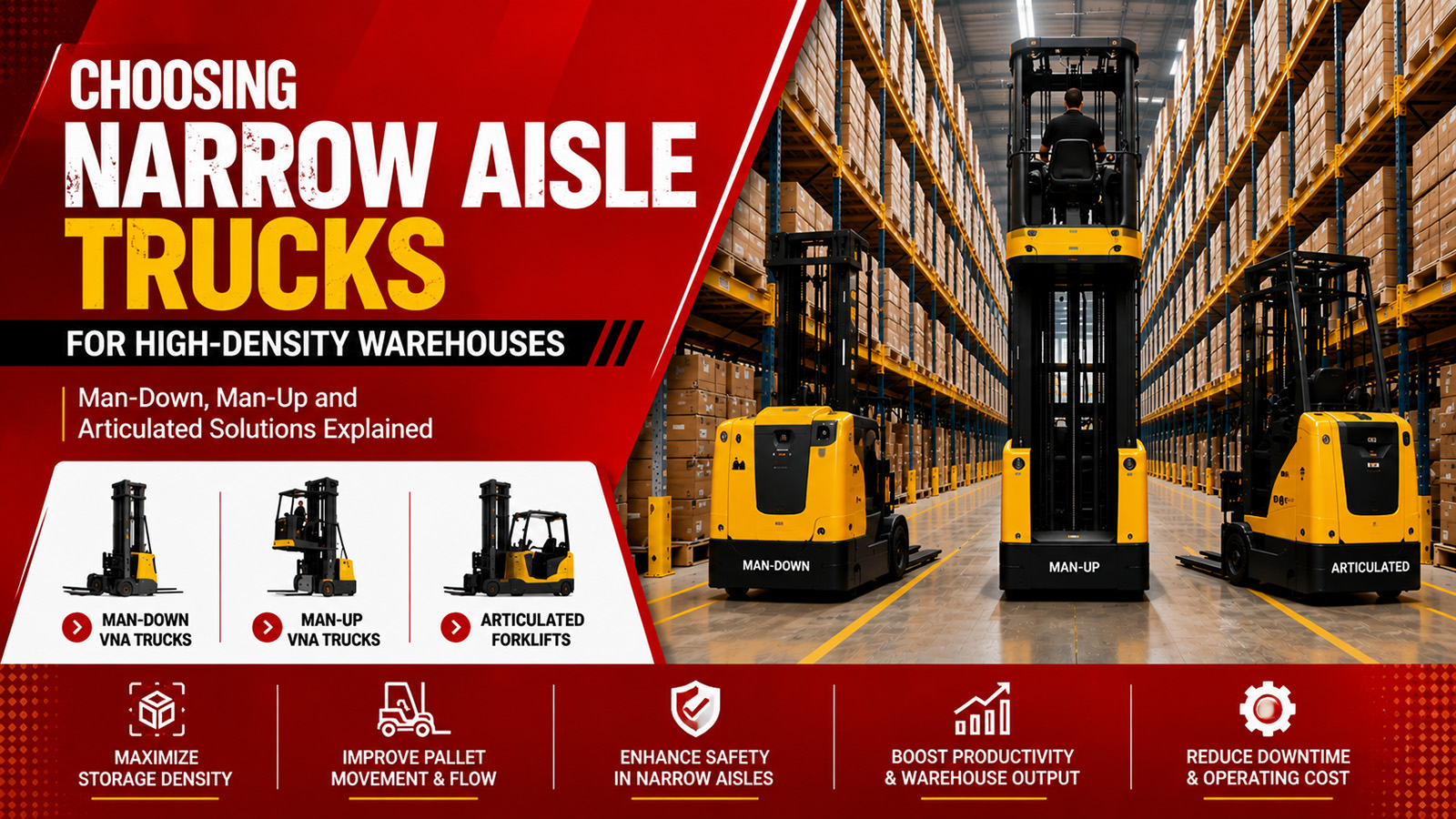
A man-down narrow aisle truck keeps the operator at floor level while the forks handle pallets at height. This arrangement can suit operations where the primary requirement is pallet storage and retrieval rather than individual case picking.
A man-up VNA truck raises the operator together with the load-handling section. The operator can therefore work at elevated rack levels, which can be useful where the operation combines pallet handling with order picking.
The distinction matters. If a warehouse mainly moves complete pallets, paying for capabilities designed around elevated picking may add complexity without creating enough operational value. Conversely, selecting a pallet-only configuration for an operation that frequently requires case picking can create additional handling steps and reduce productivity.
Articulated forklifts approach the narrow aisle problem differently. Their articulated mast or chassis arrangement allows the truck to position loads into racking while operating in tighter aisles than many conventional forklifts.
One practical advantage is operational flexibility. In some applications, an articulated forklift can move between narrow racking aisles and more open areas of the facility. This can reduce the need to transfer pallets between different machines.
That does not automatically make an articulated forklift the right choice. Dedicated VNA equipment may be more appropriate where storage density, high lifting heights, guidance systems, and intensive aisle-based operation are the priorities.
The decision should therefore be based on the complete pallet journey, not simply the narrowest aisle the truck can enter.
Start With the Warehouse, Not the Truck Specification
A common equipment selection mistake is choosing a truck based mainly on nominal capacity and maximum lift height.
Suppose a truck is rated to lift a certain load and can reach the highest rack beam. That does not necessarily mean it can safely handle the actual pallet at that height. Residual capacity can change as lift height, load centre, attachments, mast configuration, and other factors change.
The warehouse layout creates additional constraints. Aisle width is important, but so are rack clearances, pallet dimensions, turning areas, transfer aisles, floor quality, overhead obstructions, and the space available at aisle ends.
Before selecting narrow aisle trucks, evaluate:
Floor condition deserves particular attention in high-lift applications. Small variations that seem insignificant at ground level can become much more important when a load and operating position are elevated. Warehouses considering specialised VNA equipment may therefore need to assess whether the existing floor is suitable for the intended truck and operating height.
Storage Density Must Be Balanced With Pallet Flow
It is easy to focus on how many additional pallet locations narrower aisles can create. But storage capacity alone does not determine warehouse performance.
Imagine a distribution centre that increases pallet locations substantially by narrowing its aisles. If trucks then spend too much time waiting to enter occupied aisles, travelling to transfer points, or exchanging pallets with another type of forklift, the additional storage capacity may come with lower handling productivity.
This is the hidden cost of looking at racking and forklifts as separate decisions.
Warehouse managers should map the complete material flow: receiving, inspection, staging, put-away, replenishment, picking, and dispatch. A narrow aisle truck may be extremely efficient inside the racking zone but still form part of an inefficient overall process if pallets repeatedly wait at transfer points.
Aisle traffic also matters. Some very narrow aisle configurations effectively limit simultaneous truck movement within an aisle. During peak periods, poor task allocation can therefore create queues even when individual truck performance is good.
For fast-moving operations, throughput analysis should accompany storage-density calculations. The best layout is not necessarily the one with the maximum number of pallet positions. It is the one that provides the required storage capacity without restricting the flow needed by the business.
Safety, Operator Fatigue and Uptime Affect the Decision
High-density storage places trucks, loads, and racking close together. Safe operation therefore depends on controlled movement, suitable clearances, trained operators, and equipment matched correctly to the environment.
Guidance systems may be used in certain VNA applications to help trucks maintain the required path within an aisle. The appropriate system depends on the truck, floor, layout, and operational design.
Operator ergonomics should also be considered, particularly where trucks operate for long shifts or where man-up equipment is used repeatedly at height. Visibility, control position, access, vibration, repetitive movements, and the frequency of picking tasks can all influence operator fatigue and productivity.
Battery planning is another area that can be overlooked. An electric narrow aisle truck that performs well for several hours but repeatedly requires charging during the busiest part of the shift can become a bottleneck.
This is particularly relevant for high-throughput distribution centres, cold stores, and multi-shift operations. Battery technology, usable operating time, charging opportunities, and available charging infrastructure should be considered as part of fleet planning rather than after the trucks arrive.
Maintenance access matters as well. Specialised trucks may operate intensively and can be central to the warehouse flow. If one machine serves a critical aisle zone, unexpected downtime can affect multiple storage and retrieval tasks.
For operations in the UAE, Saudi Arabia, Oman, and other Gulf markets, operating conditions can add another consideration. Trucks may move between temperature-controlled warehouses, loading areas, and hotter external environments. Dust, heat, intensive utilisation, and charging conditions can all influence maintenance planning and equipment configuration.
ATCOLIFT and other material handling specialists may classify several different truck designs under the broad narrow aisle category, but equipment terminology should never replace an application study. Two warehouses with similar rack heights can require very different machines because their pallet flow, aisle geometry, and picking processes are different.
Evaluate the Complete Operation Before Choosing
Before finalising a narrow aisle truck, warehouse managers should compare each option against the actual operation rather than a generic specification sheet.
A useful final evaluation is:
The purpose of a high-density warehouse is not simply to fit more pallets into the building. Those pallets still need to move safely, predictably, and at the speed required by receiving, production, picking, and dispatch.
That leads to the most useful question before choosing between man-down, man-up, articulated, or other narrow aisle trucks: Which configuration supports the complete pallet flow of the warehouse while achieving the required storage density without creating a new operational bottleneck?
This is a common challenge in high-density warehouses. Increasing rack height and reducing aisle width can create more pallet locations, but it also changes the type of material handling equipment required. A conventional counterbalance forklift may be suitable for loading and open-floor movement, yet become inefficient or physically unable to operate once aisles become narrower.
Choosing narrow aisle trucks therefore involves more than comparing lifting heights and capacities. Warehouse managers need to consider aisle dimensions, rack configuration, pallet movement, operator tasks, floor conditions, throughput, safety, maintenance, and how the truck will interact with the rest of the operation.
Why Narrow Aisles Change the Equipment Requirement
Warehouse space is expensive. One way to increase storage density is to reduce the space allocated to travel aisles and use more of the building height for storage. The result can be significantly more pallet positions within the same footprint.
The operational challenge is that every reduction in aisle width limits the space available for a truck to turn, position a pallet, and approach the rack safely. The higher the storage level, the more important accurate positioning and load stability also become.
This is where narrow aisle trucks differ from conventional forklifts. They are designed to work in restricted spaces where normal turning manoeuvres may not be practical.
However, "narrow aisle truck" describes a group of equipment rather than one machine suitable for every warehouse. Depending on the layout and operation, managers may consider man-down VNA trucks, man-up VNA trucks, articulated forklifts, reach trucks, or other specialised handling equipment.
The correct choice starts with understanding the work the truck must perform.
Man-Down, Man-Up and Articulated Trucks Serve Different Needs
A man-down narrow aisle truck keeps the operator at floor level while the forks handle pallets at height. This arrangement can suit operations where the primary requirement is pallet storage and retrieval rather than individual case picking.
A man-up VNA truck raises the operator together with the load-handling section. The operator can therefore work at elevated rack levels, which can be useful where the operation combines pallet handling with order picking.
The distinction matters. If a warehouse mainly moves complete pallets, paying for capabilities designed around elevated picking may add complexity without creating enough operational value. Conversely, selecting a pallet-only configuration for an operation that frequently requires case picking can create additional handling steps and reduce productivity.
Articulated forklifts approach the narrow aisle problem differently. Their articulated mast or chassis arrangement allows the truck to position loads into racking while operating in tighter aisles than many conventional forklifts.
One practical advantage is operational flexibility. In some applications, an articulated forklift can move between narrow racking aisles and more open areas of the facility. This can reduce the need to transfer pallets between different machines.
That does not automatically make an articulated forklift the right choice. Dedicated VNA equipment may be more appropriate where storage density, high lifting heights, guidance systems, and intensive aisle-based operation are the priorities.
The decision should therefore be based on the complete pallet journey, not simply the narrowest aisle the truck can enter.
Start With the Warehouse, Not the Truck Specification
A common equipment selection mistake is choosing a truck based mainly on nominal capacity and maximum lift height.
Suppose a truck is rated to lift a certain load and can reach the highest rack beam. That does not necessarily mean it can safely handle the actual pallet at that height. Residual capacity can change as lift height, load centre, attachments, mast configuration, and other factors change.
The warehouse layout creates additional constraints. Aisle width is important, but so are rack clearances, pallet dimensions, turning areas, transfer aisles, floor quality, overhead obstructions, and the space available at aisle ends.
Before selecting narrow aisle trucks, evaluate:
- Actual clear aisle width and rack configuration
- Maximum required lift height and residual load capacity
- Pallet dimensions, weight, and load stability
- Required pallets moved per hour or per shift
- Full-pallet handling versus case or order picking
- Floor flatness and condition
- Guidance requirements within very narrow aisles
- Battery capacity, charging strategy, and shift pattern
- Operator visibility, ergonomics, and training requirements
- Travel between racking, staging, receiving, and dispatch areas
Floor condition deserves particular attention in high-lift applications. Small variations that seem insignificant at ground level can become much more important when a load and operating position are elevated. Warehouses considering specialised VNA equipment may therefore need to assess whether the existing floor is suitable for the intended truck and operating height.
Storage Density Must Be Balanced With Pallet Flow
It is easy to focus on how many additional pallet locations narrower aisles can create. But storage capacity alone does not determine warehouse performance.
Imagine a distribution centre that increases pallet locations substantially by narrowing its aisles. If trucks then spend too much time waiting to enter occupied aisles, travelling to transfer points, or exchanging pallets with another type of forklift, the additional storage capacity may come with lower handling productivity.
This is the hidden cost of looking at racking and forklifts as separate decisions.
Warehouse managers should map the complete material flow: receiving, inspection, staging, put-away, replenishment, picking, and dispatch. A narrow aisle truck may be extremely efficient inside the racking zone but still form part of an inefficient overall process if pallets repeatedly wait at transfer points.
Aisle traffic also matters. Some very narrow aisle configurations effectively limit simultaneous truck movement within an aisle. During peak periods, poor task allocation can therefore create queues even when individual truck performance is good.
For fast-moving operations, throughput analysis should accompany storage-density calculations. The best layout is not necessarily the one with the maximum number of pallet positions. It is the one that provides the required storage capacity without restricting the flow needed by the business.
Safety, Operator Fatigue and Uptime Affect the Decision
High-density storage places trucks, loads, and racking close together. Safe operation therefore depends on controlled movement, suitable clearances, trained operators, and equipment matched correctly to the environment.
Guidance systems may be used in certain VNA applications to help trucks maintain the required path within an aisle. The appropriate system depends on the truck, floor, layout, and operational design.
Operator ergonomics should also be considered, particularly where trucks operate for long shifts or where man-up equipment is used repeatedly at height. Visibility, control position, access, vibration, repetitive movements, and the frequency of picking tasks can all influence operator fatigue and productivity.
Battery planning is another area that can be overlooked. An electric narrow aisle truck that performs well for several hours but repeatedly requires charging during the busiest part of the shift can become a bottleneck.
This is particularly relevant for high-throughput distribution centres, cold stores, and multi-shift operations. Battery technology, usable operating time, charging opportunities, and available charging infrastructure should be considered as part of fleet planning rather than after the trucks arrive.
Maintenance access matters as well. Specialised trucks may operate intensively and can be central to the warehouse flow. If one machine serves a critical aisle zone, unexpected downtime can affect multiple storage and retrieval tasks.
For operations in the UAE, Saudi Arabia, Oman, and other Gulf markets, operating conditions can add another consideration. Trucks may move between temperature-controlled warehouses, loading areas, and hotter external environments. Dust, heat, intensive utilisation, and charging conditions can all influence maintenance planning and equipment configuration.
ATCOLIFT and other material handling specialists may classify several different truck designs under the broad narrow aisle category, but equipment terminology should never replace an application study. Two warehouses with similar rack heights can require very different machines because their pallet flow, aisle geometry, and picking processes are different.
Evaluate the Complete Operation Before Choosing
Before finalising a narrow aisle truck, warehouse managers should compare each option against the actual operation rather than a generic specification sheet.
A useful final evaluation is:
- Can the truck work within the actual aisle and rack clearances?
- Does it retain sufficient capacity at the required lift height?
- Is the operation mainly pallet handling, order picking, or both?
- Can one truck perform the required movements, or are transfer trucks needed?
- Will the proposed layout improve storage without creating traffic bottlenecks?
- Can the battery and charging plan support the required working hours?
- Are floor condition, guidance, and safety requirements understood?
- How disruptive would one truck being unavailable for maintenance be?
The purpose of a high-density warehouse is not simply to fit more pallets into the building. Those pallets still need to move safely, predictably, and at the speed required by receiving, production, picking, and dispatch.
That leads to the most useful question before choosing between man-down, man-up, articulated, or other narrow aisle trucks: Which configuration supports the complete pallet flow of the warehouse while achieving the required storage density without creating a new operational bottleneck?


GET A QUOTE
Tell us about your business requirement, one of our technical expert will be in touch with you soon..!
PROCEED
NEW PRODUCTS ALERTS