Vacuum Packaging Machines for Food Producers: Table-Top, Floor-Type & Double-Chamber Systems
In many food factories, the product is made correctly, chilled correctly, and packed on time. But after a few days in storage or distribution, problems begin to appear. Packs lose vacuum, product colour changes, moisture collects inside the bag, or shelf life becomes inconsistent.
These issues are often blamed on raw material, storage temperature, or handling. Sometimes that is true. But in many cases, the root cause is the vacuum packaging process itself.
Vacuum packaging is not only a final packing step. It is a quality-control point, a shelf-life support process, and a production efficiency factor. If the machine type, chamber size, sealing system, and operator workflow are not matched properly, the packing area can quietly become the weakest point in the line.
This article explains how table-top, floor-type, and double-chamber vacuum packaging machines work in real food production environments, and how production teams can evaluate them before making an equipment decision.
Process Role
Air removal and sealing
Cycle Time
Often 20–40 seconds
Labour Impact
Less waiting and handling
Main Benefit
Stable packed quality
Vacuum packaging removes air from the pack before sealing. By reducing oxygen inside the bag, it helps slow oxidation, preserve product appearance, reduce freezer burn, and support shelf-life performance.
For food producers handling meat, poultry, seafood, cheese, dates, nuts, coffee, spices, ready meals, frozen foods, and processed products, the packing stage has a direct effect on customer complaints, product returns, and brand consistency.
In UAE, Saudi Arabia, Oman, and other GCC markets, packed food may pass through cold rooms, delivery vehicles, central kitchens, supermarkets, export handling, and long storage cycles. High ambient temperatures and fast distribution schedules make packaging reliability even more important.
A good vacuum process helps protect the product after it leaves the factory. A weak process can create problems that appear later, when the product is already in the market.
This is why vacuum packaging machine selection should not be treated as a small purchase decision. It should be evaluated as part of production planning, quality control, labour management, and maintenance strategy.
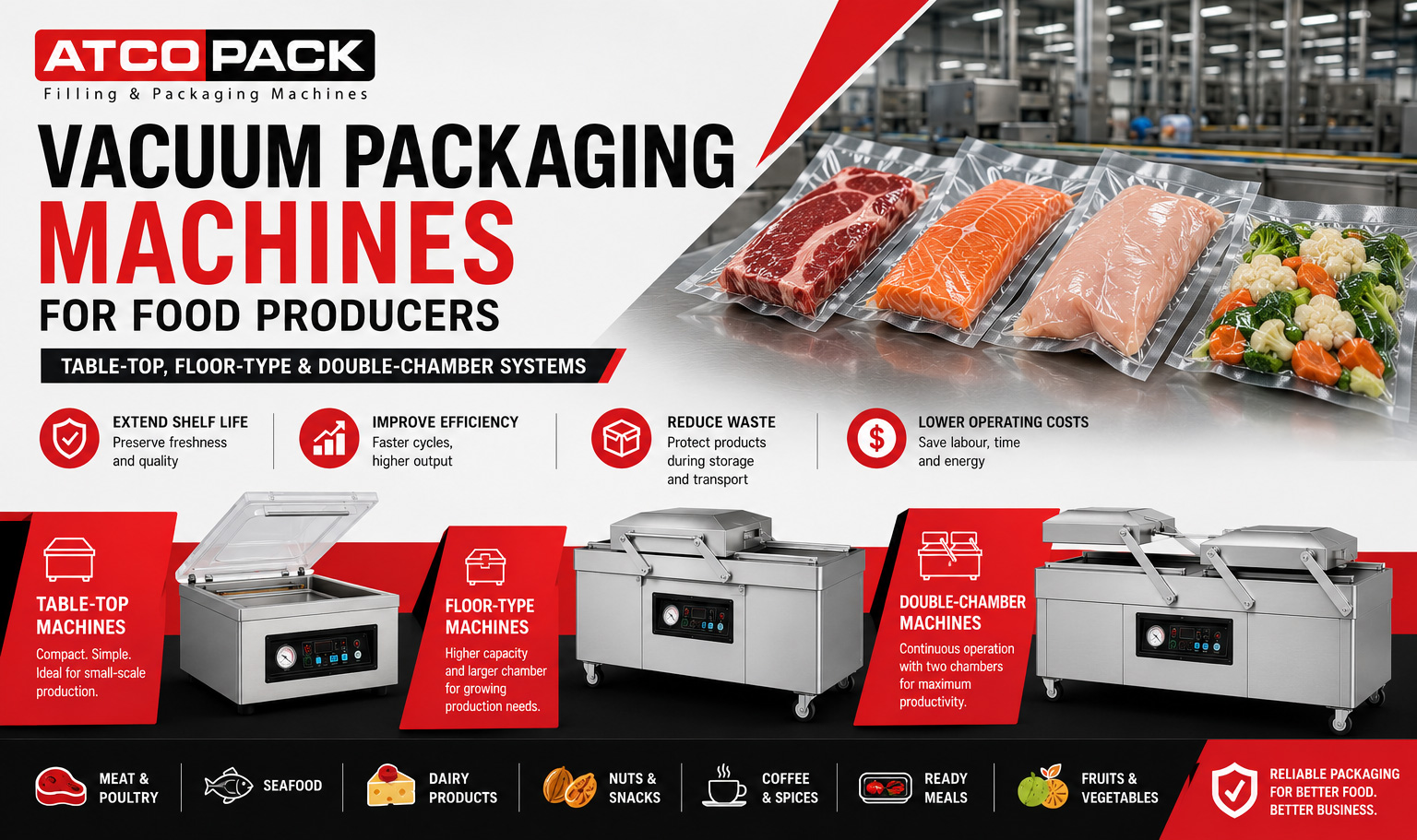
Table-top vacuum packaging machines are compact chamber machines used for small batches, product trials, specialty food packing, and low-to-medium daily volumes.
They are often suitable for butcheries, restaurants, central kitchens, small food producers, test kitchens, and facilities packing multiple products in limited quantities.
Typical products include portioned meat, fish fillets, cheese blocks, dried fruits, dates, coffee, spices, sauces in suitable pouches, and prepared food items.
The main benefit is ease of use. Operators can learn the process quickly, cleaning is manageable, and the machine does not require large floor space.
The limitation appears when production demand increases. If every pack must be loaded, vacuumed, sealed, and removed one cycle at a time, the operator may become tied to the machine. During busy periods, this can slow dispatch and create pressure at the packing station.
Table-top machines are practical when flexibility matters more than high output. They are less suitable when the same product must be packed continuously for several hours.
Floor-type vacuum packaging machines are generally used when table-top machines become too small for daily production requirements.
These machines usually offer larger chambers, stronger construction, higher working capacity, and better ergonomics for regular production use. They are suitable for food producers that need more output but do not yet require a fully continuous packaging line.
A practical example is a meat processing facility packing several thousand portions per day. If the chamber is too small, operators spend too much time arranging packs and waiting for the cycle to finish. A floor-type system can reduce repeated handling and support smoother workflow.
In many food facilities, packaging delays may consume 5% to 10% of available production time. The number may not look serious in one shift, but over a month it can affect labour cost, overtime, order completion, and delivery planning.
Floor-type machines are often selected by growing producers because they provide a stronger balance between capacity, cost, maintenance access, and operator control.
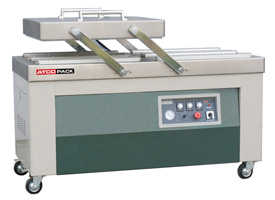
Double-chamber vacuum packaging machines are designed for higher-volume operations where waiting time between cycles becomes expensive.
The machine works with two chambers. While one chamber is vacuuming and sealing, the operator loads or unloads the other chamber. When one cycle is completed, the operator moves to the next chamber and the process continues.
This simple difference can change the entire packing flow.
Instead of waiting for every vacuum cycle to finish, the operator keeps preparing the next batch. In many production environments, this can improve packaging productivity by around 30% to 50%, depending on product type, bag size, loading method, and operator discipline.
Double-chamber systems are commonly considered for fresh meat, poultry, seafood, frozen foods, bulk packs, export products, and multi-shift operations.
The main value is not only speed. It is rhythm. A stable packing rhythm helps production managers plan output, reduce overtime pressure, and avoid last-minute dispatch delays.
A common mistake is comparing vacuum packaging machines only by chamber size, pump capacity, or price.
These details matter, but they do not tell the full story. A machine can look strong on paper and still perform poorly if it does not match the actual product flow.
For example, a facility may buy a large machine, but if operators cannot load it efficiently, the real output remains low. Another facility may buy a small machine to save cost, then struggle when daily orders increase.
The better approach is to study the full packing process: product size, number of packs per hour, bag type, cleaning time, operator movement, maintenance access, spare parts, and future production growth.
The right machine should reduce pressure on the packing area, not create a new operational problem.
| Machine Type | Suitable For | Main Strength | Watch Point |
|---|---|---|---|
| Table-Top | Small batches, trials, specialty food packing | Compact, simple, low space requirement | Can become slow during peak demand |
| Floor-Type | Growing production and medium output | Better capacity and larger chamber options | Requires proper floor space and workflow planning |
| Double-Chamber | High-volume and multi-shift packing | Less operator waiting time and higher continuity | Needs organised loading and trained operators |
This comparison helps production, maintenance, and procurement teams discuss machine selection using operational logic rather than only purchase cost.
Long-term performance depends on more than the first few weeks of operation. Vacuum packaging machines work in environments where moisture, product residue, cleaning chemicals, cold-room handling, and operator habits can affect reliability.
Seal bars, gaskets, vacuum pumps, chamber surfaces, and control settings all need attention. If cleaning is difficult or spare parts are hard to access, small issues can become long stoppages.
Maintenance teams should be included early in the selection process. They can identify service access issues, cleaning concerns, electrical requirements, and operator misuse risks before the equipment is finalised.
ATCOPACK discussions with food producers often show that the strongest equipment decision is not only technical. It is practical. The selected system must fit the way the factory works during a normal busy day.
Before selecting a vacuum packaging machine, production teams should ask one clear question:
Will this machine keep packaging stable when production volume increases, product sizes change, and delivery pressure becomes higher?
If the answer is not clear, the evaluation should go deeper into cycle time, chamber size, sealing quality, operator movement, cleaning time, maintenance access, and expected production growth.
A suitable vacuum packaging machine should protect food quality, reduce avoidable waiting time, support consistent sealing, and help the packing area keep pace with real factory demand.


GET A QUOTE
Tell us about your business requirement, one of our technical expert will be in touch with you soon..!
NEW PRODUCTS ALERTS