Staying Ahead of Logistical Challenges in the GCC in 2026
Logistics growth across the GCC is not slowing down. New industrial zones in Saudi Arabia, continued expansion in UAE free zones, and strong port activity in Oman are increasing cargo volumes across the region. At the same time, operations are under pressure. Labour availability fluctuates. Energy and insurance costs continue rising. Compliance requirements are becoming stricter. Margins leave very little room for error.
Many of the operational challenges seen in 2026 are not dramatic failures. They are small inaccuracies that accumulate — incorrect freight billing, space miscalculation, manual measurement errors, and inconsistent master data. These weaknesses quietly reduce profitability and create unnecessary rework.
Accurate data has become a frontline operational tool. Without it, automation struggles, billing disputes increase, and warehouse planning becomes reactive rather than controlled.
Why Accurate Measurement Matters in Modern GCC Warehouses
Across UAE, Saudi Arabia, and Oman, import/export dependency remains high. Containers arrive with mixed SKUs, irregular cartons, and variable packaging standards. Many facilities still rely on supplier-provided dimensions or rough internal estimates. Over time, this leads to cube distortion, freight discrepancies, and inefficient storage allocation.
Heat conditions also affect performance. Repeated manual measuring at receiving docks in high temperatures increases fatigue and slows throughput. In facilities already managing labour shortages, these inefficiencies compound quickly.
Dimensioning systems address this problem directly. They capture accurate length, width, and height automatically, often integrated with weight and barcode data. Instead of guesswork, operations gain measurable facts. That shift alone strengthens billing accuracy, storage planning, and reporting consistency.
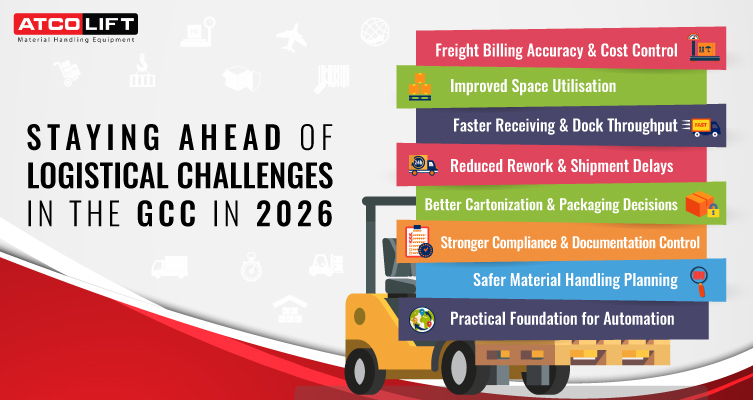
Top 8 Practical Operational Impacts in the GCC
Labour shortages remain a persistent concern. Physically demanding roles are harder to fill, and turnover increases when repetitive tasks strain workers. In high-temperature dock environments, fatigue builds quickly. Reducing unnecessary manual measurement and lifting improves both productivity and retention.
Assisted handling technologies, when implemented thoughtfully, allow smaller teams to maintain output safely. The objective is not replacing workers but enabling them to operate sustainably under demanding conditions.
Common Operational Mistakes Without Measurement Systems
Staying ahead of logistical challenges in the GCC requires measured improvements rather than dramatic overhauls. Large automation projects attract attention, but foundational accuracy often delivers more consistent returns.
Dimensioning systems may seem simple compared to robotics or full automation. Yet they directly influence billing precision, space control, operational efficiency, and compliance readiness. When data becomes reliable, decisions become clearer. When decisions become clearer, risk reduces.
For operations leaders in UAE, Saudi Arabia, and Oman, the question is not whether growth will continue. It will. The real question is whether internal systems are accurate enough to support that growth without creating hidden cost pressure and operational instability.
The facilities that strengthen their data foundation now will scale more smoothly. Those that delay may find themselves constantly correcting avoidable mistakes while margins shrink quietly in the background.
Many of the operational challenges seen in 2026 are not dramatic failures. They are small inaccuracies that accumulate — incorrect freight billing, space miscalculation, manual measurement errors, and inconsistent master data. These weaknesses quietly reduce profitability and create unnecessary rework.
Accurate data has become a frontline operational tool. Without it, automation struggles, billing disputes increase, and warehouse planning becomes reactive rather than controlled.
Why Accurate Measurement Matters in Modern GCC Warehouses
Across UAE, Saudi Arabia, and Oman, import/export dependency remains high. Containers arrive with mixed SKUs, irregular cartons, and variable packaging standards. Many facilities still rely on supplier-provided dimensions or rough internal estimates. Over time, this leads to cube distortion, freight discrepancies, and inefficient storage allocation.
Heat conditions also affect performance. Repeated manual measuring at receiving docks in high temperatures increases fatigue and slows throughput. In facilities already managing labour shortages, these inefficiencies compound quickly.
Dimensioning systems address this problem directly. They capture accurate length, width, and height automatically, often integrated with weight and barcode data. Instead of guesswork, operations gain measurable facts. That shift alone strengthens billing accuracy, storage planning, and reporting consistency.
Top 8 Practical Operational Impacts in the GCC
- 1. Freight Billing Accuracy and Cost Control
Carriers charge based on dimensional weight. Even small measurement errors inflate transport costs. Verified dimension data allows finance teams to validate invoices quickly and challenge discrepancies confidently. This directly protects margin in a high-volume environment. - 2. Improved Space Utilisation
Warehouse growth across the region has been rapid, but space remains expensive. Accurate cube data prevents over-allocation and underutilization of racking. Storage decisions become data-driven rather than assumption-based. - 3. Faster Receiving and Dock Throughput
Manual measuring slows inbound processing. Automated dimension capture reduces repetitive steps and keeps container unloading and put-away flowing, especially during seasonal peaks. - 4. Reduced Rework and Shipment Delays
Incorrect size data often leads to repacking, label corrections, and transport adjustments. Preventing these issues reduces downtime and protects service levels. - 5. Better Cartonization and Packaging Decisions
Packing operations frequently rely on experience rather than verified data. Accurate measurements improve carton selection, reduce excess void fill, and lower damage risk. - 6. Stronger Compliance and Documentation Control
Cross-border trade between GCC countries demands precise shipment data. Measurement consistency reduces customs documentation errors and improves audit readiness. - 7. Safer Material Handling Planning
When dimensions and weights are clearly recorded, supervisors can identify heavy or irregular loads that require assisted handling. Ergonomic lifting solutions, including vacuum lifters such as those developed by TAWI, can then be targeted to high-risk zones instead of applied randomly. - 8. Practical Foundation for Automation
Automation projects fail when master data is unreliable. Dimensioning strengthens the data layer first. This prepares facilities for conveyors, sortation, and robotics without rushing into large capital commitments prematurely.
Labour shortages remain a persistent concern. Physically demanding roles are harder to fill, and turnover increases when repetitive tasks strain workers. In high-temperature dock environments, fatigue builds quickly. Reducing unnecessary manual measurement and lifting improves both productivity and retention.
Assisted handling technologies, when implemented thoughtfully, allow smaller teams to maintain output safely. The objective is not replacing workers but enabling them to operate sustainably under demanding conditions.
Common Operational Mistakes Without Measurement Systems
- Depending on outdated supplier dimensions
Packaging frequently changes. When master data is not updated, planning errors multiply. - Using estimated averages instead of actual measurements
Averages hide outliers that drive cost spikes and space congestion. - Allowing manual data entry into core systems
Human input errors create inconsistencies that affect finance, operations, and reporting. - Postponing data correction until automation begins
Cleaning inaccurate data during automation rollout increases risk and cost. - Overlooking dock inefficiencies during peak heat periods
Small manual inefficiencies become larger productivity losses in extreme temperatures.
Staying ahead of logistical challenges in the GCC requires measured improvements rather than dramatic overhauls. Large automation projects attract attention, but foundational accuracy often delivers more consistent returns.
Dimensioning systems may seem simple compared to robotics or full automation. Yet they directly influence billing precision, space control, operational efficiency, and compliance readiness. When data becomes reliable, decisions become clearer. When decisions become clearer, risk reduces.
For operations leaders in UAE, Saudi Arabia, and Oman, the question is not whether growth will continue. It will. The real question is whether internal systems are accurate enough to support that growth without creating hidden cost pressure and operational instability.
The facilities that strengthen their data foundation now will scale more smoothly. Those that delay may find themselves constantly correcting avoidable mistakes while margins shrink quietly in the background.


GET A QUOTE
Tell us about your business requirement, one of our technical expert will be in touch with you soon..!
PROCEED
NEW PRODUCTS ALERTS