How Leading 3PL and Freight Companies in the UAE Are Automating Pallet Dimensioning at Scale
Running a high-volume freight operation means every minute on the warehouse floor counts. For 3PL providers, express courier hubs, and freight forwarders across the UAE, one of the most persistent bottlenecks has been something surprisingly basic — accurate pallet dimensioning before freight moves.
Manual pallet dimensioning is slow, inconsistent, and leaves room for billing disputes that damage client relationships. As shipment volumes grow, particularly with the expansion of e-commerce and cross-border trade through Dubai and Abu Dhabi, the pressure to get freight data right — fast — has pushed large operations toward automated dimensioning systems.
Why Accurate Pallet Dimensioning Directly Affects Revenue
Freight billing in the logistics industry is based on either actual weight or volumetric weight, whichever is higher. When pallet dimensioning is done manually, even small measurement errors translate into revenue leakage or overbilling disputes. For a company processing hundreds or thousands of shipments daily, those small errors accumulate quickly.
Beyond billing, inaccurate dimensions affect loading plans, truck utilization, and warehouse slot allocation. A pallet recorded 10 cm shorter than its actual size can throw off an entire loading sequence. At scale, this creates cascading inefficiencies that are difficult to trace back to their source.
How Automated Pallet Dimensioning and DWS Systems Work on the Warehouse Floor
DWS stands for Dimensioning, Weighing, and Scanning — three functions that traditionally required separate steps and separate equipment. Modern portal-based pallet dimensioning systems combine all three into a single checkpoint that takes roughly half a second per pass.
- Freight arrives at a designated pallet dimensioning checkpoint on the warehouse floor.
- A forklift, pallet truck, or E-forklift positions the freight on a platform scale beneath the portal.
- The overhead portal — ceiling, wall, or free-standing — scans the freight automatically.
- Length, width, height, volumetric data, weight, and a photograph are captured and stored in one pass — no manual entry required.
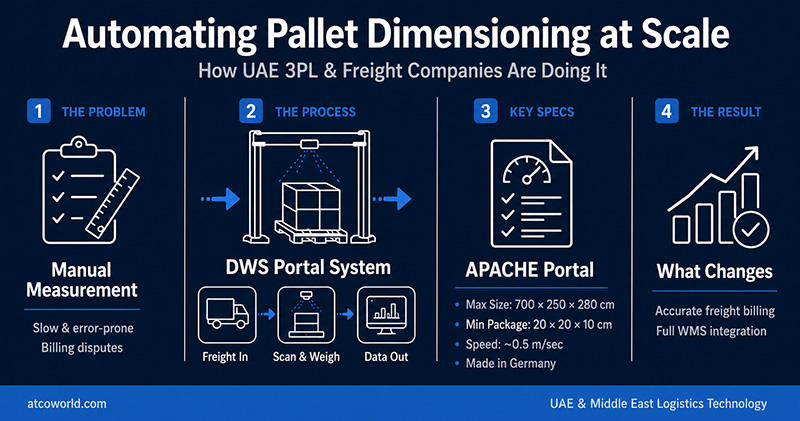
Systems like the APACHE Portal are purpose-built for high-volume pallet dimensioning, manufactured in Germany and handling freight across a wide measuring range — from small packages as compact as 20 x 20 x 10 cm up to full pallets within a 700 x 250 x 280 cm envelope. Measurement division goes down to 2 cm on length and width, and 1 cm on height. Movement speed through the portal is approximately 0.5 metres per second, fast enough to integrate into normal forklift workflow without disrupting floor operations.
APACHE Portal — Technical Specifications
| Measuring Area | 350 cm – 700 cm × 250 cm × 280 cm |
| Minimum Package Size | 20 cm × 20 cm × 10 cm |
| Measurement Division | 2 cm / 2 cm / 1 cm (L × W × H) |
| Movement Speed | ~0.5 m/sec |
| Mount Options | Ceiling, Wall, Free-standing |
| Versions | Stationary & Portable |
| Country of Manufacture | Germany |
What Enterprise Logistics Operations in the UAE Look for in a Pallet Dimensioning System
Enterprise freight companies don't adopt new floor equipment lightly. The decision usually comes down to a few practical questions: Does it integrate with the existing WMS or TMS? Can it handle the full range of freight types moving through the facility? Is it reliable enough for 24-hour operations across multiple shifts? And can it be deployed consistently across more than one site?
Stationary pallet dimensioning installations work well for fixed checkpoints at inbound or outbound docks — common in large distribution centers and airport cargo terminals. Portable configurations suit operations where measurement needs to happen at different points on the floor, or across multiple facilities where full stationary setups are not practical at every location.
For 3PLs managing contracts with multiple clients, the automatic photo documentation adds another layer of value. A timestamped image tied to every shipment record provides clear evidence in the event of a cargo condition dispute — something that comes up more often than most operations managers would prefer.
The Broader Picture for UAE and Middle East Logistics
The UAE's position as a regional logistics hub means freight volumes are not slowing down. Dubai's Jebel Ali port remains one of the busiest container terminals in the world. The growth of dedicated logistics zones, combined with the continued expansion of regional e-commerce — which saw double-digit growth across the GCC in recent years — points toward higher throughput demands on warehouse operations for the foreseeable future.
In this environment, automating pallet dimensioning is less about adopting new technology and more about removing a known operational weakness. Companies that still rely on tape measures and manual data entry are carrying a risk that many of their competitors have already addressed.
The shift toward automated pallet dimensioning and DWS systems at enterprise level is well established in Europe and North America. Across the Middle East, the adoption curve is steepening, driven by the same operational pressures and client expectations that pushed global logistics leaders in that direction years ago.
A Practical Note on Implementation
Installing a pallet dimensioning portal does not require a facility redesign. Most systems are engineered to fit into existing dock layouts, with mounting options that suit different ceiling heights and floor configurations. Calibration is handled during installation, and measurement data feeds directly into whatever documentation or billing workflow the operation already uses.
For companies evaluating options, the key variables are measuring range, integration capability, and whether stationary, portable, or a combination of both fits the facility layout. Getting those three factors right tends to make everything else in the implementation straightforward.
Frequently Asked Questions




GET A QUOTE
Tell us about your business requirement, one of our technical expert will be in touch with you soon..!
NEW PRODUCTS ALERTS