Commercial Vegetable Peelers and Dicers: Types & Applications
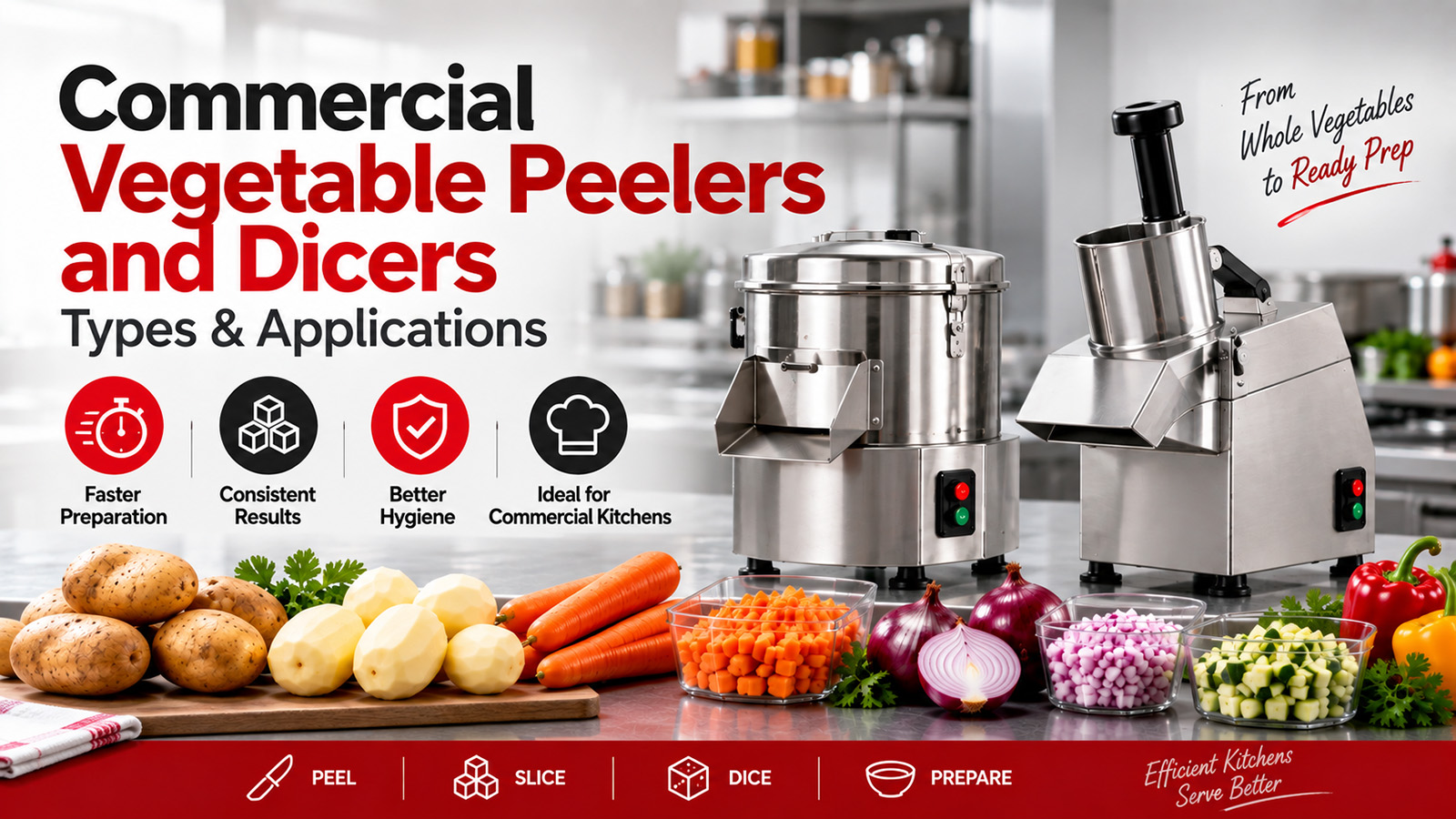
A restaurant preparing for dinner service may need onions diced for sauces, potatoes prepared for side dishes, and vegetables portioned for several menu items at the same time. In a central kitchen or catering facility, the quantities can be considerably larger. When much of this work depends on manual preparation, the prep section can quickly become a bottleneck.
Commercial vegetable peelers and dicers are designed to reduce repetitive preparation work and produce more consistent results. However, peeling and dicing are different processes, and equipment that performs well for one ingredient or production volume may not be suitable for another.
Understanding the machine types, applications, capacity, cleaning requirements, and product limitations is therefore important before selecting equipment for a professional kitchen or food processing operation.
Why Vegetable Preparation Becomes a Workflow Problem
Manual vegetable preparation may appear manageable when volumes are low. The difficulty becomes clearer when production increases or several menu items require preparation at the same time.
A chef may need staff to peel potatoes, remove onion skins, prepare garlic, and cut vegetables into consistent sizes before cooking begins. During banquet preparation, catering production, or central kitchen operations, these tasks may involve many kilograms of ingredients within a limited preparation window.
The problem is not simply labour time. Manual preparation can also create variation in cut size, inconsistent yield, additional handling, and greater dependence on individual staff skills.
The objective of mechanised preparation should not simply be to process ingredients faster. It should create a more predictable flow between receiving, washing, preparation, cooking, portioning, and cleaning.
Types of Commercial Vegetable Peelers
Commercial peelers use different mechanisms depending on the ingredient and required finish. Understanding these differences is important because there is no single peeling method suitable for every product.
- Abrasive peelers: Commonly used for potatoes and similar root vegetables. The product moves against an abrasive surface that removes the outer skin. These machines are useful where relatively large batches need to be processed repeatedly.
- Knife peeling systems: These remove the outer layer through controlled cutting rather than abrasion. They may be selected where the application requires a different surface finish or where controlling product loss is particularly important.
- Onion and garlic peeling equipment: Onion and garlic skins behave differently from potato skins. Dedicated systems may use dry peeling, air, mechanical action, or other processes depending on the machine design and production requirement.
- Special-purpose peeling equipment: Certain food production operations may require machines designed for specific products such as almonds or other ingredients that cannot be treated in the same way as conventional root vegetables.
Product loss should also be considered. Removing more material than necessary increases waste, and over many production cycles that waste becomes an operating cost rather than simply a preparation issue.
Commercial Vegetable Dicers and Their Applications
Once ingredients are peeled and cleaned, many professional kitchens require controlled cutting before cooking, chilling, mixing, packing, or portioning.
Commercial vegetable dicers use cutting assemblies to produce defined shapes and dimensions. Depending on the machine and cutting set, applications may include cubes, strips, slices, or other cuts.
A restaurant may use a dicer for vegetables going into soups, sauces, salads, or cooked dishes. A hotel central kitchen may need consistent cuts across several outlets. Catering operations may process larger batches before portioning them into production containers.
This consistency has an operational benefit. When vegetables have similar dimensions, cooking times are easier to control and portion presentation becomes more predictable.
Machine selection should therefore begin with the required finished product rather than simply the motor power or maximum output figure.
Questions to ask before selection
What ingredients will be processed? What cut dimensions are needed? How frequently will sizes change? Can the cutting components be changed without creating excessive downtime?
The feeding method also matters. Staff should be able to load ingredients safely and at a pace that matches the rest of the preparation workflow. A high-capacity machine provides little benefit if upstream washing or downstream handling cannot keep up with it.
Hygiene, Cleaning and Maintenance Matter as Much as Output
Vegetable preparation equipment comes into repeated contact with raw ingredients, moisture, soil residues, starches, skins, and food particles. Cleaning access should therefore be evaluated before purchasing, not after installation.
Areas around cutting discs, peeling chambers, discharge points, seals, and product-contact surfaces can retain residue if they are difficult to access. If cleaning takes too long, there is also a practical risk that busy staff may not clean the equipment as thoroughly or as frequently as the operating procedure requires.
Removable food-contact components can make routine sanitation easier where the machine design permits them. Staff should also understand which components require daily cleaning and which parts need periodic inspection.
Blades and cutting assemblies require particular attention. A worn cutting component may still operate, but the result can gradually deteriorate. Vegetables may become crushed, torn, or irregular instead of being cleanly cut.
Maintenance planning should therefore include blade condition, abrasive surfaces, belts or drive components where applicable, seals, safety mechanisms, and manufacturer-recommended service intervals.
What to Check Before Selecting a Peeler or Dicer
A machine should fit the kitchen's actual preparation process. This is particularly important in hotels, central kitchens, catering facilities, and high-volume food operations where preparation equipment may run repeatedly throughout the day.
- Ingredient range: Confirm which vegetables or other products the machine is specifically designed to process.
- Required output: Compare realistic batch or hourly demand with machine capacity rather than automatically selecting the highest-output model.
- Finished result: Check peeling quality, required cut sizes, product consistency, and acceptable product loss.
- Cleaning access: Consider how easily food-contact components, cutting tools, chambers, and discharge areas can be cleaned.
- Available space: Allow room for loading, discharge containers, operator movement, cleaning, and servicing rather than considering machine dimensions alone.
- Workflow position: Plan how ingredients move from washing to peeling, cutting, cooking, chilling, or packing without unnecessary backtracking.
- Maintenance: Check the availability and replacement process for blades, discs, abrasive components, seals, and other wear parts.
These considerations can be particularly important in UAE, Saudi Arabia, Oman, and other GCC foodservice operations where hotels, catering businesses, restaurants, and central kitchens may handle high production volumes while maintaining strict cleaning and food-handling procedures.
The machine should also be evaluated as part of the complete preparation section. Installing a powerful dicer does not automatically improve productivity if vegetables are still waiting for washing, operators have insufficient working space, or processed ingredients have nowhere to move efficiently after cutting.
Final consideration: The most useful question before choosing commercial vegetable peelers and dicers is not simply, “How much can this machine process?” It is: “Which machine can produce the required ingredient quality and volume while fitting safely and efficiently into our preparation, cleaning, and maintenance workflow?”



GET A QUOTE
Tell us about your business requirement, one of our technical expert will be in touch with you soon..!
NEW PRODUCTS ALERTS