Quality Inspection Equipment: Selection Criteria For Food Manufacturers

Findings from a recent Food Online survey of nearly 100 food manufacturing professionals indicate that the FSMA (Food Safety Modernization Act) is
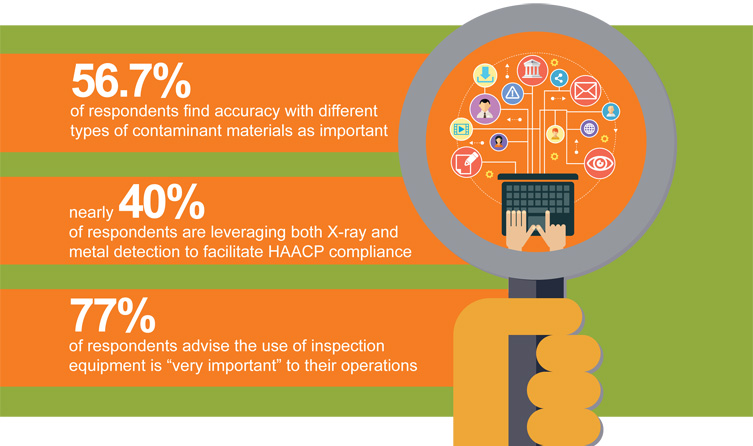
a top-of-mind concern, and as such, manufacturers are ramping up their food quality inspection efforts. When asked, how important is the use of inspection equipment, such as metal detection or X-ray inspection, to your food processing and/or packaging operations, nearly 77 percent of respondents answered “very important.”
That stands to good reason, as Section 103 of the aforementioned Act, signed into law by President Obama earlier this year, addresses Hazard Analysis and Risk-Based Preventive Controls. The law calls for owners, operators, or agents in charge of food manufacturing facilities to:
Our survey findings indicate that to address these requirements, a majority of food manufacturing facilities are leveraging either X-ray, metal detection — or in nearly 40 percent of facilities, both technologies — to facilitate HAACP (Hazard Analysis & Critical Control Points) compliance. In this paper, we’ll focus on survey findings related to the food quality inspection system selection criteria applied by the food manufacturing industry. We’ll also provide some actionable insight into the themes uncovered by the query.
Top Purchase Criteria: Accuracy, Cost, Non-Conforming Product Identification
Asked their primary criteria for purchase of an inspection system, accuracy with different types of contaminant materials ranked as the food manufacturer’s top concern (56.7 percent), followed by initial cost (55.6 percent), accuracy with small contaminants (51.1 percent), and ability to reject non-conforming product (32.2 percent).
Let’s consider the advantages of X-ray technology in the context of these top concerns.
Accuracy with different types of contaminant materials and small contaminants.
The fact that the accurate identification of varying types of contaminants tops the list of inspection system purchase criteria poses a strong argument for increased adoption of X-ray inspection systems that are developed specifically for food manufacturing environments. Modern systems capabilities exceed the functionality achieved by metal detection systems alone. X-ray systems that are purpose-built for food industry applications will also feature a small focal point and matched high resolution X-ray camera, both highly tuned to find small contaminants.
Initial cost.
Because it’s built on more complex technology that enables detection of a more comprehensive spectrum of contaminants, X-ray technology has come at a greater cost than conventional metal detection systems. However, in some industries, the robust adoption of X-ray technology has increased the volume of its manufacture, thereby reducing the cost of X-ray generator and detector components and resulting in an overall reduction to the cost of the finished system. X-ray system manufacturers that source components from vertically integrated supply chain providers have been particularly successful at reducing the initial cost of X-ray systems, to the point that many are on-par with metal detection systems. What’s more, where the ROI of risk avoidance is difficult to measure, it’s clear that the broader the spectrum of risk avoided, the greater the return.
Ability to reject non-conforming product.
Because X-ray inspection systems can simultaneously perform in-line quality checks as they monitor process lines for contaminants, the technology also lends itself to the manufacturer’s ability to reject non-conforming products. Modern X-ray systems can measure mass, monitor fill level, measure headspace, count components, identify missing or broken products, inspect seal integrity, and identify damaged products and packaging. These features enable the detection of non-conformance — whether that non-conformance is related to the product itself or the product’s packaging and presentation — and alert manufacturers to take corrective action.
Modern low-power X-ray camera technology features a finely tuned signal-to-noise ratio, enabling its ability to differentiate between background material and contaminants — even very fine foreign bodies — with a high degree of accuracy
False Positive Avoidance, Safety, Maintenance, Production Speed Round Out Purchase Criteria
Additional purchase criteria identified in the Food Online survey of food manufacturing professionals underscore equipment performance, maintenance, and safety concerns. Specifically, 26.7 percent identified false positive avoidance as a top interest, 20 percent indicated concerns about the safety of the inspection equipment, required maintenance expectations were top-of-mind for 16.7 percent, and 12.2 percent said impact on production speed is issue number one. Lets examine each of these findings in the context of modern X-ray technology
False positives.
Because X-ray technology measures product density, rather than simply scanning for metal, early applications of X-ray in food inspection environments were prone to false positive readings, specifically when products were of variable density. However, the X-ray generators, software, and receiving hardware employed by modern systems result in a much sharper and more detailed image than that produced by their predecessors. With minimal training, operators can easily distinguish harmful contaminants. In automated environments, X-ray technology has matured to the point that false positives or missed detections are extremely rare; when they do occur, they’re typically the result of a faulty or improperly adjusted program, as opposed to the X-ray equipment itself. As with any food quality inspection equipment, ongoing testing and documentation is paramount to both compliance with FSMA and the avoidance of false positive results. Product safety.
The 20 percent of survey respondents who expressed concern about the safety record of the food quality inspection equipment they procure approach the issue from two angles: how does the equipment introduced to the manufacturing line impact the quality of products, and how does it impact the health and safety of line operators?
The short answer on X-ray technology developed specifically for food inspection applications is that it neither impacts food quality nor does it put operators at risk. A 1997 study by the World Health Organization (WHO), revealed that food radiation exposure levels up to 10,000 Sievert (Sv, the common unit of radiation measurement) had no impact to either the safety of food or it’s nutritional value, and the radiation levels used in modern X-ray inspection machines are less than one ten millionth of the levels used in the study. If an operator were in direct contact with a modern X-ray system for a full 40 hours per week, that operator’s exposure would be limited to 2 Millisievert per year. To provide context, natural background radiation exposes the average person to 2.4 Millisievert per year. The implementation of X-ray inspection equipment in food manufacturing environments poses absolutely no risk to product quality or operator safety.
Required maintenance.
Food manufacturing environments are hostile to mechanical equipment. As it relates to X-ray technology, that means generators and cameras must be purpose-built for the environment in which they’ll serve. In effect, an X-ray generator is a light bulb; it will fail at some point in time, but long term TCO (total cost of ownership) is greatly increased when it’s not running incessantly at full power. To achieve TCO goals and reduce maintenance requirements, many experts recommend over-specifying the X-ray generator purchase; in other words, if a 100W generator serves the needs of the application, the manufacturer should purchase a system with a 200W generator and run it at 50 percent capacity Where the light bulb analogy ends is in the X-ray generator’s housing, which should be sealed from outside air and internally oil-cooled to ensure longevity. While some suppliers manufacture generators with “breather holes” to allow for expansion of the oil, they’re not necessarily conducive to food manufacturing environments.
How it would affect production speeds.
While food safety is increasingly scrutinized, and according to survey results, increasingly important to manufacturers, speed remains a key factor in the consideration of inspection equipment. No manufacturer is willing to sacrifice production for excessive delays due to quality control initiatives. Modern X-ray systems that are purposebuilt for high throughput food manufacturing facilities can scan at rates of 2 meters (6.5 feet) per second, creating little-to-no impact on production speed.
 As the passing of the FSMA shifts the FDA’s focus from dealing with food safety crises to preventing them from happening in the first place, food manufacturers will face increased pressure to comply with HACCP guidelines, which include the implementation of inspection equipment at critical
control points, ongoing documentation of that equipment’s performance, and routine inspections. The inspection system purchasing criteria uncovered
by the Food Online survey paints a picture of a food manufacturing industry determined to catch up with FSMA mandates, to avoid the costs of
both regulatory noncompliance and the business crippling risks associated with food safety issues.
As the passing of the FSMA shifts the FDA’s focus from dealing with food safety crises to preventing them from happening in the first place, food manufacturers will face increased pressure to comply with HACCP guidelines, which include the implementation of inspection equipment at critical
control points, ongoing documentation of that equipment’s performance, and routine inspections. The inspection system purchasing criteria uncovered
by the Food Online survey paints a picture of a food manufacturing industry determined to catch up with FSMA mandates, to avoid the costs of
both regulatory noncompliance and the business crippling risks associated with food safety issues.
As food manufacturers research the inspection systems available on the market today, it behooves them to ask detailed questions about the systems they’re considering, and the components comprising those systems. It’s highly unlikely that an ‘X-ray system in a box” is purpose-built for specific food manufacturing applications — from the mechanical equipment in the X-ray generator and camera to the operator interface. Consult with vendors who demonstrate expertise specific to the food manufacturing industry, and as your purchase criteria unfold, hold those vendors accountable to providing a thorough education on the best system for your application.
That stands to good reason, as Section 103 of the aforementioned Act, signed into law by President Obama earlier this year, addresses Hazard Analysis and Risk-Based Preventive Controls. The law calls for owners, operators, or agents in charge of food manufacturing facilities to:
- Identify and evaluate known or reasonably foreseeable hazards that may be associated with the facility, including:
- biological, chemical, physical, and radiological hazards, natural toxins, pesticides, drug residues, decomposition, parasites, allergens, and unapproved food and color additives
- hazards that occur naturally, or may be unintentionally introduced; and
- Identify and evaluate hazards that may be intentionally introduced, including by acts of terrorism
- Develop a written analysis of the hazards.
Our survey findings indicate that to address these requirements, a majority of food manufacturing facilities are leveraging either X-ray, metal detection — or in nearly 40 percent of facilities, both technologies — to facilitate HAACP (Hazard Analysis & Critical Control Points) compliance. In this paper, we’ll focus on survey findings related to the food quality inspection system selection criteria applied by the food manufacturing industry. We’ll also provide some actionable insight into the themes uncovered by the query.
Top Purchase Criteria: Accuracy, Cost, Non-Conforming Product Identification
Asked their primary criteria for purchase of an inspection system, accuracy with different types of contaminant materials ranked as the food manufacturer’s top concern (56.7 percent), followed by initial cost (55.6 percent), accuracy with small contaminants (51.1 percent), and ability to reject non-conforming product (32.2 percent).
Let’s consider the advantages of X-ray technology in the context of these top concerns.
Accuracy with different types of contaminant materials and small contaminants.
The fact that the accurate identification of varying types of contaminants tops the list of inspection system purchase criteria poses a strong argument for increased adoption of X-ray inspection systems that are developed specifically for food manufacturing environments. Modern systems capabilities exceed the functionality achieved by metal detection systems alone. X-ray systems that are purpose-built for food industry applications will also feature a small focal point and matched high resolution X-ray camera, both highly tuned to find small contaminants.
Initial cost.
Because it’s built on more complex technology that enables detection of a more comprehensive spectrum of contaminants, X-ray technology has come at a greater cost than conventional metal detection systems. However, in some industries, the robust adoption of X-ray technology has increased the volume of its manufacture, thereby reducing the cost of X-ray generator and detector components and resulting in an overall reduction to the cost of the finished system. X-ray system manufacturers that source components from vertically integrated supply chain providers have been particularly successful at reducing the initial cost of X-ray systems, to the point that many are on-par with metal detection systems. What’s more, where the ROI of risk avoidance is difficult to measure, it’s clear that the broader the spectrum of risk avoided, the greater the return.
Ability to reject non-conforming product.
Because X-ray inspection systems can simultaneously perform in-line quality checks as they monitor process lines for contaminants, the technology also lends itself to the manufacturer’s ability to reject non-conforming products. Modern X-ray systems can measure mass, monitor fill level, measure headspace, count components, identify missing or broken products, inspect seal integrity, and identify damaged products and packaging. These features enable the detection of non-conformance — whether that non-conformance is related to the product itself or the product’s packaging and presentation — and alert manufacturers to take corrective action.
Modern low-power X-ray camera technology features a finely tuned signal-to-noise ratio, enabling its ability to differentiate between background material and contaminants — even very fine foreign bodies — with a high degree of accuracy
False Positive Avoidance, Safety, Maintenance, Production Speed Round Out Purchase Criteria
Additional purchase criteria identified in the Food Online survey of food manufacturing professionals underscore equipment performance, maintenance, and safety concerns. Specifically, 26.7 percent identified false positive avoidance as a top interest, 20 percent indicated concerns about the safety of the inspection equipment, required maintenance expectations were top-of-mind for 16.7 percent, and 12.2 percent said impact on production speed is issue number one. Lets examine each of these findings in the context of modern X-ray technology
False positives.
Because X-ray technology measures product density, rather than simply scanning for metal, early applications of X-ray in food inspection environments were prone to false positive readings, specifically when products were of variable density. However, the X-ray generators, software, and receiving hardware employed by modern systems result in a much sharper and more detailed image than that produced by their predecessors. With minimal training, operators can easily distinguish harmful contaminants. In automated environments, X-ray technology has matured to the point that false positives or missed detections are extremely rare; when they do occur, they’re typically the result of a faulty or improperly adjusted program, as opposed to the X-ray equipment itself. As with any food quality inspection equipment, ongoing testing and documentation is paramount to both compliance with FSMA and the avoidance of false positive results. Product safety.
The 20 percent of survey respondents who expressed concern about the safety record of the food quality inspection equipment they procure approach the issue from two angles: how does the equipment introduced to the manufacturing line impact the quality of products, and how does it impact the health and safety of line operators?
The short answer on X-ray technology developed specifically for food inspection applications is that it neither impacts food quality nor does it put operators at risk. A 1997 study by the World Health Organization (WHO), revealed that food radiation exposure levels up to 10,000 Sievert (Sv, the common unit of radiation measurement) had no impact to either the safety of food or it’s nutritional value, and the radiation levels used in modern X-ray inspection machines are less than one ten millionth of the levels used in the study. If an operator were in direct contact with a modern X-ray system for a full 40 hours per week, that operator’s exposure would be limited to 2 Millisievert per year. To provide context, natural background radiation exposes the average person to 2.4 Millisievert per year. The implementation of X-ray inspection equipment in food manufacturing environments poses absolutely no risk to product quality or operator safety.
Required maintenance.
Food manufacturing environments are hostile to mechanical equipment. As it relates to X-ray technology, that means generators and cameras must be purpose-built for the environment in which they’ll serve. In effect, an X-ray generator is a light bulb; it will fail at some point in time, but long term TCO (total cost of ownership) is greatly increased when it’s not running incessantly at full power. To achieve TCO goals and reduce maintenance requirements, many experts recommend over-specifying the X-ray generator purchase; in other words, if a 100W generator serves the needs of the application, the manufacturer should purchase a system with a 200W generator and run it at 50 percent capacity Where the light bulb analogy ends is in the X-ray generator’s housing, which should be sealed from outside air and internally oil-cooled to ensure longevity. While some suppliers manufacture generators with “breather holes” to allow for expansion of the oil, they’re not necessarily conducive to food manufacturing environments.
How it would affect production speeds.
While food safety is increasingly scrutinized, and according to survey results, increasingly important to manufacturers, speed remains a key factor in the consideration of inspection equipment. No manufacturer is willing to sacrifice production for excessive delays due to quality control initiatives. Modern X-ray systems that are purposebuilt for high throughput food manufacturing facilities can scan at rates of 2 meters (6.5 feet) per second, creating little-to-no impact on production speed.
As food manufacturers research the inspection systems available on the market today, it behooves them to ask detailed questions about the systems they’re considering, and the components comprising those systems. It’s highly unlikely that an ‘X-ray system in a box” is purpose-built for specific food manufacturing applications — from the mechanical equipment in the X-ray generator and camera to the operator interface. Consult with vendors who demonstrate expertise specific to the food manufacturing industry, and as your purchase criteria unfold, hold those vendors accountable to providing a thorough education on the best system for your application.



GET A QUOTE
Tell us about your business requirement, one of our technical expert will be in touch with you soon..!
PROCEED
NEW PRODUCTS ALERTS