Machinery Update: Talks to Fortress about brand safety

Last year Mars recalled its products from more than 55 countries after plastic was discovered in one of its chocolate bars and, claims Phil Brown, sales
director at Fortress Technology UK the company’s swift response helped to protect the confectionery manufacturer’s reputation for high quality products.
Highlighting that foreign body hazards in confectionery are more likely to be metal fragments from processing equipment wear and tear rather than malicious tampering of products, Brown explains why the sensitivity of a metal detector plays a vital role in mitigating a metal contamination product recall.
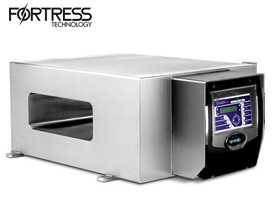
He says that as confectionery is sold in so many different formats, the aperture size of the metal detector head is vitally important, as the smaller the aperture the more sensitive the metal detector is. Very often, sweet manufacturers inspect sugar based products when in ‘rope’ format using small, high performance metal detectors. Here, the sensitivity levels are extremely high and looking for extremely small metal fragments. “There’s little point looking for a 3mm metal sphere in a fruit gum,” remarks Phil, who adds that “for individual pieces of chewing gum you would be reaching pharmaceutical performance levels.”
On the face of it, sweet treats like chocolate bars, biscuits, sweets and chewing gum should be easy to inspect. However, the metallised film wrapper in which they are often packed also puts them in the ‘wet’ product effect zone. “If you arere inspecting goods after wrapping, the metal detector needs to be set to factor in the worst case product effect – the wrapper,” says Brown. For metallised film that is made up of aluminium dots on film, the product effect changes according to the format and quality. “It’s not so much of an issue for those producing a small range of candy bars, but those manufacturing and packing an extensive range using multiple types of wrappers, the metal detectors sensitivity is usually set to the worst case wrapper scenario.
“To further complicate matters, you may need to consider orientation effect, especially with sealed packs as this creates a dense line of metallised dots,” he says. Today’s metal detecting machines are designed to autoselect the ‘correct’ operating frequency in seconds but there are still limitations for confectioners producing a more expansive product range, especially conductive products, says Brown. To solve this, for instance, Fortress Technology engineered a simultaneous frequency option where the product and metal detection frequencies are split.
This technology essentially ignores the product effect, making it ideal for conductive products that vary in size and density or are wrapped in a metallised film. Another factor to consider is how any confectionery products are fed into packs while at the same time, eliminating false rejects, he says.
Source: machineryupdate.co.uk
He says that as confectionery is sold in so many different formats, the aperture size of the metal detector head is vitally important, as the smaller the aperture the more sensitive the metal detector is. Very often, sweet manufacturers inspect sugar based products when in ‘rope’ format using small, high performance metal detectors. Here, the sensitivity levels are extremely high and looking for extremely small metal fragments. “There’s little point looking for a 3mm metal sphere in a fruit gum,” remarks Phil, who adds that “for individual pieces of chewing gum you would be reaching pharmaceutical performance levels.”
On the face of it, sweet treats like chocolate bars, biscuits, sweets and chewing gum should be easy to inspect. However, the metallised film wrapper in which they are often packed also puts them in the ‘wet’ product effect zone. “If you arere inspecting goods after wrapping, the metal detector needs to be set to factor in the worst case product effect – the wrapper,” says Brown. For metallised film that is made up of aluminium dots on film, the product effect changes according to the format and quality. “It’s not so much of an issue for those producing a small range of candy bars, but those manufacturing and packing an extensive range using multiple types of wrappers, the metal detectors sensitivity is usually set to the worst case wrapper scenario.
“To further complicate matters, you may need to consider orientation effect, especially with sealed packs as this creates a dense line of metallised dots,” he says. Today’s metal detecting machines are designed to autoselect the ‘correct’ operating frequency in seconds but there are still limitations for confectioners producing a more expansive product range, especially conductive products, says Brown. To solve this, for instance, Fortress Technology engineered a simultaneous frequency option where the product and metal detection frequencies are split.
This technology essentially ignores the product effect, making it ideal for conductive products that vary in size and density or are wrapped in a metallised film. Another factor to consider is how any confectionery products are fed into packs while at the same time, eliminating false rejects, he says.
Source: machineryupdate.co.uk


GET A QUOTE
Tell us about your business requirement, one of our technical expert will be in touch with you soon..!
PROCEED
NEW PRODUCTS ALERTS