X-Ray Food Inspection Systems: MEKI Models & Compliance Guide
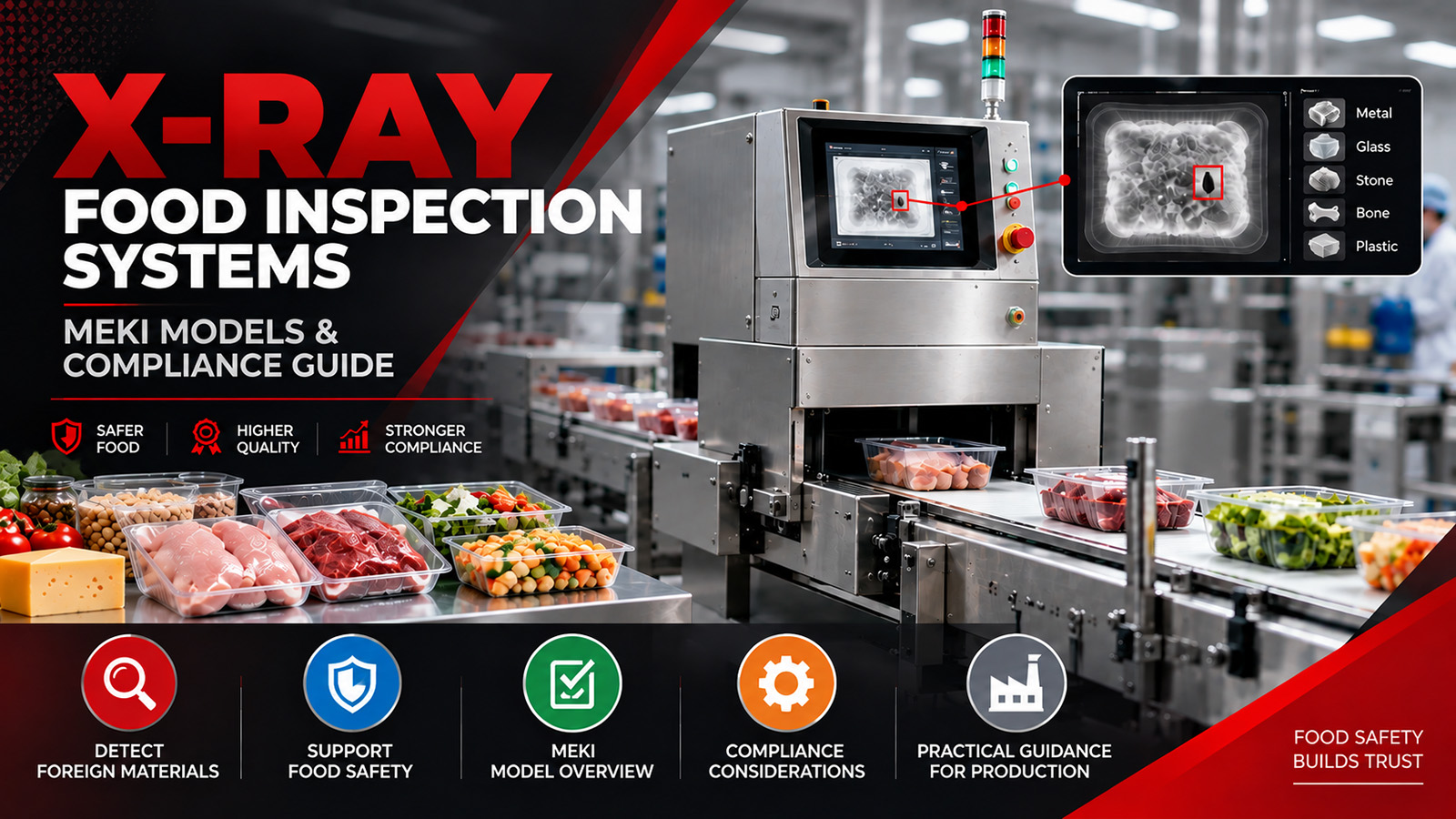
A production line can run at the correct speed, seal every pack properly and still release a product containing an unwanted foreign object. Metal fragments are only part of the risk. Depending on the food and inspection conditions, contaminants may also include glass, stone, calcified bone and some dense plastics. X-ray inspection helps identify density differences inside a product without opening the package.
This becomes particularly important when a factory handles several SKUs, exports to different markets or operates under customer-specific food safety requirements. The inspection point has to work as part of the production process, not as an isolated machine.
How Food X-Ray Inspection Works
As a food pack moves through an X-ray inspection system, X-rays pass through the product and a detector measures the energy reaching it. Materials absorb X-rays differently according to factors such as density and thickness. The resulting image allows the inspection software to identify density variations that may indicate a foreign object.
This gives X-ray technology an important advantage in applications where metal detection alone may not cover the identified hazards. Under suitable conditions, X-ray systems can detect metals as well as materials such as glass, stone and calcified bone. They can also inspect products in foil or metallized packaging, although actual detection capability must always be established through product testing.
Inspection is only one part of the control process. When the system identifies a suspect product, the line must reliably remove it, contain it and, where required, confirm that rejection actually occurred. Records should then allow the quality team to investigate what happened.
Understanding the MEKI Models
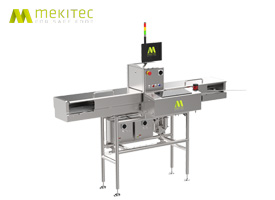
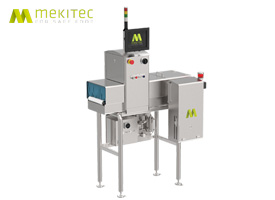
The MEKI range covers different product sizes, package formats and inspection positions. When evaluating these systems, the starting point should be the product and line requirements rather than X-ray power alone. ATCOPACK may reference different MEKI configurations according to the application, but final selection should always be based on actual production conditions.
| MEKI Model | Typical Application | Selection Consideration |
|---|---|---|
| MEKI ONE | Primary packaged foods | Integrated inspection, rejection, reject containment, confirmation and reporting. |
| MEKI | Smaller primary packages | Compact platform for lighter and relatively small packaged products. |
| MIDMEKI | Medium packages, trays and multipacks | Higher product capacity for applications beyond compact MEKI configurations. |
| SIDEMEKI | Bottles, cans, cartons and upright packs | Side-view inspection for tall products. |
| WIDEMEKI | Wide, relatively low-profile packages | Designed to inspect a wider product area. |
| BULK MIDMEKI | Nuts, dried fruits, seeds and vegetables | For unpackaged bulk-flow applications. |
| HIGHER MIDMEKI | Thicker or denser products | Suitable for applications such as cheese, butter, larger bags, trays and multipacks. |
| BIGMEKI | Large primary and secondary packages | Designed for larger packs, trays and heavier conveyor loads. |
Published machine specifications should be read as configuration-dependent values. Product height can affect usable inspection width, while package weight, length and conveyor speed may also vary by configuration. A headline maximum should not automatically be treated as the usable operating point for every product.
Compliance Is More Than Installing an X-Ray Machine
An X-ray inspection system can support a food safety or quality-control programme, but installing the equipment does not by itself make a production line compliant.
The inspection point should be linked to the manufacturer's hazard analysis, food safety plan and applicable customer or regulatory requirements. The factory needs to establish what hazard is being controlled, where inspection should occur, what detection performance is acceptable and what happens when the system rejects a product.
- Document sensitivity and performance tests using the actual product and packaging.
- Define procedures for start-up, product changeover and routine verification.
- Use an automatic reject arrangement appropriate for the pack and production speed.
- Control access to rejected products and establish an investigation procedure.
- Confirm rejection where required by the food safety or customer programme.
- Maintain records covering tests, faults, rejects, corrective actions and relevant production events.
- Train operators and control access to inspection settings and product recipes.
The same principle applies across foreign-object control programmes: documented verification and investigation of rejected products are important parts of the process. The presence of inspection equipment alone is not sufficient.
Equipment safety also needs attention. Relevant radiation-protection requirements, machine safety circuits and local rules for radiation-emitting equipment should be verified for the country where the system will operate. Food production, workplace safety and export requirements can differ between markets.
What Should Be Checked Before Selecting a System?
Start with a product matrix. List the smallest and largest packs, dimensions, weight, food density, packaging material, normal conveyor speed and the contaminants or quality defects that need to be detected. Include likely future products if the line is expected to change.
Next, examine the production environment. Ambient temperature, washdown practices, humidity, dust, available floor space and electrical conditions can affect equipment selection. This deserves particular attention in UAE, Saudi Arabia, Oman and other Gulf manufacturing environments where production areas may experience elevated temperatures.
Line integration deserves equal attention. Conveyor height, upstream product spacing, downstream accumulation, reject-bin access, cleaning requirements and maintenance clearance can all determine whether an installation works reliably during daily production.
- Test representative products in their actual packaging.
- Use relevant foreign-material test samples.
- Run tests at realistic production speeds and product spacing.
- Verify reject performance, not only detection performance.
- Check cleaning access, maintenance clearance and operator usability.
A specification sheet cannot tell a factory exactly what contaminant size will be detectable in every SKU. Detection performance is application-specific. Representative packs should therefore be tested with relevant foreign materials under conditions that resemble actual production as closely as possible.
Finally, consider what happens when something goes wrong. Can operators identify why a pack was rejected? Can quality personnel retrieve the necessary records? Can the reject mechanism be tested without creating unnecessary production disruption? How quickly can maintenance diagnose a fault? These questions often reveal more about the suitability of an inspection system than X-ray power alone.
Making the Final Evaluation
For manufacturers in the UAE, Saudi Arabia, Oman and the wider Gulf, the practical decision is not simply whether to install X-ray inspection . It is to determine which inspection configuration matches the actual product risk, packaging format, line speed, operating environment and compliance programme.
Procurement, production, quality and maintenance teams should evaluate the application together. A system that satisfies a technical specification but creates difficult cleaning, frequent false rejects or poor maintenance access may become an operational problem after installation.
Before approving a system, ask: Has this exact product, in its actual packaging and under realistic production conditions, been tested and validated with the contaminants the factory needs to control?
If the answer is clear and documented, the equipment specification becomes much easier to evaluate.



GET A QUOTE
Tell us about your business requirement, one of our technical expert will be in touch with you soon..!
NEW PRODUCTS ALERTS