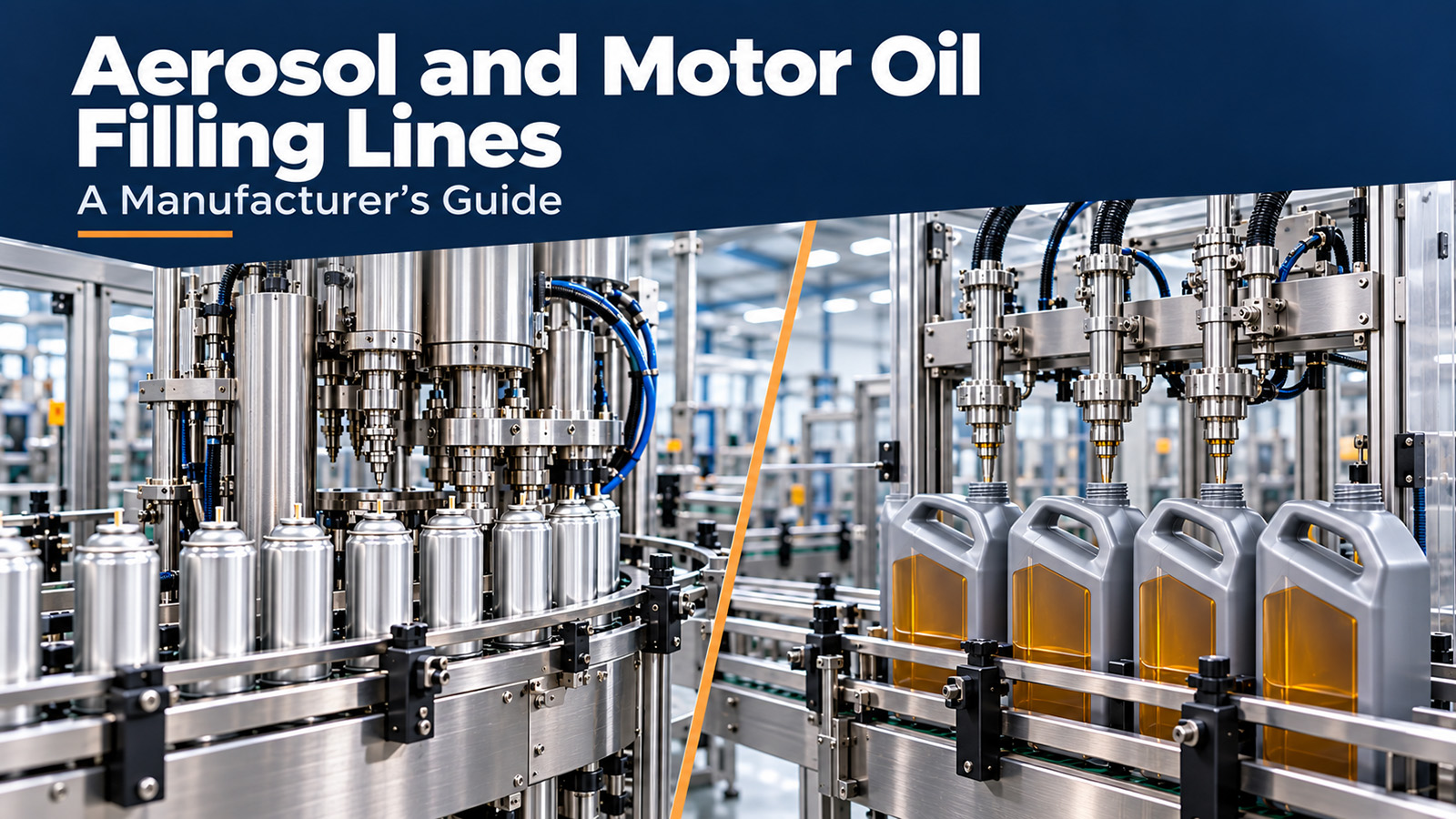
A production manager needs more than a machine that fills containers quickly. The line must deliver the correct quantity, close each pack reliably and keep finished products moving towards dispatch. When one stage fails, the factory pays through rejected packs, extra handling and missed production targets.
Aerosol and motor oil filling lines meet different production needs. Aerosols combine a product, a valve and a pressurised delivery system. Motor oil lines fill liquid into bottles, jerrycans or larger containers before closing and packing them. Understanding these differences helps manufacturers specify equipment that suits their products and daily workload.
How aerosol and motor oil filling lines work
An aerosol filling line prepares, fills, seals and checks a pressurised container. In a conventional arrangement, empty cans enter the line, receive product concentrate, and move through valve insertion and crimping. Propellant is then introduced using equipment suited to the formulation and valve system. Inspection, actuator fitting, protective cap fitting and packing follow as required.
Crimping secures the aerosol valve to the can opening. An incorrect crimp can compromise the seal even when the product and propellant quantities are correct. The can, valve, sealing materials and tooling therefore need to work as a matched system.
Not every aerosol uses the same arrangement. Bag-on-valve products, for example, separate the product from the pressurising medium. A line intended for one aerosol format should not be assumed suitable for another without checking the filling sequence and tooling.
A motor oil filling line measures oil into a container, applies a closure and prepares the pack for distribution. Typical stages include container feeding, filling, capping, any specified sealing operation, labelling, batch coding and case packing. Some operations use semi-automatic stations; others connect these stages through conveyors and automatic controls.
Both lines need balanced capacity. A fast filler cannot compensate for a slower inspection or packing station. If finished containers repeatedly accumulate, increasing filling speed may create more stoppages rather than more saleable output.
Select the filling method around the product
For motor oil, filling method selection starts with the oil grades, working temperature, pack sizes and required quantity tolerance. Piston fillers measure a set volume through a controlled displacement. Other systems use pumps or suitable flow meters. Net-weight fillers measure the product added to each container by weight.
These methods have different operating considerations. Piston systems need appropriate seals and product-contact parts. Flow-based systems need suitable measurement conditions. Weight-based systems need stable weighing and correct container tare handling. The supplier should demonstrate the proposed method with the actual oils and containers.
Temperature matters because it affects oil viscosity and density. If a product is sold by volume but filled by weight, the target weight must be established using the appropriate density and reference conditions. A precise weighing result does not automatically prove that the labelled volume requirement has been met.
Foaming and dripping also deserve attention. Depending on the product, controlled fill speed, suitable nozzle movement and an effective shut-off can help. Oil left on a bottle neck may interfere with sealing, while oil on the outside can affect label adhesion and carton cleanliness.
For aerosols, product concentrate and propellant require separate consideration. Their compatibility with the valve, container and filling equipment influences the process. A trial should assess the finished spray or discharge performance as well as the quantities filled.
Control quality before products reach the carton
A correct fill is only one part of an acceptable pack. An aerosol can can pass a quantity check but still leak. A motor oil bottle can contain the correct amount yet leave the line with a crossed cap thread or an unreadable batch code.
Set inspection points around the likely failure modes:
- Aerosols: Check product and propellant quantities, valve presence, crimp settings, leakage and discharge performance using an agreed inspection plan.
- Motor oil: Check fill quantity, cap presence and application, any specified seal, leakage, label identity and batch-code readability.
- Both processes: Verify that rejected packs are removed reliably and cannot accidentally return to accepted production.
Aerosol leak testing must suit the container, formulation and applicable requirements. Heated water-bath testing is used in some processes; other validated arrangements may apply. The test method, rejection criteria and response to a failed pack should be defined before production begins.
Where flammable propellants are used, the facility also needs an appropriate assessment of gas handling, ventilation, detection, electrical equipment and emergency controls. These requirements affect the plant layout and utilities, not just the filling machine.
Record rejection reasons separately. A rising fill-weight rejection count suggests a different investigation from repeated cap faults. Combining everything under one “reject” total makes it harder for maintenance and production teams to locate the cause.
Calculate output and plan changeovers realistically
Start capacity planning with accepted output per shift. Include product preparation, planned breaks, cleaning, format changes and routine checks. Then assess the additional losses caused by breakdowns, short stops and rejected packs.
For illustration: a line running at 30 packs per minute for 360 available production minutes has a theoretical capacity of 10,800 packs. If unplanned stops remove 40 minutes, output falls to 9,600 before quality losses. A 2% rejection rate would leave 9,408 accepted packs. These figures are an example, not a performance benchmark.
This calculation explains why reducing repeated stops can be more valuable than buying a faster filler. Log the reason and duration of each stoppage. Container feeding, cap supply and manual carton handling may be the actual constraints.
Changeovers should be assessed as a complete job. On an aerosol line, a new format may require changes to guides, valve handling and crimp tooling. On a motor oil line, bottle guides, nozzle positions, fill settings and capper adjustments may change. Product transitions also require a defined method for managing residual material.
Stored recipes help operators repeat settings, but they cannot confirm that the correct tooling, caps or labels have been fitted. Use a first-pack approval check before releasing the new run. Keep the approved settings and change parts clearly identified.
Maintenance planning should cover seals, nozzles, pumps, sensors, closure tooling and conveyor components. Confirm access for inspection and replacement. A low-cost wear part can cause a long shutdown if it is unavailable or difficult to reach.
What to confirm before purchasing a line
A common procurement mistake is to compare quotations using maximum speed and purchase price alone. Two lines with similar advertised output may differ considerably in format flexibility, inspection coverage, cleaning effort and support requirements.
Give each supplier the same operating brief and assess these points:
- Product and packaging range: Actual formulations, oil grades, pack sizes, containers, valves and closures.
- Acceptance criteria: Required accepted output, fill tolerances, closure checks and acceptable rejection levels during agreed trials.
- Site requirements: Space, power, compressed air, product supply, ventilation and access for maintenance.
- Daily operating costs: Staffing, changeover time, cleaning material, product losses and replacement parts.
- Support: Training, documentation, critical spares and realistic service response.
For plants in the UAE, Saudi Arabia, Oman and other GCC markets, confirm the expected ambient and product-temperature ranges. Check that the proposed utilities and equipment suit the actual installation. Exporting manufacturers should also verify destination requirements for labels, coding and packaging.
Ask ATCOPACK or any prospective supplier to demonstrate a difficult product and pack combination during acceptance testing. Include a format change and verify the rejection system. A brief demonstration using an easy product provides limited evidence of everyday performance.
The purchasing decision should answer one practical question: can this line deliver the required quantity of correctly filled, securely closed and traceable packs within the available shift, with changeovers and maintenance that the factory team can manage?