Weigh Price Labellers and Print-and-Apply Systems for Food Retail
During a busy packing shift, an operator changes from one product to another. The trays look similar, the conveyor keeps moving, and the labels print clearly. Several minutes later, someone notices that the previous product’s price is still active.
Production now needs to stop. Affected packs must be identified, separated and checked before they can return to dispatch. The printing mechanism may be working correctly; the failure is in how product information is controlled.
Weigh price labellers and print-and-apply systems address different parts of this process. Understanding their functions helps production and procurement teams select equipment around actual pack requirements, changeovers and operating conditions.
How Weigh price labellers and print-and-apply systems differ
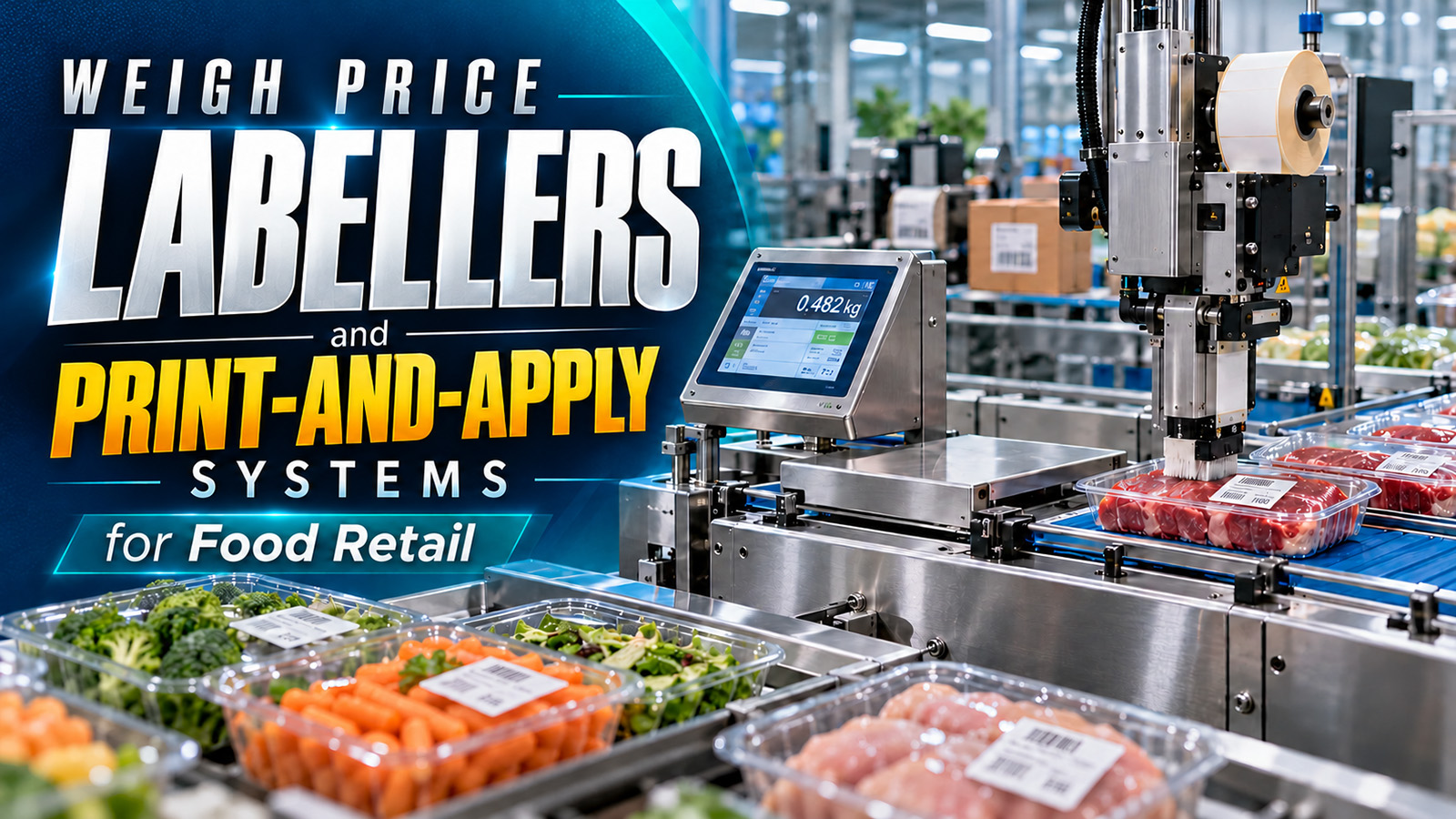
A weigh price labeller measures a pack, accounts for packaging tare, calculates the selling price from the configured unit price, and prints the associated label. Application may be manual or automatic, depending on the equipment.
This process suits variable-weight products such as meat, poultry, fish, cheese and fresh produce, where individual packs contain different quantities and therefore carry different prices.
The tray and wrapping must be excluded through the correct tare. Changing the packaging without reviewing its tare can introduce a pricing error even when the scale measures accurately.
A print-and-apply system prints variable information and automatically attaches the label to suitable packaging. That information may include product identification, batch details, dates or barcodes. The system does not inherently weigh products or calculate prices; those functions need suitable equipment and data integration where required.
Both technologies may be needed within the same operation. A retail tray can require individual weight-based pricing, while its outer carton requires a separate distribution label. Define the information needed at each packaging level before deciding on the equipment arrangement.
Why clear labels can still be incorrect
Better print quality does not automatically mean better labelling accuracy. A sharp barcode can identify the wrong product just as reliably as the correct one.
Errors often begin with product records. Similar descriptions can lead to incorrect selection. An outdated unit price may remain active at one station. A packaging change may leave the previous tare in place. These are information-control problems that a replacement printhead will not solve.
Pack handling introduces different risks. Trays arriving too close together may disrupt weighing or application. Moving contents can affect weight stability. A label position that works on a rigid carton may be unsuitable for flexible film or a curved lid.
An automatic line must also keep each pack connected to its own weight and label data. Removing a tray between weighing and application must not cause its label to move to the next pack. Check this behaviour during interruptions and restarts, as well as continuous production.
Chilled packaging needs particular attention. Moisture, grease and surface temperature can affect adhesion. More application pressure will not reliably compensate for an unsuitable adhesive or contaminated surface. Test labels on actual packs through representative storage and handling.
Measure usable output rather than advertised speed
A common buyer mistake is comparing machines mainly by their maximum packs-per-minute rating. That number does not show how the equipment performs with your products, label lengths, changeovers and operator routine.
A line planned to run at 30 packs per minute experiences six five-minute interruptions. The resulting 30 minutes represents 6.25% of an eight-hour production window and 900 packs of potential capacity at the planned rate.
This is an illustrative calculation, not an industry benchmark or a guaranteed loss or improvement.
The operational cost can continue after the conveyor restarts. Staff may need to inspect held stock, remove incorrect labels and verify reworked packs. If records cannot establish when an error began, the inspection scope becomes larger.
A supermarket preparation room running many short batches may benefit more from straightforward, controlled changeovers than additional peak speed. A central packing facility running longer batches may prioritise continuous feeding, consumable capacity and inspection integration.
Compare correctly labelled packs released during a representative period. Include routine roll changes and product changes. Record rejected and reworked packs separately so that repeated handling does not inflate the apparent output.
Control changeovers, exceptions and maintenance
Each product record should link the correct description, unit price, tare, barcode format and approved artwork. Make the active product easy to recognise, and restrict changes to authorised personnel. Date settings should follow the approved product and food-safety process.
After a product or packaging change, inspect the first pack before releasing the batch. Confirm its identity, weight basis, calculated price, dates and barcode response. Where checkout compatibility matters, test the intended retail system rather than relying only on a successful handheld scan.
Agree on the response to predictable faults:
- A pack cannot be weighed reliably or arrives with insufficient spacing.
- A label is missing, unreadable or incorrectly positioned.
- Required product information becomes unavailable.
- Production stops with packs between weighing and label application.
Where automatic rejection is fitted, confirm that the affected pack actually leaves the accepted product stream. Rejected packs need a controlled rework route and a clear release check.
Maintenance access also affects daily reliability. Operators need safe access to consumables, sensors, printheads and label paths. Confirm compatibility with the cleaning procedure; stainless-steel construction alone does not establish washdown suitability.
What to prove before accepting the equipment
When evaluating DIGI equipment, use representative packs and confirm the functions of the proposed model and configuration. Identify which tasks are included, which need optional equipment, and which depend on integration with existing systems.
For facilities in the UAE, Saudi Arabia and Oman, reproduce the actual temperature conditions around the labelling station. A chilled tray entering a warmer room may behave differently from a dry demonstration sample. Check adhesion and readability after storage as well as immediately after application.
Where bilingual artwork is required, assess the complete layout at its intended size. Keep descriptions readable and preserve barcode proportions and clear space. Confirm applicable label-content and trade-weighing requirements for the intended market separately.
Run the smallest and largest packs, difficult surfaces and frequent changeovers during acceptance. Include a roll replacement, an interruption and a controlled restart. Let the operating team perform routine tasks so the trial reflects normal working conditions.
The deciding question is whether your team can consistently release correctly weighed, priced and identified packs throughout a normal shift—including the changes and interruptions that happen every day.


GET A QUOTE
Tell us about your business requirement, one of our technical expert will be in touch with you soon..!
NEW PRODUCTS ALERTS