SUNMIX Spiral Mixers for Bakery Labor Shortages
Labor pressure is no longer a temporary challenge for bakeries across the UAE, Saudi Arabia, and Oman. Skilled dough handlers are harder to retain, wage structures are tightening under regulatory oversight, and production schedules are becoming tighter. At the same time, demand from supermarkets, hotels, quick-service restaurants, and foodservice chains continues to grow.
Many bakeries still rely on manual kneading or semi-mechanized processes. When an experienced operator is absent, batch quality often changes. Hydration varies slightly. Gluten development becomes inconsistent. Mixing cycles stretch longer than planned. During peak production hours, these small variations gradually turn into real production delays.
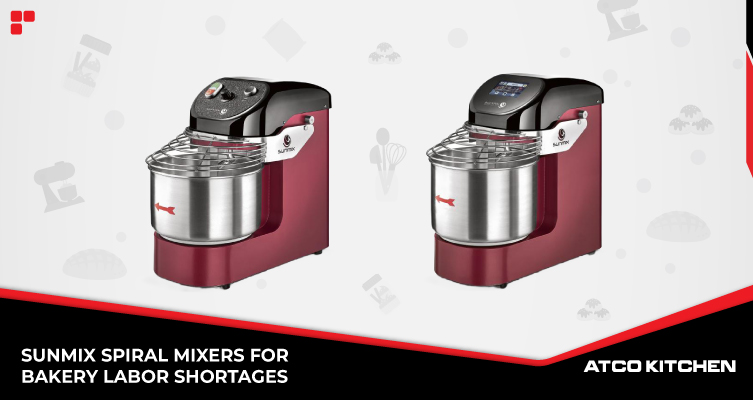
SUNMIX Spiral Mixers provide a structured way to reduce operator dependency while maintaining dough strength, consistency, and workflow discipline. The objective is not to remove people from the process, but to stabilize production so smaller teams can manage higher volumes without compromising dough quality or production timing.
Why Labor Shortages Are Affecting Dough Production More Than Expected
Dough preparation is not simply a mechanical step. It requires timing awareness, temperature monitoring, ingredient balance, and controlled mixing intensity. In GCC climates, ambient heat introduces additional challenges. When production areas warm up, friction heat increases during mixing cycles. Excessive heat can weaken gluten networks, while under-mixed dough results in poor structure and inconsistent crumb.
When bakery teams operate with limited staff, several operational issues begin to appear:
How Spiral Mixing Reduces Operator Dependency
A spiral mixers is designed specifically for dough development. Unlike planetary mixers, the spiral hook rotates while the bowl turns simultaneously. This movement creates a controlled folding and stretching action that strengthens gluten without generating excessive friction heat.
Structured spiral mixing provides several operational advantages:
Operational Benefits in GCC Production Conditions
Bakeries across the Gulf region often operate extended production hours to supply supermarkets, restaurants, and hospitality groups. Equipment used in these environments must tolerate continuous workloads without instability.
Spiral mixers designed for commercial bakeries maintain stable bowl rotation and consistent motor performance during continuous batching. This stability becomes particularly important in warm climates where dough temperature must remain controlled.
Consistent dough development improves several downstream processes:
Top 10 Practical Impacts of Structured Spiral Mixing
Real Production Scenario in GCC Bakeries
Many supermarket central kitchens in the region produce several dough batches every day for burger buns, Arabic bread, pizza bases, and pastry items. When manual kneading varies between shifts, fermentation timing becomes unpredictable. This affects downstream equipment such as dough dividers, proofers, and ovens.
Stabilizing the mixing stage ensures that dough structure remains consistent before entering the next stages of processing. Controlled spiral mixing helps maintain predictable production flow even when staffing levels fluctuate.
Common Mistakes Bakeries Make Without Structured Mixing Systems
Many bakeries attempt to address labor shortages simply by extending working hours or assigning additional manual tasks to existing staff. This approach often increases fatigue and production inconsistency rather than solving the root problem.
Common operational mistakes include:
Addressing Rising Costs Without Expanding Headcount
Labor regulations across the GCC continue to evolve, affecting visa structures, accommodation requirements, and workforce planning. Expanding staff numbers is not always the most efficient path forward for bakery operators.
Structured mixing systems allow bakeries to stabilize production without increasing workforce size. Skilled bakers can concentrate on formulation, quality control, and production planning rather than repetitive physical mixing tasks.
ATCOKITCHEN supports bakeries transitioning from manual dough preparation to controlled spiral mixing systems that maintain torque stability, consistent bowl movement, and reliable batch development for bread, pastry, and pizza applications.
Planning Equipment Decisions for Long-Term Production Stability
Bakery managers evaluating mixing equipment should look beyond capacity specifications alone. Operational reliability depends on several factors:
SUNMIX Spiral Mixers represent a shift from operator-dependent kneading toward controlled and repeatable dough development. For bakeries managing workforce pressure and rising operational costs, that shift can significantly improve production reliability and long-term stability.
Many bakeries still rely on manual kneading or semi-mechanized processes. When an experienced operator is absent, batch quality often changes. Hydration varies slightly. Gluten development becomes inconsistent. Mixing cycles stretch longer than planned. During peak production hours, these small variations gradually turn into real production delays.
SUNMIX Spiral Mixers provide a structured way to reduce operator dependency while maintaining dough strength, consistency, and workflow discipline. The objective is not to remove people from the process, but to stabilize production so smaller teams can manage higher volumes without compromising dough quality or production timing.
Why Labor Shortages Are Affecting Dough Production More Than Expected
Dough preparation is not simply a mechanical step. It requires timing awareness, temperature monitoring, ingredient balance, and controlled mixing intensity. In GCC climates, ambient heat introduces additional challenges. When production areas warm up, friction heat increases during mixing cycles. Excessive heat can weaken gluten networks, while under-mixed dough results in poor structure and inconsistent crumb.
When bakery teams operate with limited staff, several operational issues begin to appear:
- Manual kneading cycles become inconsistent.
- Hydration stages are rushed during peak production.
- Dough temperature monitoring becomes irregular.
- Cleaning and sanitation cycles are delayed.
- Preventive maintenance checks are skipped.
How Spiral Mixing Reduces Operator Dependency
A spiral mixers is designed specifically for dough development. Unlike planetary mixers, the spiral hook rotates while the bowl turns simultaneously. This movement creates a controlled folding and stretching action that strengthens gluten without generating excessive friction heat.
Structured spiral mixing provides several operational advantages:
- Defined low-speed and high-speed mixing cycles.
- Repeatable hydration and gluten development stages.
- Stable torque performance across different dough weights.
- Reduced reliance on operator judgment during busy shifts.
Operational Benefits in GCC Production Conditions
Bakeries across the Gulf region often operate extended production hours to supply supermarkets, restaurants, and hospitality groups. Equipment used in these environments must tolerate continuous workloads without instability.
Spiral mixers designed for commercial bakeries maintain stable bowl rotation and consistent motor performance during continuous batching. This stability becomes particularly important in warm climates where dough temperature must remain controlled.
Consistent dough development improves several downstream processes:
- Uniform fermentation and proofing behavior.
- Predictable baking times.
- Lower product rejection rates.
- Reduced ingredient waste.
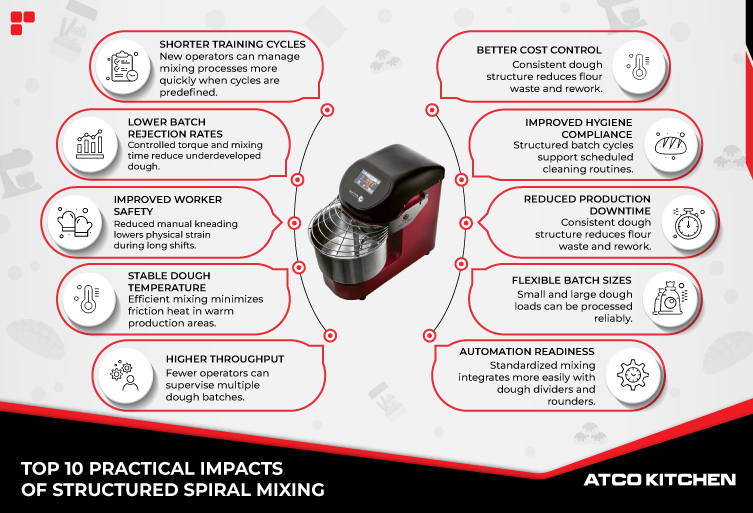
Top 10 Practical Impacts of Structured Spiral Mixing
- Shorter Training Cycles – New operators can manage mixing processes more quickly when cycles are predefined.
- Lower Batch Rejection Rates – Controlled torque and mixing time reduce underdeveloped dough.
- Improved Worker Safety – Reduced manual kneading lowers physical strain during long shifts.
- Stable Dough Temperature – Efficient mixing minimizes friction heat in warm production areas.
- Higher Throughput – Fewer operators can supervise multiple dough batches.
- Better Cost Control – Consistent dough structure reduces flour waste and rework.
- Improved Hygiene Compliance – Structured batch cycles support scheduled cleaning routines.
- Reduced Production Downtime – Stable dough quality prevents delays in proofing and baking stages.
- Flexible Batch Sizes – Small and large dough loads can be processed reliably.
- Automation Readiness – Standardized mixing integrates more easily with dough dividers and rounders.
Real Production Scenario in GCC Bakeries
Many supermarket central kitchens in the region produce several dough batches every day for burger buns, Arabic bread, pizza bases, and pastry items. When manual kneading varies between shifts, fermentation timing becomes unpredictable. This affects downstream equipment such as dough dividers, proofers, and ovens.
Stabilizing the mixing stage ensures that dough structure remains consistent before entering the next stages of processing. Controlled spiral mixing helps maintain predictable production flow even when staffing levels fluctuate.
Common Mistakes Bakeries Make Without Structured Mixing Systems
Many bakeries attempt to address labor shortages simply by extending working hours or assigning additional manual tasks to existing staff. This approach often increases fatigue and production inconsistency rather than solving the root problem.
Common operational mistakes include:
- Relying entirely on manual timing for mixing cycles.
- Ignoring torque limits, which stresses motors and components.
- Overloading mixing bowls to compensate for limited staff.
- Skipping dough temperature checks during busy shifts.
- Underestimating the cost impact of inconsistent dough quality.
Addressing Rising Costs Without Expanding Headcount
Labor regulations across the GCC continue to evolve, affecting visa structures, accommodation requirements, and workforce planning. Expanding staff numbers is not always the most efficient path forward for bakery operators.
Structured mixing systems allow bakeries to stabilize production without increasing workforce size. Skilled bakers can concentrate on formulation, quality control, and production planning rather than repetitive physical mixing tasks.
ATCOKITCHEN supports bakeries transitioning from manual dough preparation to controlled spiral mixing systems that maintain torque stability, consistent bowl movement, and reliable batch development for bread, pastry, and pizza applications.
Planning Equipment Decisions for Long-Term Production Stability
Bakery managers evaluating mixing equipment should look beyond capacity specifications alone. Operational reliability depends on several factors:
- Ability to maintain torque stability during continuous production.
- Resistance to temperature fluctuations in warm environments.
- Programmable mixing stages for consistent dough development.
- Reduced manual handling during mixing cycles.
- Compatibility with future automation equipment.
SUNMIX Spiral Mixers represent a shift from operator-dependent kneading toward controlled and repeatable dough development. For bakeries managing workforce pressure and rising operational costs, that shift can significantly improve production reliability and long-term stability.


GET A QUOTE
Tell us about your business requirement, one of our technical expert will be in touch with you soon..!
PROCEED
NEW PRODUCTS ALERTS