Liquid Filling Lines for Food & Beverage Manufacturers: Piston Fillers, Dosers & Blow Moulding Systems
A filling machine may be capable of producing thousands of bottles per hour, yet production targets can still be missed.
Operators make frequent adjustments. Fill levels become inconsistent. Bottles are rejected during inspection. Maintenance teams spend valuable time troubleshooting recurring issues.
In many food and beverage facilities, the problem is not always a single machine. The challenge is how the entire liquid filling line performs as a connected production system.
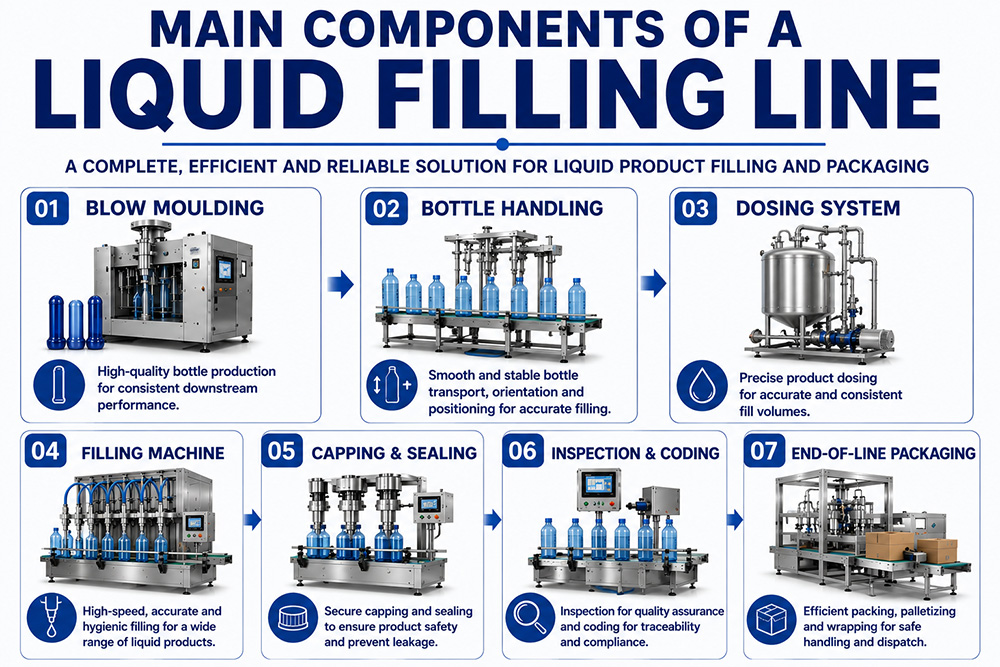
Bottle manufacturing, dosing accuracy, filling consistency, capping, inspection, and end-of-line packaging all influence final output. When one process becomes unstable, the whole line feels the impact.
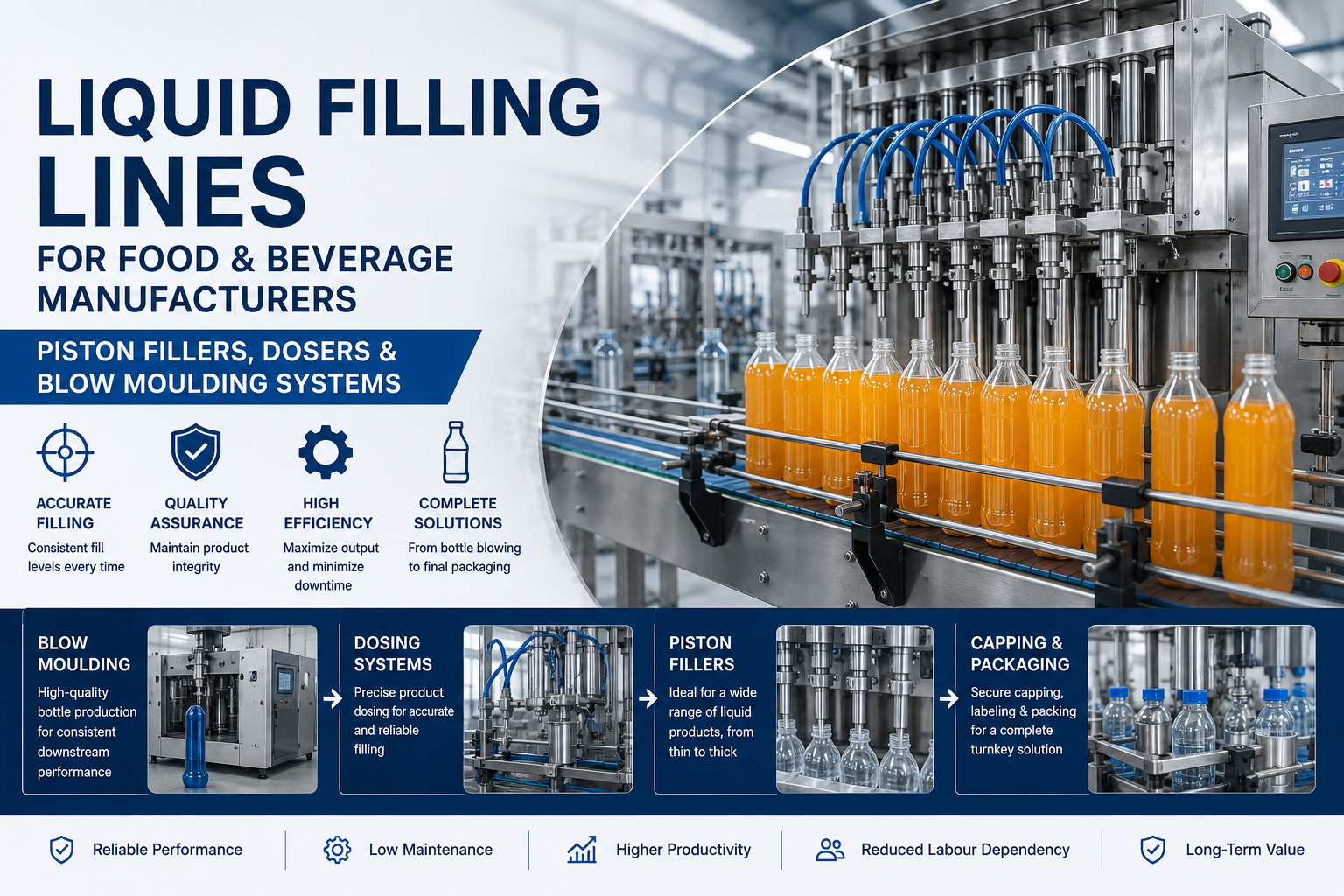
A liquid filling line is an integrated production system used to fill liquids into bottles, jars, containers, or other packaging formats before capping, labelling, inspection, and final packing.
Depending on the product and production requirement, a filling line may include bottle manufacturing equipment, product feeding systems, filling machines, dosing systems, capping equipment, inspection systems, coding machines, labellers, and end-of-line packaging solutions.
These systems are commonly used for water, fruit juices, dairy beverages, cooking oils, sauces, ketchup, syrups, concentrates, honey, and other liquid or viscous food products.
The objective is simple: deliver consistent product quantity, maintain package quality, and keep production moving efficiently.
Many filling line problems do not appear suddenly. They build slowly through small inefficiencies that operators manage every day.
- Product giveaway caused by overfilling
- Underfilled containers that create quality or compliance concerns
- Bottle variation from inconsistent blow moulding
- Conveyor jams and unstable bottle movement
- Capping failures caused by poor bottle neck alignment
- Label misalignment and higher rejection rates
These issues reduce output even when the main filling machine appears to be running.
Many purchasing decisions focus heavily on machine speed. Bottles per minute and containers per hour are easy numbers to compare, but they do not always explain real production performance.
A line operating at 85% speed with stable performance may outperform a faster line that experiences repeated stoppages, product giveaway, quality issues, and operator intervention.
Poor filling accuracy creates hidden costs through product loss, additional quality inspections, rejected containers, rework, and delayed dispatch schedules.
Even a small overfill can become expensive when thousands of bottles are produced every day. For a plant filling 40,000 bottles daily, a few millilitres of overfill per bottle can become a significant monthly product loss.
This is why experienced production teams ask whether the line can hold stable filling accuracy during real conditions such as temperature variation, viscosity change, product changeover, cleaning, and long production runs.
Piston Fillers
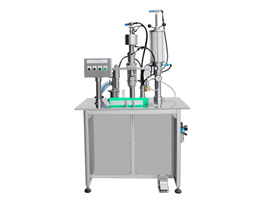
Suitable for accurate volumetric filling of sauces, honey, syrups, creams, mayonnaise, dressings, and other viscous food products.
Dosers
Help control quantity consistency, reduce giveaway, and support net content accuracy across bottles, jars, pouches, and containers.
Blow Moulding
Produces bottles from preforms. Bottle shape, volume, neck finish, and base stability can directly affect downstream filling performance.
Piston fillers are widely used because they provide reliable volumetric filling for products with varying viscosities. Unlike gravity filling systems, piston fillers mechanically control product movement, allowing more consistent filling performance.
They are particularly useful for sauces, dressings, honey, mayonnaise, syrups, creams, concentrated food products, and other liquids that do not flow easily.
For manufacturers processing viscous products, accurate filling helps reduce waste while maintaining product consistency across production batches.
However, piston fillers must be selected based on product behaviour, filling volume, number of filling heads, cleaning requirements, container shape, and expected production speed. A machine suitable for thin juice may not be suitable for thick sauce or honey.
A filling machine can only perform as accurately as the dosing system feeding it. Dosers determine how much product enters each package.
If dosing accuracy drifts because of viscosity changes, temperature fluctuations, ingredient settling, equipment wear, or inconsistent product preparation, product quality can quickly suffer.
One common mistake is assuming that filling problems always originate from the filler itself. In reality, inaccurate dosing often contributes significantly to filling inconsistencies.
For this reason, many modern food and beverage facilities place increasing importance on process monitoring, product preparation, and filling control throughout the production cycle.
Bottle production is often treated as a separate operation from filling. On the production floor, both processes are closely connected.
Blow moulding systems produce bottles by heating and expanding PET preforms into their final shape. When bottle dimensions vary outside acceptable tolerances, several downstream issues may appear.
- Uneven fill appearance
- Cap alignment issues
- Bottle instability on conveyors
- Labelling problems
- Higher rejection rates
This is why liquid packaging systems should be evaluated as a complete process rather than individual machines.
Different food and beverage products behave differently during filling. Viscosity, foam generation, temperature, particulates, and container type all influence machine selection.
| Product Type | Typical Filling Method | Key Consideration |
|---|---|---|
| Water | Gravity Filling | High-speed filling with stable flow |
| Juice | Gravity or Overflow Filling | Foam control and visual fill consistency |
| Cooking Oil | Pump Filling | Clean transfer and controlled flow |
| Honey | Piston Filling | High viscosity and accurate volume control |
| Ketchup and Sauces | Piston Filling | Thick product handling and filling repeatability |
| Mayonnaise and Creams | Piston Filling | Viscous product control and clean filling |
Selecting the correct filling technology depends on product characteristics, container type, required accuracy, cleaning requirements, and expected production output.
| Filling Technology | Typical Applications | Key Consideration |
|---|---|---|
| Gravity Filling | Water, juices, low-viscosity liquids | Best for free-flowing products |
| Piston Filling | Sauces, honey, syrups, creams | Suitable for viscous products and accurate volume control |
| Pump Filling | Cooking oils, specialty liquids, medium-viscosity products | Useful where product flow needs controlled transfer |
| Overflow Filling | Transparent liquids requiring uniform fill appearance | Helps maintain consistent visual fill level |
Food and beverage manufacturers in the UAE, Saudi Arabia, Oman, and the wider Gulf region often face growing production demand, labour availability challenges, high-temperature operating conditions, export requirements, and stronger quality expectations. These conditions make operational stability more important than simple machine speed.
Many manufacturers evaluate equipment based on the purchase cost and rated output. In real production, long-term performance depends on how the full line behaves during daily operation.
Production teams should review downtime frequency, changeover duration, maintenance access, spare parts requirements, operator skill level, cleaning time, bottle quality, product loss, and future expansion capacity.
In practical factory conditions, actual efficiency can be 15% to 30% lower than theoretical machine capacity when the line is not properly balanced. A filler rated for high output cannot achieve that output consistently if bottle feeding, capping, inspection, or packing becomes a bottleneck.
This is where proper line design becomes important. Evaluating machine interaction helps production teams identify where many filling and packaging problems actually start.
Before investing in a liquid filling and packaging system, manufacturers should assess several practical considerations.
- What products will be filled?
- How many containers are required per hour?
- What filling accuracy is required?
- Will product viscosity vary during production?
- What bottle sizes and packaging formats will be used?
- How often will product or bottle changeovers occur?
- Is future production expansion likely?
These questions help procurement, production, and maintenance teams evaluate the complete process, not just one machine specification.
The strongest filling lines are not necessarily the fastest. They are the systems that consistently maintain product quality, filling accuracy, operational stability, and predictable output under real production conditions.
For many production managers, the most important question is not only how many bottles a machine can fill per hour.
Can the complete process continue delivering the required quality, uptime, and production performance as demand grows over the coming years?


GET A QUOTE
Tell us about your business requirement, one of our technical expert will be in touch with you soon..!
NEW PRODUCTS ALERTS