Inside Modern Warehouse Automation: Conveyors, Sortation & AMRs
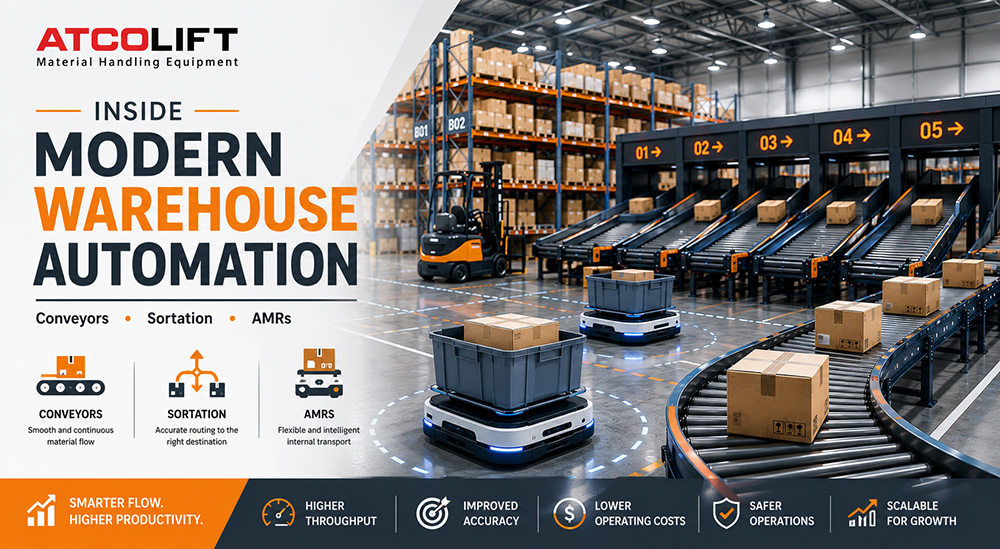
A busy warehouse rarely slows down because of one big problem. More often, the delay starts in small places. A loaded pallet waits near the dispatch area. Cartons are ready for packing, but the next zone is already full. Operators walk long distances to move totes. A forklift is available, but it is tied up in another aisle. Orders are picked, but sorting is still manual, so dispatch lanes become crowded.
This is where modern warehouse automation becomes important. It is not simply about adding conveyors, sortation systems, or autonomous mobile robots. It is about improving the movement of goods across the complete operation, from receiving to storage, picking, packing, sorting, and dispatch.
For warehouses, factories, logistics hubs, cold stores, retail distribution centres, and industrial facilities across the UAE, Saudi Arabia, Oman, and the wider GCC, automation is becoming more relevant because space, labour, time, and accuracy are under pressure. Fast delivery expectations are rising, but many facilities still depend on manual movement, forklifts for every internal transfer, and operators making repeated decisions during every shift.
Conveyors
Create controlled movement between fixed warehouse zones.
Sortation Systems
Route cartons, parcels, totes, and orders to the right destination.
AMRs
Add flexible automated transport where routes may change.
Why Warehouse Flow Breaks Down
Most warehouse flow problems are not caused by slow workers. They are caused by poor system design. When products do not have a clear movement path, people and machines begin to compensate. Forklifts travel longer distances. Pallet trucks are used for tasks they were not selected for. Operators wait at packing stations. Dispatch teams search for the right cartons or pallets. Aisles become blocked because goods are staged in the wrong place.
In manual operations, every transfer needs a person, a machine, space, and time. If one of these is not available, the flow stops. During peak hours, this creates a chain reaction. Receiving delays affect storage. Storage delays affect picking. Picking delays affect packing. Packing delays affect sorting and dispatch.
A common mistake is trying to solve these problems by adding more forklifts or more labour without studying the flow. Extra equipment can help in some cases, but it can also increase traffic, congestion, battery charging demand, fuel cost, maintenance load, and operator coordination issues.
Warehouse automation works best when it is used to remove repeated movement, reduce waiting time, and create a more predictable path for goods.
How Conveyors Improve Material Movement
Conveyors are often the foundation of warehouse automation systems because they create a fixed and controlled route for goods. Instead of using forklifts, pallet trucks, or manual labour for every internal movement, conveyors help move cartons, totes, parcels, crates, bags, or pallets between specific points.
For example, in a distribution centre, picked cartons may need to move from the picking area to packing, then to weighing, labelling, sorting, and dispatch. If this movement is manual, workers spend a large part of the shift walking, pushing, lifting, or waiting. A conveyor system reduces this wasted movement and keeps goods moving in one direction.
The benefit is not only speed. Conveyors also improve control. They help managers design a cleaner process where goods move through defined stages. This reduces confusion, improves visibility, and supports better planning during peak periods.
However, conveyors must be selected carefully. A conveyor that is too short, too slow, too narrow, or poorly positioned may simply move the bottleneck to another area. The system must match the product size, load weight, handling frequency, available floor space, turning points, accumulation requirement, and future expansion plan.
In GCC warehouses, temperature, dust, operating hours, and maintenance access should also be considered. A conveyor system in a high-volume logistics hub or industrial facility may run for long hours, so durability, spare parts availability, cleaning access, and safe operator interaction are important.
Where Sortation Systems Add Real Value
Sortation systems become important when a warehouse handles many orders, destinations, routes, stores, customers, or dispatch lanes. The main purpose of sortation is to direct each item, carton, tote, or parcel to the correct location with less manual decision-making.
In manual sorting, an operator may scan a label, read an order, identify the destination, and place the item in the correct area. This works at low volume. But when order volumes increase, mistakes become more likely. Wrong sorting can lead to wrong dispatches, missed delivery windows, rework, customer complaints, and extra handling.
An automated sortation system uses information from barcode scanning, weighing, dimensioning, warehouse software, or order data to route goods correctly. Depending on the operation, this can support e-commerce fulfilment, courier operations, retail distribution, spare parts handling, manufacturing dispatch, cold chain logistics, and food distribution.
The hidden cost of poor sorting is often underestimated. A wrongly sorted carton does not only affect one order. It may require checking, repacking, relabelling, rescheduling, and sometimes reverse logistics. During busy shifts, this also distracts supervisors and creates pressure on dispatch teams.
Sortation should not be viewed only as a high-speed system. Even a moderate-speed sortation setup can create major value if it reduces manual handling, improves accuracy, and keeps dispatch lanes organized.
How AMRs Support Flexible Warehouse Automation
Autonomous Mobile Robots, or AMRs, are useful where fixed automation is not suitable for every movement. Unlike conveyors, AMRs do not need a fixed physical path. They can move materials between different points using sensors, mapping, and intelligent navigation.
This flexibility is valuable in warehouses where layouts change, order profiles vary, or different departments need support at different times of the day. AMRs can move totes, cartons, components, tools, or finished goods between receiving, storage, picking, packing, production, inspection, and dispatch areas.
AMRs are especially useful when operators spend too much time walking. In many warehouses, walking time is one of the biggest productivity losses. A picker may spend more time travelling than actually picking. An AMR-assisted workflow can reduce this travel burden and allow operators to focus on picking, checking, packing, or other value-added tasks.
AMRs can also reduce dependence on forklifts for light or medium internal transport. This is useful where forklift traffic creates safety risks, especially near pedestrian zones, packing areas, or narrow aisles.
Still, AMRs are not a replacement for every material handling machine. Heavy pallets, high racking, outdoor yards, uneven floors, and intensive loading operations may still require forklifts, reach trucks, pallet trucks, stackers, or other equipment. The right approach is to understand where AMRs fit inside the total warehouse flow.
Conveyors are better for fixed, repeated, high-volume movement between defined points. AMRs are better for flexible transport where routes, destinations, or workflows may change. Many modern warehouses use both: conveyors for continuous flow and AMRs for flexible internal movement.
Common Selection Mistakes in Warehouse Automation
One common mistake is selecting automation based only on technology, not on the actual warehouse problem. A warehouse may invest in AMRs when the main issue is poor dispatch staging. Another facility may add conveyors when the real problem is inaccurate picking or blocked aisles. Some operations focus on machine speed but ignore loading points, operator movement, software integration, or maintenance access.
Before selecting conveyors, sortation systems, or AMRs, managers should study the real movement of goods during normal and peak shifts. The best system is not always the most advanced one. It is the one that removes the right bottleneck.
- Check the product flow: Understand how goods move from receiving to dispatch.
- Identify the bottleneck: Find where materials wait, slow down, or require repeated handling.
- Review product types: Consider carton size, pallet weight, tote dimensions, fragile items, and cold storage needs.
- Study warehouse traffic: Look at forklift routes, pedestrian movement, aisle width, and dispatch congestion.
- Consider software integration: Automation should connect with scanning, WMS, order data, or tracking where needed.
- Plan for maintenance: Check access for service, cleaning, spare parts, and downtime recovery.
A technically strong warehouse automation plan should also consider what happens when the system stops. Maintenance access, bypass routes, manual backup procedures, and operator training are important. If a conveyor or sortation line stops during peak dispatch, the warehouse must still have a safe and practical recovery method.
Safety, Maintenance, and Operating Cost Considerations
Automation can improve safety, but only when it is designed correctly. Conveyors need guarding, emergency stops, safe access points, and clear operator zones. Sortation systems need controlled loading and unloading areas. AMRs need safe navigation paths, pedestrian awareness, floor condition checks, and proper traffic rules.
In mixed operations, where forklifts, pallet trucks, people, conveyors, and AMRs work in the same facility, traffic planning becomes critical. Poorly planned automation can create new risks if people cross conveyor zones, AMRs enter congested areas, or forklift routes are not separated from automated movement paths.
Maintenance is another important factor. A system that improves speed but is difficult to maintain can create long-term problems. Dust, heat, long operating hours, poor cleaning access, and unavailable spare parts can increase downtime. In the GCC, where many warehouses operate under demanding conditions, maintenance planning should be part of the automation decision from the beginning.
Operating cost should also be reviewed beyond the initial purchase price. The real cost includes installation, controls, software connection, operator training, maintenance, energy use, spare parts, downtime risk, layout changes, and future expansion. A lower-cost system may become expensive if it creates bottlenecks or cannot grow with the business.
When Conveyors, Sortation, and AMRs Work Together
The strongest warehouse automation systems often combine different technologies. Conveyors handle fixed and repeated product flow. Sortation systems route goods to the correct destination. AMRs support flexible movement between changing points. Together, they reduce unnecessary manual handling and create a more structured warehouse operation.
For example, a warehouse may use conveyors to move cartons from picking to packing, a sortation system to direct them to dispatch lanes, and AMRs to move empty totes, replenishment items, or selected goods between zones. In this type of setup, each system solves a specific movement problem.
The goal is not to automate everything. The goal is to automate the right movement. Some tasks still need skilled operators, forklifts, reach trucks, pallet trucks, order pickers, or manual checking. A good automation plan respects the real operation instead of forcing one technology into every process.
ATCOLIFT may be relevant in this discussion where warehouse automation needs to be evaluated alongside material handling equipment, storage systems, loading bay movement, and fleet planning. In many facilities, automation decisions cannot be separated from forklift traffic, racking layout, pallet movement, and dispatch flow.
Practical Evaluation Before Choosing a System
Before investing in warehouse automation systems, decision-makers should ask practical operational questions. These questions help avoid choosing equipment that looks impressive but does not solve the daily problem.
- Where does the delay actually happen? Receiving, storage, picking, packing, sorting, or dispatch?
- What is being moved? Pallets, cartons, totes, parcels, crates, raw materials, or finished goods?
- Is the movement fixed or flexible? Fixed routes may suit conveyors; changing routes may suit AMRs.
- Is the issue speed, accuracy, labour, safety, or space? Each problem may need a different system design.
- Can the warehouse layout support automation? Check floor condition, aisle width, staging areas, power, and access.
- What happens during downtime? A backup process is necessary for busy operations.
- Can the system grow later? Future order volume, SKU growth, and dispatch expansion should be considered.
Modern warehouse automation is most effective when it is planned around real material flow. Conveyors, sortation systems, and AMRs can improve speed, accuracy, safety, and labour productivity, but only when they are matched to the right operational problem.


GET A QUOTE
Tell us about your business requirement, one of our technical expert will be in touch with you soon..!
NEW PRODUCTS ALERTS