How to Set Up a Complete Food Packaging Line: VFFS to Inspection
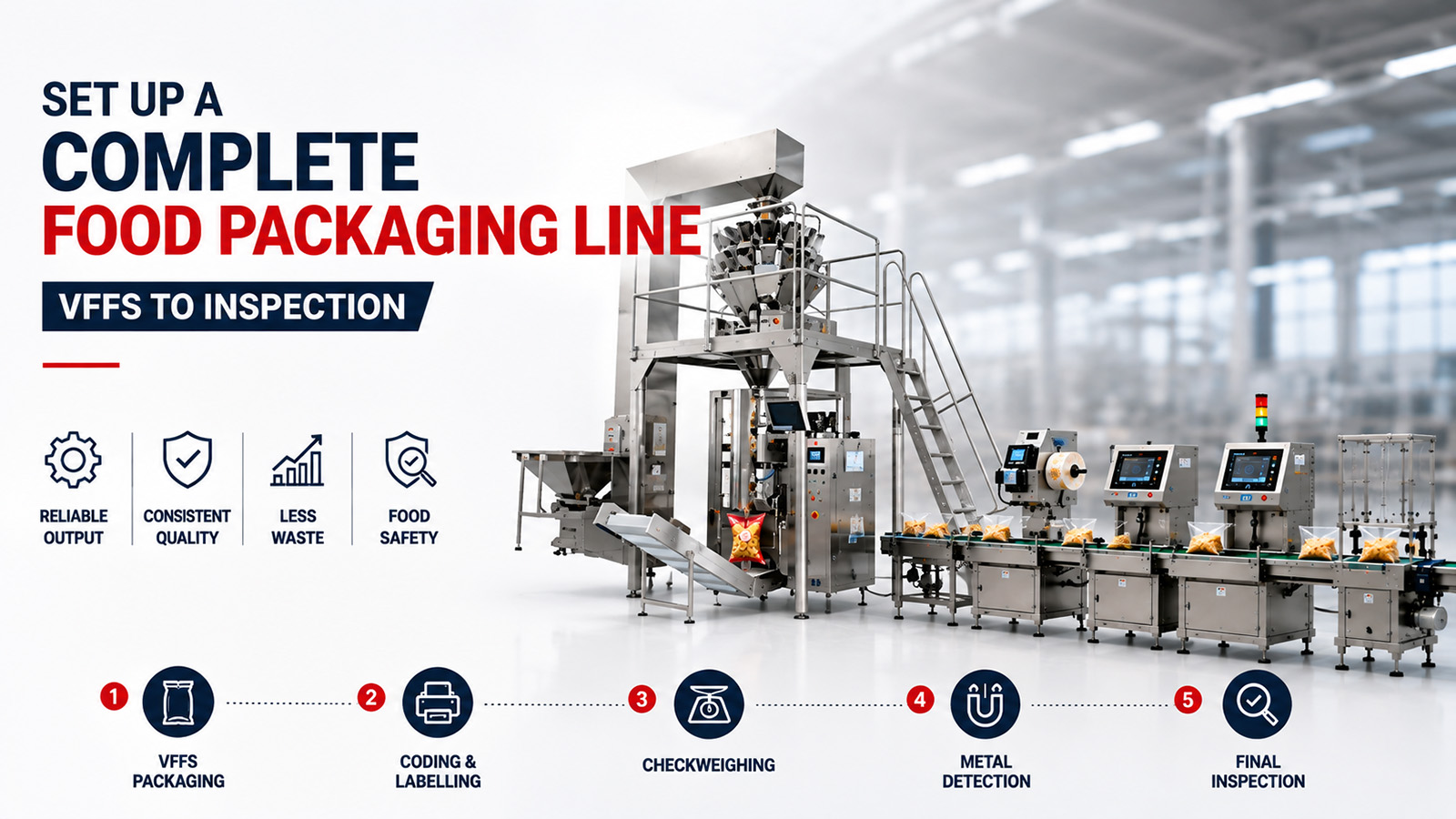
A food packaging line can look straightforward on paper: weigh the product, form the bag, fill it, seal it, print the date and inspect the finished pack. On the factory floor, however, these processes depend heavily on one another.
A VFFS machine capable of 80 packs per minute does not create an 80-pack-per-minute production line if the weighing system regularly struggles to feed it. The same applies downstream. A poorly positioned coder, unstable conveyor or inspection system that cannot handle the incoming pack flow can restrict the entire operation.
Setting up a complete food packaging line therefore starts with understanding the product, required output and complete production flow—not simply selecting a VFFS machine.
Start With the Product, Pack and Required Output
Before deciding on equipment, define what actually needs to leave the packaging area each shift.
Suppose a factory needs to pack 500 g bags for an eight-hour production shift. The useful starting point is not the maximum speed printed on a machine specification sheet. It is the number of finished, acceptable packs required during the available production time.
The product itself then affects almost every equipment decision. Rice, nuts, coffee beans, snacks, frozen vegetables and powders do not behave in the same way during feeding and filling. Free-flowing granules may work well with one weighing method, while fine powders or fragile products require a different approach.
- Product characteristics, including density, flow and fragility
- Required pack weights and bag dimensions
- Packaging film and required seal quality
- Target packs per minute and shift output
- Product changeover and cleaning requirements
- Coding, traceability and inspection requirements
- Available floor space, electrical supply and compressed air
This information creates the operating specification for the complete line. Without it, machinery may be selected individually and expected to work together later. That is where many integration problems begin.
Build the Line Around a Stable Product Flow
In a typical automated food packaging line, the process may follow this sequence:
Labelling, metal detection, checkweighing or other inspection stages can be positioned according to the product, packaging material and quality-control requirements.
Product feeding is easy to underestimate. If an elevator or conveyor cannot maintain a controlled supply to the weighing system, the packaging machine may repeatedly wait for product. Too much product can create another problem by overloading upstream equipment or affecting weighing performance.
The dosing technology must also suit the product. Multihead weighers are commonly used where fast, accurate portioning of suitable food products is required. Auger fillers are often considered for powders, while volumetric systems can suit applications where the product and required accuracy make them appropriate.
The objective is consistent dosing rather than maximum theoretical speed.
This is why small upstream problems deserve attention. They often appear as VFFS downtime even when the packaging machine itself is functioning correctly.
Match the VFFS Machine to the Whole Process
A Vertical Form Fill Seal (VFFS) machine forms packaging film into a bag, receives the measured product and seals the package in a repeating automated cycle. For many dry and frozen food applications, it becomes the central machine around which the rest of the packaging line operates.
Machine selection should consider more than maximum packs per minute. Bag dimensions, film properties, product volume, sealing requirements, filling method and changeover frequency can all influence achievable production speed.
Seal performance is particularly important. Increasing machine speed is of little value if insufficient sealing time or unstable product flow causes weak seals, trapped product or rejected packs.
For plants running several SKUs, changeover time deserves equal attention. Moving between different pack sizes may involve changing film rolls, former sets, recipes, printer settings and inspection parameters.
Saving several minutes on a frequently repeated changeover can sometimes provide more useful production capacity than purchasing a machine with a higher headline speed.
Coding and Labelling Must Keep Up With Production
Once a pack is formed and sealed, it may still need batch information, production dates, expiry or best-before dates, lot identification, barcodes or labels.
Coding is not simply a printing task. It is part of traceability and production control.
The coding technology should be matched to the packaging material, required print information and line speed. The position of the code also matters. Printing close to folds, seals or uneven surfaces can reduce readability and create avoidable quality problems.
Where labels are required, applicator speed and pack presentation become important. Packages must reach the labelling point in a predictable orientation and at suitable spacing. An unstable pack coming from a conveyor can produce inconsistent label placement even when the labelling machine is operating correctly.
Machines cannot compensate indefinitely for an unstable process entering them.
A better approach is to evaluate how the machines communicate, how products transfer between stages and what happens when one machine stops.
For example, if the downstream inspection system stops, does the VFFS machine receive a stop signal? Is there enough conveyor accumulation to prevent an immediate shutdown? What happens to packs already between the machines?
These questions may seem minor during procurement. During production, they directly affect downtime and operator workload.
Inspection Protects More Than Product Quality
Final inspection is where a packaging line confirms that the finished product meets defined requirements before it moves toward secondary packaging, warehousing or dispatch.
Depending on the food and process, this may involve metal detection, checkweighing or other inspection technologies.
A metal detector can identify specified metallic contaminants under defined operating conditions. A checkweigher verifies individual pack weights against established limits and can reject packs outside those parameters.
The important point is to treat inspection as part of the production process rather than simply an end-of-line accessory.
Checkweigher data, for example, can reveal gradual changes in filling performance. If average pack weights begin moving upward, the plant may be giving away more product than necessary. If they move downward, the process may approach the lower acceptable weight limit.
For high-volume production, even a small average overfill can become commercially significant when multiplied across thousands of packs per shift.
Inspection equipment also needs enough capacity for the expected production rate. Running a VFFS machine. close to the maximum capacity of the downstream checkweigher leaves little room for normal fluctuations, pack spacing changes or future increases in output.
Rejection handling deserves attention as well. A reject system should reliably separate affected packs without creating another bottleneck, and factory procedures should define what happens to rejected products afterward.
Design for Real Factory Conditions
A packaging line must eventually fit into a physical production area with operators, raw materials, packaging film, cleaning procedures and maintenance activity.
This becomes particularly relevant in expanding food manufacturing operations across the UAE, Saudi Arabia, Oman and the wider GCC, where companies may be increasing automation while still operating within existing factory layouts.
Space around equipment is often underestimated. A machine that physically fits into the available area may still be difficult to operate if there is insufficient room to replace film rolls, remove forming sets, access electrical panels or clean product-contact areas.
Maintenance access should be reviewed before the layout is approved. A component that takes 20 minutes to replace in an open workshop may take much longer when technicians cannot reach it easily between machines.
Environmental conditions also matter. Temperature, dust, humidity, washdown requirements and the factory's cooling conditions can influence electrical components, packaging films, printers and product behaviour. Equipment specifications should therefore be reviewed against the actual operating environment.
During line planning, ATCOPACK or any machinery integrator involved should ideally receive the production requirements before individual equipment is finalized. This allows feeding, filling, packaging, coding, conveying and inspection stages to be assessed as one process rather than separate purchases.
Evaluate the Complete Line Before Making the Equipment Decision
When comparing packaging-line configurations, procurement teams naturally consider capital cost. Production and maintenance teams usually see a different part of the equation: what happens after commissioning.
A useful evaluation should therefore cover more than purchase price.
- Sustainable packs per minute with the actual product
- Filling accuracy and expected product giveaway
- Film, bag size and SKU changeover requirements
- Cleaning and routine maintenance access
- Compatibility between upstream and downstream machines
- Coding, traceability and inspection requirements
- Availability and replacement time of critical spare parts
- Space for operators, servicing and future line changes
It is also useful to ask what happens during a failure rather than looking only at normal operation.
If the weigher stops, how quickly can the cause be identified? If the coder develops a fault, must the complete packaging line stop? If a sensor fails, is the replacement readily available? Can maintenance personnel access the affected area without dismantling another section of the line?
These questions expose operational risks that rarely appear in machine brochures.
Before approving a complete food packaging line, one practical question is worth asking: Can every stage—from product feeding and VFFS packaging to coding and final inspection—run together reliably at the output the factory actually needs?
If the answer is clear, the line is being evaluated as a production system rather than a collection of machines.


GET A QUOTE
Tell us about your business requirement, one of our technical expert will be in touch with you soon..!
NEW PRODUCTS ALERTS