How Perfume Automatic Packaging Lines Improve Production Stability
Why Accurate Production Data Matters in Modern Manufacturing Facilities
Perfume manufacturing facilities across the UAE, Saudi Arabia, and Oman are expanding rapidly. Private-label fragrance brands, contract fillers, and regional distributors are increasing production volumes to serve both domestic retail markets and export demand. However, higher production targets also introduce operational pressure. Even small disruptions in filling, sealing, bottle handling, or packaging stages can slow the entire production line.
Production instability often begins with manual operations. When operators fill bottles manually, dosing accuracy varies. Bottle positioning may shift during filling. Sealing stages may experience delays when operators handle pumps and collars manually. These variations gradually create downtime, rejected batches, and unpredictable production output.
Perfume Automatic Packaging Lines help stabilize production by automating filling accuracy, bottle handling, sealing, and final packaging processes across the fragrance manufacturing workflow. By connecting multiple machines into a synchronized system, manufacturers reduce variability and maintain predictable production throughput.
Understanding Perfume Automatic Packaging Lines
Perfume Automatic Packaging Lines are integrated production systems designed to handle multiple stages of fragrance packaging automatically. Instead of operating separate standalone machines, these lines connect bottle preparation, filling, sealing, and packaging into a coordinated workflow.
A typical perfume packaging line may include a perfume freezing filter, storage tanks, bottle washer, air cleaning unit, rotary filling machine, crimping machine, pump pipe cutting machine, and overwrapping system. Bottles move through each stage automatically while sensors monitor positioning, filling levels, and machine timing.
Automation allows machines to operate with consistent cycle times. This reduces delays between processes and prevents production bottlenecks. It also generates operational data such as output rate, filling accuracy, and stoppage frequency, helping production managers monitor line performance.
How Measurement Accuracy Improves Production Stability
Stable production depends heavily on measurement accuracy. Fragrance bottles must be filled with precise liquid volumes to meet brand standards and regulatory requirements. Even small deviations can trigger quality control failures.
Automated filling machines use calibrated dosing systems that maintain repeatable filling levels. Bottle positioning systems ensure containers remain stable during filling, reducing spillage. Sealing machines apply uniform pressure to secure pumps and collars properly.
Consistent packaging dimensions also support warehouse operations. Uniform carton packing improves pallet stacking and simplifies shipping calculations. When packaging remains predictable, logistics teams can estimate freight volume and warehouse space more accurately.
Top Operational Impacts of Perfume Automatic Packaging Lines
Operational Challenges When Automation Is Missing
Facilities that rely heavily on manual perfume filling frequently experience unstable production output. Operators may struggle to maintain consistent dosing speed during long shifts. Bottle alignment issues can cause spillage and slow down production lines.
During peak demand periods, manual operations often become bottlenecks. Workers attempt to compensate by increasing speed, which raises the risk of mistakes and product wastage. Over time, this cycle increases downtime and creates quality inconsistencies.
High ambient temperatures in regional warehouses also influence production performance. Heat can affect liquid viscosity and machine components. Automated systems maintain more stable process timing and reduce variability caused by environmental conditions.
Common Mistakes Without Structured Measurement Systems
Key Takeaways
Frequently Asked Questions
Closing Insight for Operations Leaders
Production stability does not come from speed alone. It depends on process consistency, accurate dosing, and coordinated machine operations. Perfume Automatic Packaging Lines provide the structure required to maintain stable production output in fragrance manufacturing environments.
When filling accuracy improves, product waste decreases. When bottle handling becomes automated, workplace safety improves. When packaging dimensions remain consistent, logistics planning becomes more reliable.
For manufacturers planning to expand production capacity, investing in stable automated packaging processes helps maintain efficiency while controlling operational risks.
Perfume manufacturing facilities across the UAE, Saudi Arabia, and Oman are expanding rapidly. Private-label fragrance brands, contract fillers, and regional distributors are increasing production volumes to serve both domestic retail markets and export demand. However, higher production targets also introduce operational pressure. Even small disruptions in filling, sealing, bottle handling, or packaging stages can slow the entire production line.
Production instability often begins with manual operations. When operators fill bottles manually, dosing accuracy varies. Bottle positioning may shift during filling. Sealing stages may experience delays when operators handle pumps and collars manually. These variations gradually create downtime, rejected batches, and unpredictable production output.
Perfume Automatic Packaging Lines help stabilize production by automating filling accuracy, bottle handling, sealing, and final packaging processes across the fragrance manufacturing workflow. By connecting multiple machines into a synchronized system, manufacturers reduce variability and maintain predictable production throughput.
Understanding Perfume Automatic Packaging Lines
Perfume Automatic Packaging Lines are integrated production systems designed to handle multiple stages of fragrance packaging automatically. Instead of operating separate standalone machines, these lines connect bottle preparation, filling, sealing, and packaging into a coordinated workflow.
A typical perfume packaging line may include a perfume freezing filter, storage tanks, bottle washer, air cleaning unit, rotary filling machine, crimping machine, pump pipe cutting machine, and overwrapping system. Bottles move through each stage automatically while sensors monitor positioning, filling levels, and machine timing.
Automation allows machines to operate with consistent cycle times. This reduces delays between processes and prevents production bottlenecks. It also generates operational data such as output rate, filling accuracy, and stoppage frequency, helping production managers monitor line performance.
How Measurement Accuracy Improves Production Stability
Stable production depends heavily on measurement accuracy. Fragrance bottles must be filled with precise liquid volumes to meet brand standards and regulatory requirements. Even small deviations can trigger quality control failures.
Automated filling machines use calibrated dosing systems that maintain repeatable filling levels. Bottle positioning systems ensure containers remain stable during filling, reducing spillage. Sealing machines apply uniform pressure to secure pumps and collars properly.
Consistent packaging dimensions also support warehouse operations. Uniform carton packing improves pallet stacking and simplifies shipping calculations. When packaging remains predictable, logistics teams can estimate freight volume and warehouse space more accurately.
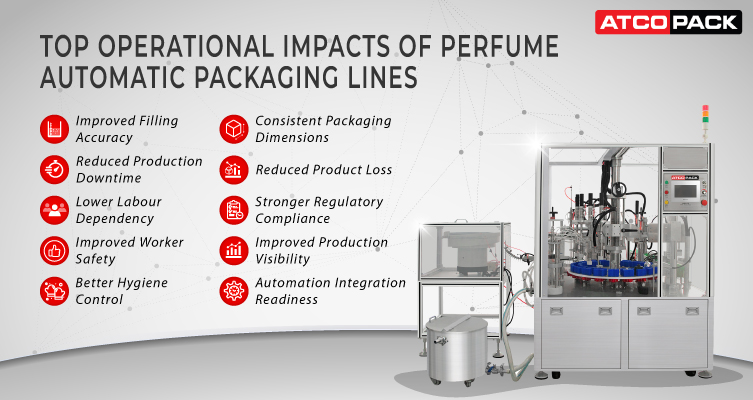
Top Operational Impacts of Perfume Automatic Packaging Lines
- Improved Filling Accuracy
Automated dosing systems maintain consistent liquid volumes, preventing underfilling or overfilling. - Reduced Production Downtime
Integrated machines synchronize bottle movement, minimizing idle time between stages. - Lower Labour Dependency
Automation reduces reliance on manual filling and sealing operators, which helps manage labour shortages. - Improved Worker Safety
Automated bottle transport reduces repetitive handling tasks that can lead to fatigue and injuries. - Better Hygiene Control
Bottle washing and air cleaning machines prepare containers before filling, supporting product quality. - Consistent Packaging Dimensions
Uniform packaging improves carton filling efficiency and warehouse stacking stability. - Reduced Product Loss
Accurate filling and secure sealing minimize liquid spillage during production. - Stronger Regulatory Compliance
Precise dosing and controlled packaging processes help meet international product standards. - Improved Production Visibility
Automated systems generate operational data that helps managers track efficiency and identify bottlenecks. - Automation Integration Readiness
Stable bottle flow enables integration with labeling machines, inspection systems, and case packers.
Operational Challenges When Automation Is Missing
Facilities that rely heavily on manual perfume filling frequently experience unstable production output. Operators may struggle to maintain consistent dosing speed during long shifts. Bottle alignment issues can cause spillage and slow down production lines.
During peak demand periods, manual operations often become bottlenecks. Workers attempt to compensate by increasing speed, which raises the risk of mistakes and product wastage. Over time, this cycle increases downtime and creates quality inconsistencies.
High ambient temperatures in regional warehouses also influence production performance. Heat can affect liquid viscosity and machine components. Automated systems maintain more stable process timing and reduce variability caused by environmental conditions.
Common Mistakes Without Structured Measurement Systems
- Inconsistent Filling Calibration
Manual filling systems often drift from target dosing levels during long production runs. - Untracked Downtime
Without automated monitoring, small stoppages go unnoticed but continue affecting productivity. - Poor Carton Utilization
Inconsistent packaging sizes reduce carton efficiency and increase shipping costs. - Warehouse Space Miscalculation
Irregular packaging dimensions make storage planning more difficult. - Overdependence on Operator Skill
Production quality relies heavily on individual operator experience rather than standardized automation.
Key Takeaways
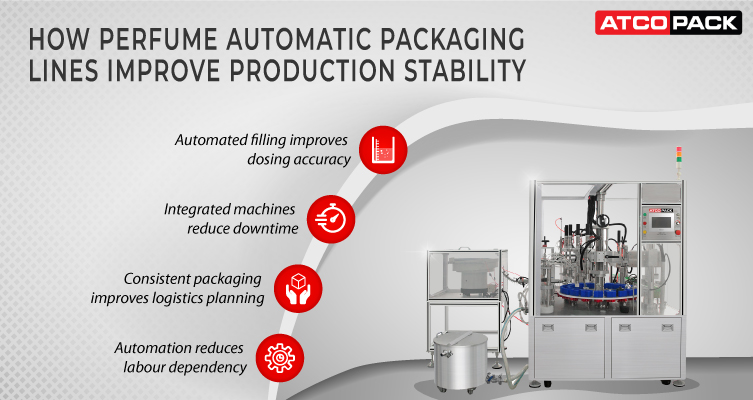
- Automated filling improves dosing accuracy
- Integrated machines reduce downtime
- Consistent packaging improves logistics planning
- Automation reduces labour dependency
Frequently Asked Questions
- What are perfume automatic packaging lines?
They are integrated systems that automate bottle washing, filling, sealing, labeling, and packaging processes in fragrance production. - Why do perfume factories use automated packaging?
Automation improves filling accuracy, reduces labour dependency, and stabilizes production output. - How do automated perfume packaging lines reduce downtime?
Integrated machines synchronize bottle movement between stages, minimizing delays and improving line efficiency.
Closing Insight for Operations Leaders
Production stability does not come from speed alone. It depends on process consistency, accurate dosing, and coordinated machine operations. Perfume Automatic Packaging Lines provide the structure required to maintain stable production output in fragrance manufacturing environments.
When filling accuracy improves, product waste decreases. When bottle handling becomes automated, workplace safety improves. When packaging dimensions remain consistent, logistics planning becomes more reliable.
For manufacturers planning to expand production capacity, investing in stable automated packaging processes helps maintain efficiency while controlling operational risks.


GET A QUOTE
Tell us about your business requirement, one of our technical expert will be in touch with you soon..!
PROCEED
NEW PRODUCTS ALERTS