Food Inspection Systems for Food Manufacturers: Metal Detectors, X-Ray & Checkweighers Compared
A food production line can look stable from outside, but small inspection failures can create serious problems. One missed metal fragment, one underweight pack, or one repeated false reject can turn into customer complaints, rework, rejected shipments, audit issues, or production downtime.
This is why food inspection systems are no longer viewed only as end-of-line safety equipment. In modern factories, metal detectors, X-ray inspection systems, and checkweighers support quality control, brand protection, process improvement, and operational discipline. The challenge is not simply buying an inspection machine. The real challenge is selecting the right technology for the product, packaging, line speed, contamination risk, and compliance expectation.
A counterintuitive point is important here: the most advanced inspection system is not always the most suitable one. A well-selected metal detector may be more practical than an X-ray system for some dry products. A checkweigher may reduce more daily cost than a contaminant detector if giveaway is the main issue. In many production lines, the right answer is not one system, but the correct combination.
Why Food Inspection Fails in Real Factories
Most inspection problems do not begin with the machine. They begin with unclear expectations. A production manager may expect one system to detect every risk. A procurement team may compare only the purchase price. A maintenance team may not be asked about access, calibration, or spare parts. Operators may not be trained to understand false rejects and product effect.
In food manufacturing, inspection performance depends on the product itself. Moisture, salt, temperature, density, packaging material, product shape, and product spacing can all affect accuracy. A frozen product behaves differently from a dry snack. A metallised film pack creates different challenges compared with a plain pouch. A glass jar line has different risks compared with a carton line.
In UAE, Saudi Arabia, Oman, and wider GCC food factories, production pressure is also a major factor. Many plants run long shifts, handle multiple SKUs, and supply supermarkets, hotels, catering companies, export customers, and private-label buyers. In this environment, inspection systems must support safety and compliance without creating unnecessary bottlenecks.
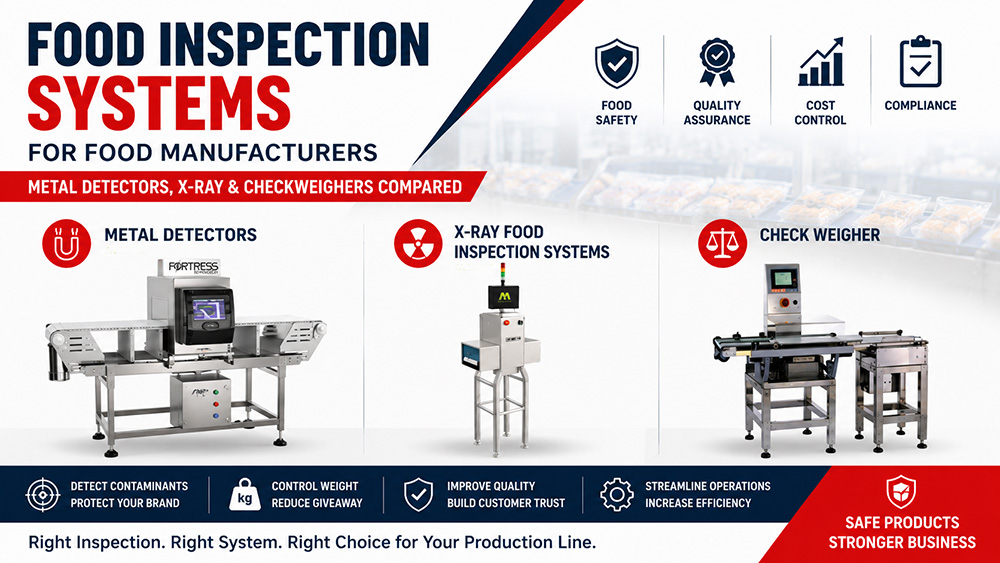
Metal Detectors: Reliable Protection Against Metallic Contamination
Metal detectors are widely used in food processing and packaging because metallic contamination is one of the most common and serious risks. They can detect ferrous metals, non-ferrous metals, and stainless steel depending on product conditions, aperture size, sensitivity setting, and calibration quality.
They are commonly installed after forming, filling, sealing, wrapping, or packing. In some processes, they are used before packaging to inspect loose or bulk products. Typical applications include bakery items, snacks, spices, grains, confectionery, frozen foods, meat products, powders, and packaged ready-to-eat products.
The main strength of a metal detector is practicality. It is usually easier to install, easier to validate, and more cost-effective than X-ray inspection. For many factories, especially those dealing with non-metallised packaging and clear metallic contamination risks, a metal detector remains the most sensible first inspection step.
The limitation is that a metal detector only detects metal. It will not detect glass, stone, bone, dense plastic, or missing product components. Sensitivity can also be affected by product effect, especially in wet, salty, conductive, or warm products. This is why testing with real product samples is important before final selection.
- Metal contamination is the main foreign body risk.
- The product and packaging allow stable sensitivity.
- The line requires a practical, proven, and cost-controlled inspection method.
- Retailer or customer requirements specify metal detection validation.
X-Ray Inspection: Wider Detection for Complex Risks
X-ray inspection systems are used when the contamination risk is broader than metal. They can detect many dense foreign bodies such as metal, glass, stone, mineral fragments, calcified bone, and some dense plastics. They are especially useful where product safety requirements are strict or where packaging makes metal detection difficult.
X-ray systems are often selected for glass jars, cans, trays, cartons, pouches with metallised film, frozen products, meat, seafood, dairy, ready meals, and high-value export products. Besides contaminant detection, some X-ray systems can also check fill level, missing items, broken product, seal area contamination, and product count depending on the configuration.
The advantage is wider inspection capability. The trade-off is higher investment, more technical evaluation, and greater need for correct setup. X-ray inspection is powerful, but it still has limits. It detects based on density difference, so very low-density contaminants may not always be detected. Product thickness, overlapping items, and packaging shape also influence performance.
A factory should not select X-ray only because it sounds more advanced. The better question is: what contaminants are realistic in this process? If glass, stone, dense bone, or metallised packaging are genuine concerns, X-ray may be justified. If the risk is mainly metal, a properly selected metal detector may be enough.
Checkweighers: Controlling Weight, Giveaway, and Compliance
A checkweigher does not detect foreign bodies. Its job is to weigh every pack while it moves on the conveyor and reject packs that fall outside the accepted weight range. This makes it one of the most important inspection systems for cost control and legal compliance.
In food manufacturing, weight errors create two different problems. Underweight packs may fail retailer, export, or legal requirements. Overweight packs create product giveaway, which slowly reduces margins every day. For high-volume factories, even a small overweight average can become a large monthly loss.
Checkweighers are commonly installed after filling, sealing, wrapping, or labelling. In some lines, feedback from the checkweigher can help operators adjust filling machines before the problem becomes large. This is especially useful in powders, granules, snacks, frozen foods, liquids, and portioned products where fill variation can drift during production.
Typical inline checkweighers can handle a wide range of speeds, from moderate manual-fed lines to high-speed automatic packing lines. The actual performance depends on pack length, conveyor stability, product spacing, weight range, and the accuracy required. A poorly spaced product flow can reduce weighing accuracy even if the checkweigher itself is technically capable.
Comparing the Three Systems
| System | Main Purpose | Best Used When | Key Limitation |
|---|---|---|---|
| Metal Detector | Detects metallic contamination. | Metal is the main foreign body risk and packaging allows stable detection. | Does not detect non-metal contaminants. |
| X-Ray Inspection | Detects dense foreign bodies and some product defects. | Glass, stone, bone, metallised packaging, or complex product risks are involved. | Higher investment and application-specific testing required. |
| Checkweigher | Controls pack weight and rejects underweight or overweight packs. | Weight compliance, giveaway control, and filling accuracy are important. | Does not detect contaminants. |
In many factories, these systems are not competitors. They are part of a quality control strategy. A snack line may use a metal detector and checkweigher. A glass jar sauce line may use X-ray and checkweighing. A frozen meat line may require X-ray because bone risk is more relevant than simple metal contamination.
Implementation Points Before Buying
Before selecting any food inspection system, factories should review the full production environment. Conveyor height, line speed, pack size, product spacing, reject bin security, operator access, cleaning requirements, power supply, air supply, validation method, and data reporting all affect performance.
Maintenance teams should be involved early. If the reject mechanism is hard to access, if the conveyor is difficult to clean, or if calibration is not practical during shift change, the equipment may become a daily frustration. Inspection machines must support production discipline, not create another bottleneck.
Procurement teams should also look beyond the quoted price. Total cost includes installation, product testing, training, validation samples, spare parts, service response, reject handling, and potential production stoppage during commissioning. A lower-cost machine can become expensive if it causes frequent false rejects or cannot meet customer audit requirements.
- If the main risk is metal contamination, begin with metal detection evaluation.
- If the product is packed in glass, cans, trays, or metallised film, review X-ray suitability.
- If weight variation is causing giveaway, complaints, or compliance pressure, evaluate checkweighing.
- If both safety and weight control are important, consider a combined inspection layout.
GCC Manufacturing Context
Food manufacturers in the GCC often operate under a mix of local market demand, export requirements, private-label contracts, and retailer audits. This increases the importance of reliable inspection. Labour availability, high-temperature operating conditions, fast production expansion, and pressure to reduce waste also influence equipment decisions.
For growing manufacturers, inspection systems should be selected with future capacity in mind. A machine suitable for today’s manual-fed line may not support tomorrow’s automatic filling and packing line. This is where practical guidance from equipment specialists, including ATCOPACK when relevant to a project, can help teams evaluate the application before committing to a layout.
The strongest inspection strategy starts with risk mapping. What can realistically enter the product? Where can weight variation occur? Which customers require documented inspection? What happens if a product is rejected? Who verifies the system during production? These questions are more useful than asking only which machine is cheaper.
Final Evaluation Question
Before deciding between a metal detector, X-ray inspection system, checkweigher, or combined system, a production manager should ask one practical question:
The answer usually points to the right inspection priority. A good food inspection system should not only catch problems at the end of the line. It should help the factory understand where quality is drifting, where cost is leaking, and where production needs better control.



GET A QUOTE
Tell us about your business requirement, one of our technical expert will be in touch with you soon..!
NEW PRODUCTS ALERTS