Electric Forklift vs Reach Truck vs VNA Truck: Which Fits Your Warehouse?
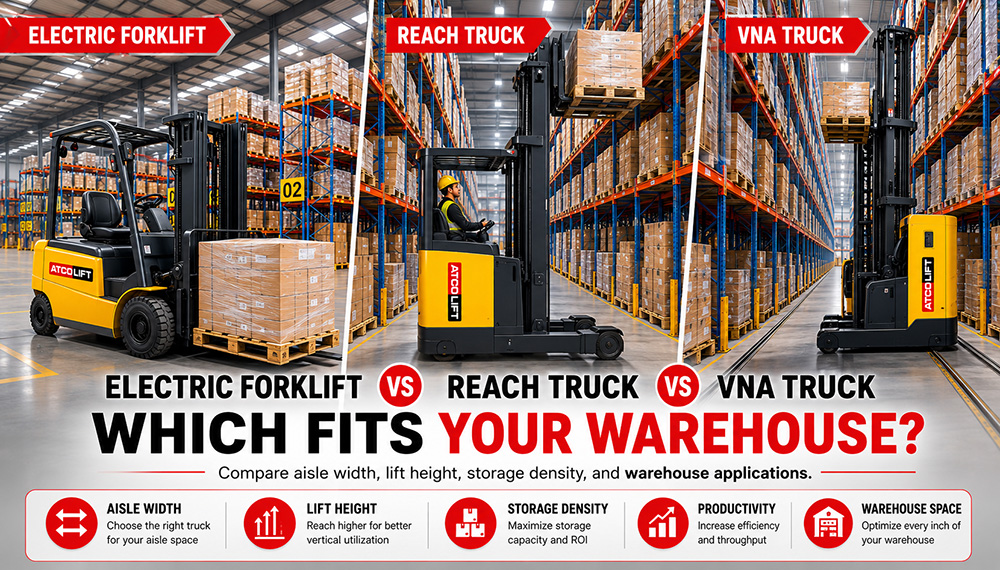
A loaded pallet is ready near the dispatch area. The operator is waiting, the truck is available, but movement is still slow.
The problem is not always manpower. It is not always the racking layout either. In many warehouses, the real issue is that the wrong type of truck is being used for the job.
An electric forklift may be strong and flexible, but it needs enough turning space. A reach truck may lift higher and work better indoors, but it is not always the best choice for loading and general movement. A VNA truck can increase storage capacity, but only when the warehouse layout, floor condition, racking design, and operating discipline support it.
For warehouse managers, logistics teams, fleet supervisors, and procurement teams in the UAE, Saudi Arabia, Oman, and the wider GCC, this comparison is not only technical. It directly affects daily pallet flow, safety, storage density, operator productivity, and long-term operating cost.
Suppliers such as ATCOLIFT are often involved when warehouse teams need to compare electric forklifts, reach trucks, and narrow aisle trucks based on real site conditions. But the right decision should always start from the operation, not from the machine name.
How Each Truck Works in a Warehouse
An electric forklift is usually used as a flexible material handling truck. It can load and unload vehicles, move pallets between warehouse zones, support production areas, and handle general stacking.
It is commonly used where movement is mixed and the warehouse has enough aisle space.
A reach truck is mainly designed for indoor pallet storage and retrieval. Its mast and reach mechanism allow the truck to access higher racking while working in narrower aisles.
It is useful where vertical storage matters more than outdoor movement.
A VNA truck, or very narrow aisle truck, is designed for high-density storage. It works inside very narrow aisles and is often used with high racking systems.
It can increase pallet positions, but it needs better planning than a normal forklift operation.
Side-by-Side Warehouse Equipment Comparison
Main use:
General pallet movement, loading, unloading, stacking, and internal transport.
Typical aisle requirement:
Usually needs wider aisles, often around 3.5 m or more depending on model and load.
Typical lift height:
Commonly suitable for low to medium-height stacking.
Load handling:
Good for heavier and mixed pallet movement.
Best environment:
Warehouses, factories, loading areas, dispatch zones, and production areas.
Main limitation:
Needs more turning space compared with reach trucks and VNA trucks.
Main use:
Indoor racking, high-level pallet storage, and pallet retrieval.
Typical aisle requirement:
Works in narrower aisles, often around 2.7 m to 3.2 m depending on truck type.
Typical lift height:
Suitable for higher racking applications.
Load handling:
Good for pallet storage at height, subject to load centre and residual capacity.
Best environment:
Indoor warehouses, cold stores, FMCG facilities, and distribution centres.
Main limitation:
Less suitable for rough outdoor work and mixed loading tasks.
Main use:
Very narrow aisle storage and high-density racking operations.
Typical aisle requirement:
Designed for very narrow aisles, often around 1.6 m to 2.0 m depending on the system.
Typical lift height:
Suitable for high-bay and dense storage layouts.
Load handling:
Good for controlled pallet handling in narrow aisles.
Best environment:
High-density warehouses with planned racking layouts.
Main limitation:
Needs proper floor condition, racking alignment, and trained operation.
Where Equipment Selection Usually Goes Wrong
One common mistake is buying one machine and expecting it to solve every warehouse movement problem.
For example, a warehouse may choose an electric forklift because it is familiar and easy to operate. But if the aisles are too narrow, operators need more time to turn, reverse, and position the load. This slows down pallet movement and increases the chance of rack impact.
Another warehouse may choose a reach truck because it wants to use higher racking. That can be the right decision, but problems begin when the same reach truck is also used for long travel distances, loading work, or rough floor movement. The machine is then pulled away from its strongest function.
With VNA trucks, the risk is different. A VNA truck may look like the best choice because it saves space. But if the warehouse floor is uneven, if pallet quality is poor, or if racking is not aligned properly, the operation may not get the expected productivity.
Aisle Width, Racking Height, and Pallet Flow
Aisle width is one of the first things to check before comparing an electric forklift, reach truck, and VNA truck.
An electric forklift usually needs more space to turn. It works well in open areas, loading bays, dispatch zones, and production areas where the operator needs flexibility.
A reach truck helps when the warehouse wants to store pallets higher while keeping aisles narrower. It is often useful for FMCG warehouses, spare parts storage, cold stores, and retail distribution centres.
A VNA truck is different because it changes the storage strategy itself. It allows tighter aisles and more pallet positions, but it also requires more control. The truck, racking, floor, pallet quality, and operator process must work together.
A warehouse that only looks at racking height may miss the bigger issue: how goods move through the full operation. If pallets move slowly from receiving to storage, or from picking to dispatch, higher racking alone will not solve the problem.
What to Check Before Choosing
Before choosing between an electric forklift, reach truck, and VNA truck, review these practical warehouse factors during real operation.
Aisle Width & Turning Space
This decides whether the truck can move smoothly without repeated reversing, slow positioning, or unsafe rack-side movement.
Racking Height & Load Weight
The machine must safely lift the required pallet weight at the required height, not only at ground level.
Pallet Movement Volume
High pallet movement may need speed, traffic control, and charging planning more than maximum lift height alone.
Loading & Unloading Work
If the truck works near loading docks or containers, flexibility, stability, and safe travel control become more important.
Floor Condition
Reach trucks and VNA trucks need suitable indoor surfaces. Poor flooring affects safety, speed, tyres, and maintenance.
Battery & Charging Plan
Electric machines need proper charging schedules, spare battery planning, or opportunity charging based on shift patterns.
Operator Skill Level
VNA trucks and high-reach applications need trained operators who understand load handling, height, and narrow aisle movement.
Maintenance Access
A machine with poor service planning can create downtime during peak warehouse hours and delay pallet movement.
Practical Site Review
This checklist should be checked on the warehouse floor during real movement, not only during office-level planning.
Productivity Is Not Only About Speed
A fast truck does not automatically create a fast warehouse.
Productivity depends on how smoothly goods move from receiving to storage, picking, staging, and dispatch. If a truck is too large for the aisle, the operator slows down. If a truck is too specialised for mixed tasks, another machine may be needed. If charging is poorly planned, downtime appears during busy shifts.
Improves productivity when the warehouse needs flexible movement across several zones. It can support loading, internal transport, dispatch preparation, and production movement.
Improves productivity when the main activity is pallet storage and retrieval at height. It helps operators work faster in racking aisles where a standard forklift may need more turning space.
Improves productivity when storage density is the main priority and the warehouse is organised around narrow aisle operations. It can reduce wasted floor space when movement is planned.
Safety and Maintenance Considerations
Unsafe handling often starts with poor equipment matching.
If a forklift is forced into narrow aisles, rack damage becomes more likely. If a reach truck is used in the wrong zone, visibility and stability can become concerns. If VNA operation is not properly planned, small floor or racking issues can affect daily safety.
Maintenance also changes by equipment type. Electric forklifts need battery care, charger planning, tyre checks, brake inspection, and hydraulic maintenance. Reach trucks need careful attention to mast systems, wheels, reach mechanism, and electronic controls. VNA trucks may need more specialised support because they often work in tighter, higher, and more controlled environments.
In GCC warehouses, heat, dust, long shifts, and busy loading schedules can increase pressure on both machines and operators. That makes maintenance planning part of the buying decision, not something to think about later.
Hidden Cost Behind the Wrong Choice
The cheapest machine at purchase stage may become expensive during operation.
The hidden cost appears through slow movement, rack damage, underused fleet capacity, operator waiting time, battery misuse, tyre wear, service downtime, and unsafe handling.
If an electric forklift is used in aisles that are too narrow, the warehouse may lose a few seconds on every pallet movement. Across hundreds of movements per week, it becomes a real productivity loss.
If a reach truck is selected without checking residual capacity at height, it may not safely handle the intended load on upper racking levels.
If a VNA truck is selected without proper layout planning, the warehouse may invest in a high-density system but still struggle with pallet flow.
When Each Option Makes Better Sense
The warehouse needs one flexible machine for loading, unloading, internal transport, and general pallet handling.
It is suitable for factories, dispatch areas, production support, and warehouses with reasonable aisle space.
The warehouse needs to use vertical racking more efficiently.
It is suitable for indoor storage areas, cold stores, distribution centres, and facilities where pallet storage height is important.
The warehouse is running out of space and wants to increase pallet positions without expanding the building.
It is suitable for high-density storage operations where layout, flooring, racking, and operator discipline are properly planned.
Final Decision Point
Before choosing between an electric forklift, reach truck, and VNA truck, observe your warehouse during a busy shift.
Are forklifts losing time in tight aisles?
Is high racking underused?
Is storage space becoming harder to manage?
Final Thought:
The right truck is not always the most powerful or the most specialised. It is the one that fits your warehouse movement pattern, protects operators, supports storage needs, and reduces wasted time every working day.


GET A QUOTE
Tell us about your business requirement, one of our technical expert will be in touch with you soon..!
NEW PRODUCTS ALERTS