Consistent Muffin and Pastry Output with Tabletop Depositor
Production kitchens across the UAE, Saudi Arabia, and Oman are under increasing pressure to maintain product consistency while dealing with labour shortages, rising ingredient costs, and growing consumer demand. Muffins, choux pastries, sponge bases, and similar baked products require precise batter portioning. Even a small variation in weight or fill level can lead to uneven baking, inconsistent appearance, and unnecessary ingredient waste.
Many bakery operators still rely on manual scooping or basic hand-operated tools to portion batters and doughs. While these approaches work for small volumes, they often become inefficient as production demand grows. Operators struggle with repetitive work, trays are filled unevenly, and production output becomes difficult to standardize.
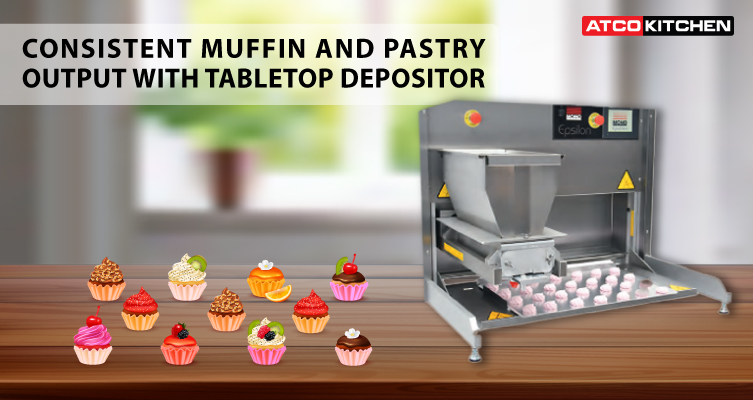
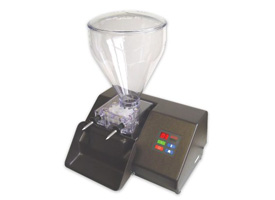
A compact depositing system such as the Epsilon Tabletop Depositor provides a practical way to maintain repeatable muffin and pastry output while reducing manual intervention. Designed for bakery and confectionery production, the unit delivers controlled deposits of soft batter mixtures while occupying very little floor space, making it suitable for retail bakeries and central kitchens alike.
Operational Challenges Facing Modern Bakery Production
Across GCC bakery operations, several operational realities are shaping equipment decisions. Production managers often face a combination of workforce constraints, increasing compliance requirements, and tighter cost control targets. Muffin and pastry production, although simple in principle, can become inconsistent without accurate depositing systems.
Some of the most common challenges include:
How Depositing Systems Improve Bakery Portion Control
Depositing equipment works by dispensing a controlled quantity of batter or dough into trays or moulds using programmable cycles. Instead of relying on manual scooping, the system regulates each deposit according to predefined settings.
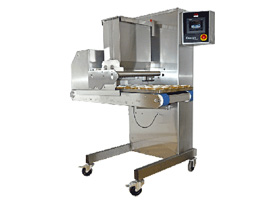
The Epsilon Tabletop Depositor uses a travelling hopper design, which removes the need for a separate conveyor. Trays are positioned directly at the front of the machine and filled in cycles, allowing operators to load and remove trays quickly. For bakeries where floor space is limited, this layout simplifies production without requiring additional conveyor infrastructure.
In bakery production environments where muffins, sponge bases, and pastry fillings must remain consistent across large batches, the system maintains uniform deposit sizes. Each tray receives the same batter volume, improving product uniformity and reducing waste.
Practical Operational Impacts in Bakery Production
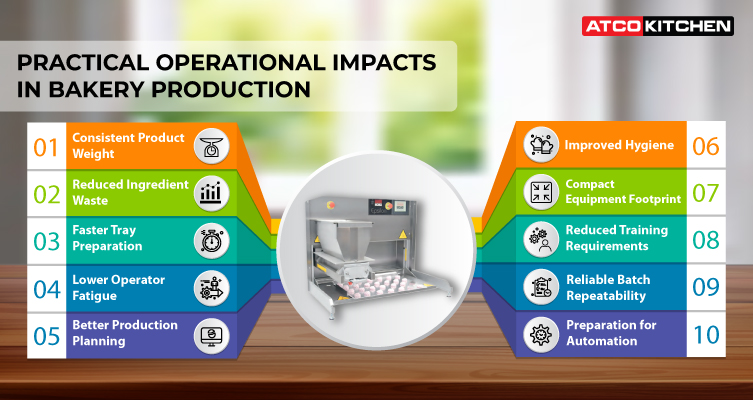 Equipment decisions in bakery kitchens are rarely based on specifications alone. Decision-makers usually focus on practical operational outcomes. Compact depositing systems influence several aspects of daily production.
1. Consistent Product Weight
Accurate batter dispensing ensures muffins and pastries maintain similar weight and appearance. This improves baking uniformity and simplifies packaging operations.
2. Reduced Ingredient Waste
When batter quantities remain controlled, ingredient overuse decreases. This becomes especially important when flour, dairy products, and specialty ingredients experience price fluctuations in GCC markets.
3. Faster Tray Preparation
Operators can prepare trays much faster compared with manual scooping. Higher tray throughput improves overall production capacity without increasing labour requirements.
4. Lower Operator Fatigue
Repetitive batter handling can cause strain during long production shifts. Automated depositing reduces this workload and allows staff to focus on supervision rather than manual portioning.
5. Better Production Planning
Consistent deposit cycles allow bakery managers to estimate output more accurately. Production schedules become easier to manage during high-demand periods such as seasonal holidays and catering orders.
6. Improved Hygiene Control
Stainless steel construction and controlled product flow help maintain hygienic processing conditions. This supports compliance with food safety standards commonly enforced across GCC food production facilities.
7. Compact Equipment Footprint
Many bakery kitchens in cities such as Dubai, Riyadh, and Muscat operate within restricted spaces. Compact equipment occupying less than one square metre can integrate into existing production lines without major layout changes.
8. Reduced Training Requirements
Programmable controls allow operators to store recipes and deposit settings. Once configured, staff can run production cycles with minimal adjustment.
9. Reliable Batch Repeatability
Stored programs allow repeated product runs without recalibrating batter portions. This ensures similar output across multiple production days.
10. Preparation for Automation Growth
Many bakeries are gradually introducing automation. Compact depositing systems provide a practical starting point for improving process consistency before investing in larger automated production lines.
Common Mistakes Bakeries Make Without Depositing Systems
Even well-managed bakeries sometimes underestimate the long-term impact of manual portioning methods. Several operational mistakes frequently appear in growing bakery facilities.
Considerations for Bakery Operators in the GCC
Climate conditions, labour regulations, and supply chain structures across the GCC create a unique environment for food production. Equipment used in bakery kitchens must operate reliably in warm environments while supporting hygienic cleaning practices and efficient workflows.
Compact depositing systems like the Epsilon Tabletop Depositor help bakery teams address these conditions by simplifying batter handling and maintaining controlled portioning. The machine’s small footprint allows it to fit through standard doorways and integrate into both retail bakeries and central production kitchens.
Manufactured by MONO Equipment in the United Kingdom, the system combines programmable controls, stainless steel construction, and controlled depositing cycles. These features help bakery operations maintain consistent product output without significantly expanding their production footprint.
Consistent muffin and pastry production depends on more than just recipe accuracy. Portion control, operator efficiency, and tray handling all contribute to the final baked result. As bakery operations grow across the GCC, small automation upgrades often deliver measurable improvements in product uniformity and labour efficiency.
Compact depositing equipment provides a practical solution for bakeries seeking repeatable results without investing in large automated production lines. For production managers balancing rising ingredient costs, workforce constraints, and growing product demand, controlled batter depositing can play an important role in maintaining stable and predictable bakery output.
Many bakery operators still rely on manual scooping or basic hand-operated tools to portion batters and doughs. While these approaches work for small volumes, they often become inefficient as production demand grows. Operators struggle with repetitive work, trays are filled unevenly, and production output becomes difficult to standardize.
A compact depositing system such as the Epsilon Tabletop Depositor provides a practical way to maintain repeatable muffin and pastry output while reducing manual intervention. Designed for bakery and confectionery production, the unit delivers controlled deposits of soft batter mixtures while occupying very little floor space, making it suitable for retail bakeries and central kitchens alike.
Operational Challenges Facing Modern Bakery Production
Across GCC bakery operations, several operational realities are shaping equipment decisions. Production managers often face a combination of workforce constraints, increasing compliance requirements, and tighter cost control targets. Muffin and pastry production, although simple in principle, can become inconsistent without accurate depositing systems.
Some of the most common challenges include:
- Manual portioning leading to weight variations between products
- Operator fatigue caused by repetitive batter scooping
- Inconsistent tray loading resulting in uneven baking
- Rising ingredient costs increasing the need for precise portion control
- Space limitations in retail bakery kitchens
- Labour regulations limiting reliance on repetitive manual work
- Production delays during peak demand periods
How Depositing Systems Improve Bakery Portion Control
Depositing equipment works by dispensing a controlled quantity of batter or dough into trays or moulds using programmable cycles. Instead of relying on manual scooping, the system regulates each deposit according to predefined settings.
The Epsilon Tabletop Depositor uses a travelling hopper design, which removes the need for a separate conveyor. Trays are positioned directly at the front of the machine and filled in cycles, allowing operators to load and remove trays quickly. For bakeries where floor space is limited, this layout simplifies production without requiring additional conveyor infrastructure.
In bakery production environments where muffins, sponge bases, and pastry fillings must remain consistent across large batches, the system maintains uniform deposit sizes. Each tray receives the same batter volume, improving product uniformity and reducing waste.
Practical Operational Impacts in Bakery Production
1. Consistent Product Weight
Accurate batter dispensing ensures muffins and pastries maintain similar weight and appearance. This improves baking uniformity and simplifies packaging operations.
2. Reduced Ingredient Waste
When batter quantities remain controlled, ingredient overuse decreases. This becomes especially important when flour, dairy products, and specialty ingredients experience price fluctuations in GCC markets.
3. Faster Tray Preparation
Operators can prepare trays much faster compared with manual scooping. Higher tray throughput improves overall production capacity without increasing labour requirements.
4. Lower Operator Fatigue
Repetitive batter handling can cause strain during long production shifts. Automated depositing reduces this workload and allows staff to focus on supervision rather than manual portioning.
5. Better Production Planning
Consistent deposit cycles allow bakery managers to estimate output more accurately. Production schedules become easier to manage during high-demand periods such as seasonal holidays and catering orders.
6. Improved Hygiene Control
Stainless steel construction and controlled product flow help maintain hygienic processing conditions. This supports compliance with food safety standards commonly enforced across GCC food production facilities.
7. Compact Equipment Footprint
Many bakery kitchens in cities such as Dubai, Riyadh, and Muscat operate within restricted spaces. Compact equipment occupying less than one square metre can integrate into existing production lines without major layout changes.
8. Reduced Training Requirements
Programmable controls allow operators to store recipes and deposit settings. Once configured, staff can run production cycles with minimal adjustment.
9. Reliable Batch Repeatability
Stored programs allow repeated product runs without recalibrating batter portions. This ensures similar output across multiple production days.
10. Preparation for Automation Growth
Many bakeries are gradually introducing automation. Compact depositing systems provide a practical starting point for improving process consistency before investing in larger automated production lines.
- Supports scalable bakery production
- Improves output consistency
- Simplifies repetitive production tasks
Common Mistakes Bakeries Make Without Depositing Systems
Even well-managed bakeries sometimes underestimate the long-term impact of manual portioning methods. Several operational mistakes frequently appear in growing bakery facilities.
- Assuming manual scooping can scale with increased demand
- Ignoring ingredient losses caused by over-portioning
- Overloading staff during peak production periods
- Underestimating the importance of consistent tray loading
- Delaying small automation upgrades until problems become severe
Considerations for Bakery Operators in the GCC
Climate conditions, labour regulations, and supply chain structures across the GCC create a unique environment for food production. Equipment used in bakery kitchens must operate reliably in warm environments while supporting hygienic cleaning practices and efficient workflows.
Compact depositing systems like the Epsilon Tabletop Depositor help bakery teams address these conditions by simplifying batter handling and maintaining controlled portioning. The machine’s small footprint allows it to fit through standard doorways and integrate into both retail bakeries and central production kitchens.
Manufactured by MONO Equipment in the United Kingdom, the system combines programmable controls, stainless steel construction, and controlled depositing cycles. These features help bakery operations maintain consistent product output without significantly expanding their production footprint.
Consistent muffin and pastry production depends on more than just recipe accuracy. Portion control, operator efficiency, and tray handling all contribute to the final baked result. As bakery operations grow across the GCC, small automation upgrades often deliver measurable improvements in product uniformity and labour efficiency.
Compact depositing equipment provides a practical solution for bakeries seeking repeatable results without investing in large automated production lines. For production managers balancing rising ingredient costs, workforce constraints, and growing product demand, controlled batter depositing can play an important role in maintaining stable and predictable bakery output.
GET A QUOTE
Tell us about your business requirement, one of our technical expert will be in touch with you soon..!
PROCEED
NEW PRODUCTS ALERTS