The invisible cost of high-conductivity bakery products

In consumer shopping baskets they may be regarded as dry products. Yet when using a metal detector, salty snacks packed in metallised film can appear as wet, as do iron-enriched cereals, supplements and breakfast bars, causing a similar challenge to high moisture products when it comes to inspecting for metal contaminants.
That’s because mineral content or metallised film packaging, can create a large magnetic signal that the detector must overcome in order to detect small pieces of metal. This phenomenon is known as ‘product effect’ and the industry term ‘wet’ extends to any higher-conductivity product, be it wet, moist, with a high salt content or containing other conductive compounds, explains Sales Director Phil Brown at Fortress Technology. “The idea that we can boost our iron intake by eating fortified cereal bars etc. is a great attraction for many consumers,” says Phil. “However, we draw the line biting into a piece of swarf, metal shard or narrow wire, and rightly so!”
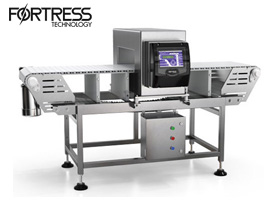
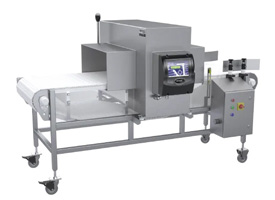
Late last year, Fortress unveiled its global solution - the Interceptor range. Phil examines the science behind screening ‘wet’ products using metal detectors, why supplements, snacks and cereals that are fortified with minerals for nutritional reasons can make the ‘product effect’ more pronounced and counts the costs of false rejects.
Bread is another staple snack that’s more vulnerable to product effect than you might think. That’s because as well as salt content, baked bread when it comes out of a warm oven it can impact the metal detectors’s ability to distinguish between any actual stainless steel metal contaminants that may have been introduced during the mixing process and the false signal given by the combination of product attributes. “What’s more, the air bubbles and density of a loaf of bread will vary, even in the same batch,” emphasises Phil. “Plus, a lot of freshly baked goods, cakes included, are baked in tins, so there’s another potential source of metal contamination.”
Solving the false positive challenge Naturally, brand-owners and retailers want to eliminate the cost and reputational damage of undetected foreign bodies, and the recalls that may result from them. Equally, food manufacturers are under pressure to reduce – or eliminate – false rejects. With margins on product tighter than ever, there is the cost of the rejected item itself. More importantly, where a fault recurs, stopping the line may incur further cost.
In fact, the real cost burden extends beyond this most immediate level. False rejects do cost the customer money, which primarily occur when a metal detector cannot discriminate between ‘product effect’ and a metal contaminant. Equally, the ‘man hours’ spent checking the performance of equipment and investigating false rejects are bound to impact line productivity and OEE.”
Precise figures for rejected products will depend on the product and, clearly, the volume of false positives. Industry estimates regularly put the potential costs at up to £14,000 per year per production line, which Phil believes is realistic.
The reason why false rejects are more likely to occur in these types of products comes down to basic physics. There are two distinct components to metal detection: magnetic permeability and conductive effect. Most products exhibit some combination of the two, but the overriding factor is likely to be conductivity. Metals also display both, but with stainless steel, the signal can be swamped by the product effect.
It all rests with understanding the material differences in metals. Ferrous metals are both magnetic and good electrical conductors so they’re relatively easy to spot. Non-ferrous metals aren’t magnetic but they’re good conductors. Stainless steels are not magnetic and are also poor conductors, so they present an added challenge. In practice this means that in a sphere of stainless steel hidden in a dry product typically needs to be 50% larger than a ferrous sphere to generate a similar signal size. That disparity can rise up to 200 to 300% in ‘wet’ conductive products, including bread or dry products with a mineral content.
Intercepting background signals In recent years most developments in metal detection have focused on the coils that transmit and receive multi-frequency signals. However, even these most advanced product compensation and phasing methods have limitations.
Refining the Simultaneous Multi-Frequency technology first integrated into Fortress metal detectors in 2009, the company’s new Interceptor metal detector now splits the product and metal detection signals and then links the readings back together. The low-frequency range can be used to eliminate the product effect, leaving any stainless steel signal in the higher-frequency range more readily identifiable.
Phil explains why this makes sense: “It takes account of the background ‘noise’ from the product, and the fact that you’re looking for an additional ‘blip’ beyond that. This approach factors in the background signal and eliminates it.”
With this latest way of applying metal detection technology, Fortress calculates that it can identify metal contaminants in wet products down to half the size of those detectable with the previous generation of equipment, with the same degree of reliability. Although a test sample sphere isn’t a real world contaminant, halving it to 0.5mm equates to a wire length contaminant measuring around 2.5cm. From a risk assessment perspective this makes a huge difference and goes a long way to protecting brand reputation and keeping metal shards out of snacks.
Made to order in the UK, Fortress’s new Interceptor units can be deployed in different checkpoints on a snack producers processing line, including packing conveyors, pipeline configurations for raw dough, or gravity systems for inspecting supplement capsules, cereals, salted peanuts or crisps.
That’s because mineral content or metallised film packaging, can create a large magnetic signal that the detector must overcome in order to detect small pieces of metal. This phenomenon is known as ‘product effect’ and the industry term ‘wet’ extends to any higher-conductivity product, be it wet, moist, with a high salt content or containing other conductive compounds, explains Sales Director Phil Brown at Fortress Technology. “The idea that we can boost our iron intake by eating fortified cereal bars etc. is a great attraction for many consumers,” says Phil. “However, we draw the line biting into a piece of swarf, metal shard or narrow wire, and rightly so!”
Late last year, Fortress unveiled its global solution - the Interceptor range. Phil examines the science behind screening ‘wet’ products using metal detectors, why supplements, snacks and cereals that are fortified with minerals for nutritional reasons can make the ‘product effect’ more pronounced and counts the costs of false rejects.
Bread is another staple snack that’s more vulnerable to product effect than you might think. That’s because as well as salt content, baked bread when it comes out of a warm oven it can impact the metal detectors’s ability to distinguish between any actual stainless steel metal contaminants that may have been introduced during the mixing process and the false signal given by the combination of product attributes. “What’s more, the air bubbles and density of a loaf of bread will vary, even in the same batch,” emphasises Phil. “Plus, a lot of freshly baked goods, cakes included, are baked in tins, so there’s another potential source of metal contamination.”
Solving the false positive challenge Naturally, brand-owners and retailers want to eliminate the cost and reputational damage of undetected foreign bodies, and the recalls that may result from them. Equally, food manufacturers are under pressure to reduce – or eliminate – false rejects. With margins on product tighter than ever, there is the cost of the rejected item itself. More importantly, where a fault recurs, stopping the line may incur further cost.
In fact, the real cost burden extends beyond this most immediate level. False rejects do cost the customer money, which primarily occur when a metal detector cannot discriminate between ‘product effect’ and a metal contaminant. Equally, the ‘man hours’ spent checking the performance of equipment and investigating false rejects are bound to impact line productivity and OEE.”
Precise figures for rejected products will depend on the product and, clearly, the volume of false positives. Industry estimates regularly put the potential costs at up to £14,000 per year per production line, which Phil believes is realistic.
The reason why false rejects are more likely to occur in these types of products comes down to basic physics. There are two distinct components to metal detection: magnetic permeability and conductive effect. Most products exhibit some combination of the two, but the overriding factor is likely to be conductivity. Metals also display both, but with stainless steel, the signal can be swamped by the product effect.
It all rests with understanding the material differences in metals. Ferrous metals are both magnetic and good electrical conductors so they’re relatively easy to spot. Non-ferrous metals aren’t magnetic but they’re good conductors. Stainless steels are not magnetic and are also poor conductors, so they present an added challenge. In practice this means that in a sphere of stainless steel hidden in a dry product typically needs to be 50% larger than a ferrous sphere to generate a similar signal size. That disparity can rise up to 200 to 300% in ‘wet’ conductive products, including bread or dry products with a mineral content.
Intercepting background signals In recent years most developments in metal detection have focused on the coils that transmit and receive multi-frequency signals. However, even these most advanced product compensation and phasing methods have limitations.
Refining the Simultaneous Multi-Frequency technology first integrated into Fortress metal detectors in 2009, the company’s new Interceptor metal detector now splits the product and metal detection signals and then links the readings back together. The low-frequency range can be used to eliminate the product effect, leaving any stainless steel signal in the higher-frequency range more readily identifiable.
Phil explains why this makes sense: “It takes account of the background ‘noise’ from the product, and the fact that you’re looking for an additional ‘blip’ beyond that. This approach factors in the background signal and eliminates it.”
With this latest way of applying metal detection technology, Fortress calculates that it can identify metal contaminants in wet products down to half the size of those detectable with the previous generation of equipment, with the same degree of reliability. Although a test sample sphere isn’t a real world contaminant, halving it to 0.5mm equates to a wire length contaminant measuring around 2.5cm. From a risk assessment perspective this makes a huge difference and goes a long way to protecting brand reputation and keeping metal shards out of snacks.
Made to order in the UK, Fortress’s new Interceptor units can be deployed in different checkpoints on a snack producers processing line, including packing conveyors, pipeline configurations for raw dough, or gravity systems for inspecting supplement capsules, cereals, salted peanuts or crisps.



GET A QUOTE
Tell us about your business requirement, one of our technical expert will be in touch with you soon..!
PROCEED
NEW PRODUCTS ALERTS