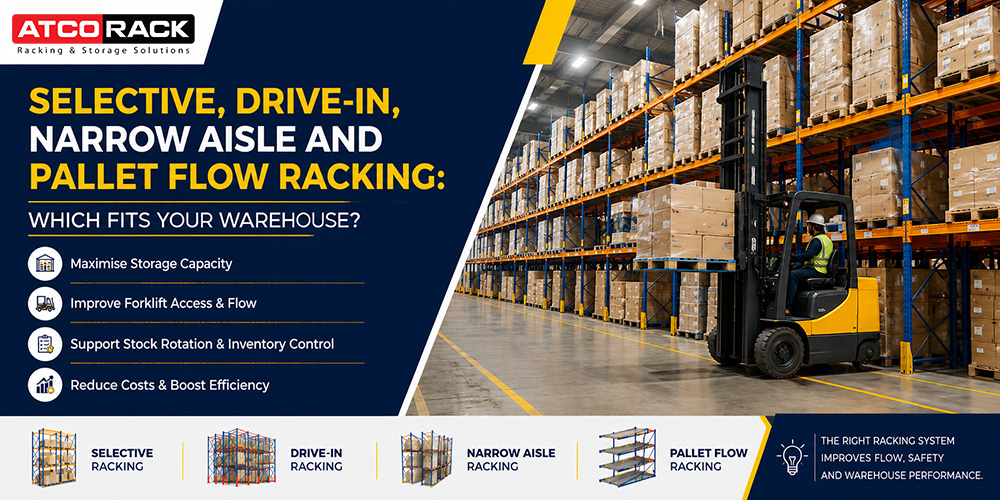
A forklift operator receives an urgent request from the dispatch team. A customer order is ready for shipment, but the required pallet is buried behind other stock. Another operator is waiting to access the same aisle, while inbound pallets continue arriving at the receiving area. The warehouse has enough forklifts, labour, and inventory. Yet product movement remains slower than expected.
Many warehouse managers initially assume these problems are caused by insufficient storage space or a lack of handling equipment. In reality, the issue often begins with the racking layout itself.
The way pallets are stored directly affects forklift travel distance, stock accessibility, inventory rotation, labour productivity, and warehouse safety. A storage system that performs well in a cold store may create daily bottlenecks in a distribution centre. Likewise, a layout that maximizes pallet capacity may reduce accessibility and increase handling time.
Selective, Drive-In, Narrow Aisle, and Pallet Flow racking systems are among the most widely used storage solutions across GCC warehouses. Each serves a different purpose and supports different operational priorities. Understanding where each system performs best can help warehouse teams improve storage utilization without creating new operational challenges.
When warehouses begin running out of space, the natural response is to search for a racking system that can accommodate more pallets.
However, storage density alone rarely determines warehouse efficiency.
The most effective storage solution is not necessarily the one that stores the most pallets. It is the one that supports the way products move through the operation every day.
Across Dubai, Abu Dhabi, Riyadh, Jeddah, Dammam, Muscat, and other GCC logistics hubs, warehouse operators are increasingly looking for ways to improve storage efficiency without expanding facility footprints. Rising land costs, growing inventory volumes, and faster delivery expectations are making storage planning more important than ever.
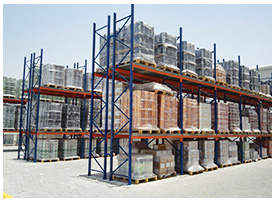
Selective racking remains the most common pallet storage system because every pallet position is directly accessible.
Forklift operators can retrieve any pallet without moving surrounding loads. This simplifies inventory management, reduces handling time, and supports faster order fulfilment.
Warehouses managing a large number of SKUs often benefit from this arrangement. Retail distribution centres, spare parts warehouses, manufacturing facilities, and third-party logistics operations frequently rely on Selective racking because inventory locations change regularly.
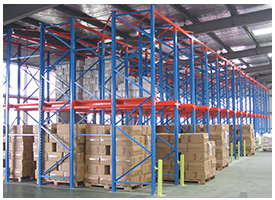
Drive-In racking is designed for warehouses storing large quantities of similar products.
Forklifts enter storage lanes and place pallets deep within the rack structure. By reducing the number of aisles required, warehouses can significantly increase pallet capacity within the same building footprint.
This approach is commonly used in cold storage facilities, food processing plants, beverage warehouses, and seasonal inventory operations where multiple pallets of the same product are stored together.
Warehouse expansion is not always practical. Relocation costs, business disruption, and limited industrial space often make expansion difficult.
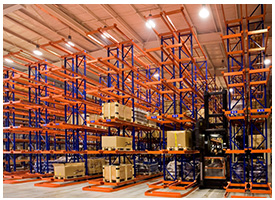
Narrow Aisle racking addresses this challenge by reducing aisle widths while maintaining direct pallet access.
Instead of traditional counterbalance forklifts, operations typically use reach trucks, articulated forklifts, or dedicated very narrow aisle equipment capable of operating safely in tighter spaces.
Pallet Flow racking uses gravity rollers that allow pallets to move automatically from the loading side to the picking side. As one pallet is removed, the next pallet advances into position.
This design naturally supports First-In-First-Out inventory management and helps reduce product ageing within storage lanes.
Food distribution centres, pharmaceutical facilities, cold chain operators, and manufacturers handling date-sensitive inventory frequently use Pallet Flow systems.
A spare parts warehouse managing thousands of SKUs typically benefits from Selective racking because immediate pallet access is critical.
A cold store handling hundreds of pallets of the same product often achieves better storage utilization with Drive-In racking.
A distribution centre running out of available floor space may choose Narrow Aisle racking to increase capacity without relocating.
A food processing or pharmaceutical facility that relies on FIFO inventory management frequently benefits from Pallet Flow racking.
The right choice depends less on the rack itself and more on how products move through the operation.
Regardless of which racking system is selected, safety and maintenance remain critical considerations.
A warehouse may have a well-designed layout, but damaged uprights, overloaded beams, poor pallet quality, and inadequate operator training can quickly create operational risks.
Many storage projects focus on pallet capacity while overlooking forklift productivity. Saving floor space may appear beneficial, but if forklifts require additional travel or handling movements, labour and equipment costs can increase over time.
- Rack condition and impact damage
- Beam loading and pallet weights
- Aisle clearance and traffic flow
- Forklift suitability for the storage layout
- Pallet quality and load stability
- Inventory rotation requirements
- Future storage growth plans
Routine inspections are often significantly less expensive than emergency repairs, operational downtime, or product damage resulting from structural failures.
Before selecting between Selective, Drive-In, Narrow Aisle, and Pallet Flow racking, evaluate not only how many pallets need to be stored, but also how frequently products move, how quickly they must be accessed, and how forklifts will operate within the proposed layout. The right decision is usually the one that balances storage density, accessibility, safety, and long-term operational efficiency.