Industrial Bakery Setup: Complete Equipment Checklist from Mixing to Packaging
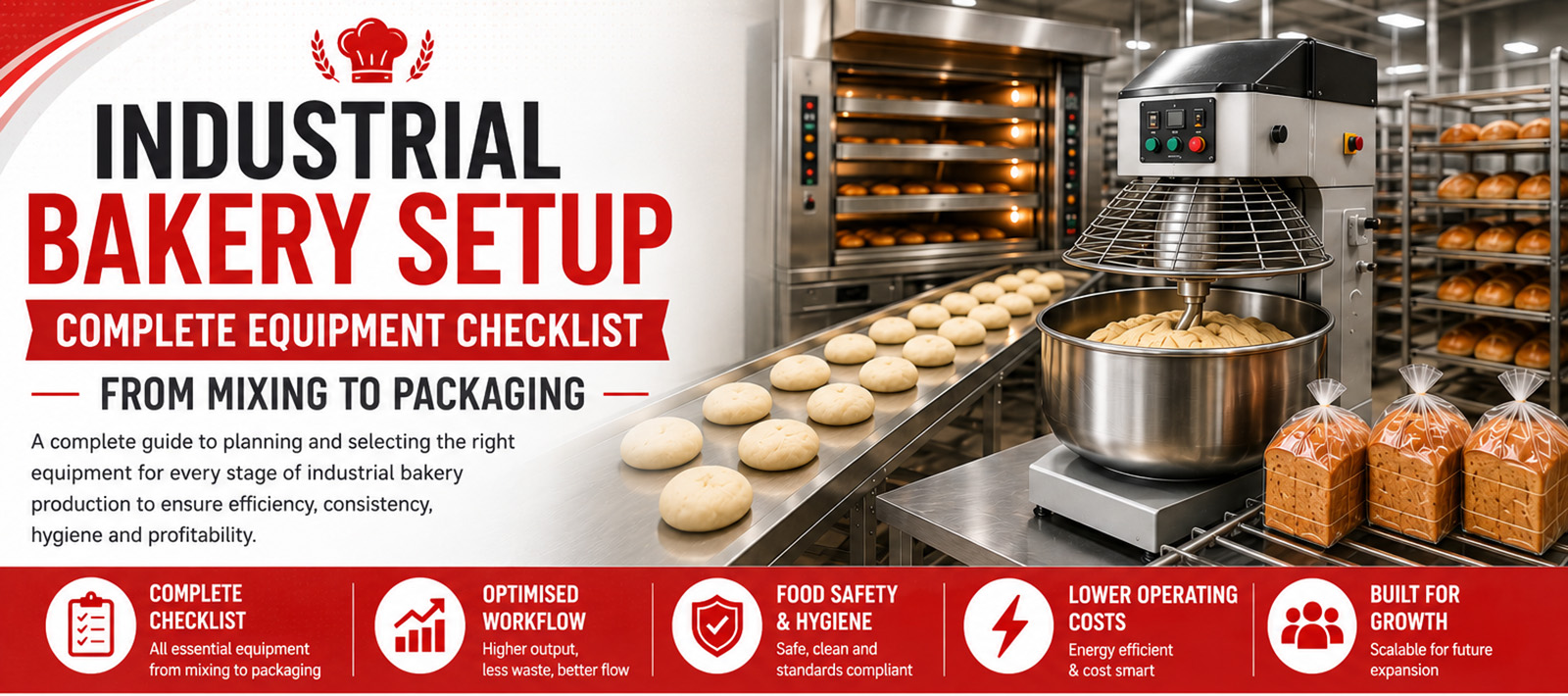
An industrial bakery rarely struggles because of one machine alone. Problems usually appear between machines. Dough may wait too long after mixing, divided pieces may reach the proofer unevenly, baked products may enter the packing area before they are fully cooled, or the packaging line may fail to keep pace with oven output.
During peak production, these gaps quickly become serious. Staff begin moving trays manually, batches overlap, cleaning gets delayed, and product consistency becomes harder to control. A reliable industrial bakery setup therefore needs more than a list of machines. It needs a production flow in which every stage is matched for capacity, timing, hygiene, utility demand, and maintenance access.
This checklist follows the bakery process from mixing to packaging. It explains the purpose of each equipment group, the common selection mistakes that create production delays, and the points bakery owners, consultants, and procurement teams should evaluate before finalising a project.
Plan the Production Flow Before Selecting Equipment
Equipment selection should begin with the product range. Bread loaves, buns, flatbreads, cakes, croissants, and laminated dough products do not follow the same production process. They need different mixing actions, dough handling methods, proofing conditions, baking profiles, cooling times, and packaging formats.
Production volume is equally important. A bakery producing several small batches needs flexibility, while a high-volume bread facility needs consistent throughput and better automation. The target output per hour, number of recipes, dough hydration, batch size, product dimensions, changeover frequency, and expected future growth all influence the equipment specification.
Utilities should also be reviewed at the planning stage. Industrial bakery equipment may require a considerable electrical load, gas supply, water, drainage, compressed air, extraction, and temperature control. In UAE, Saudi Arabia, Oman, and other GCC markets, high ambient temperatures can affect proofing, cooling, refrigeration, and packaging unless room conditions are properly managed.
Industrial Bakery Equipment Checklist
| Production Stage | Main Equipment | Operational Purpose | Key Selection Check |
|---|---|---|---|
| Ingredient preparation | Flour sifters, scales, ingredient bins | Improves recipe accuracy and ingredient control | Weighing accuracy, dust control, cleaning access |
| Mixing | Spiral mixers, planetary mixers, removable bowl mixers | Develops dough or mixes batters consistently | Batch size, dough type, mixing action, motor load |
| Dough portioning | Dough dividers, divider-rounders | Controls piece weight and production speed | Weight range, accuracy, dough handling |
| Resting and shaping | Intermediate proofers, moulders, sheeters | Relaxes, shapes, and prepares dough for final proofing | Product type, changeover time, gentle handling |
| Final proofing | Proving cabinets, rack proofers, continuous proofers | Controls fermentation before baking | Temperature, humidity, airflow, loading method |
| Baking | Deck ovens, rack ovens, rotary ovens, tunnel ovens | Applies the required baking profile | Product mix, capacity, heat source, energy use |
| Cooling | Cooling racks, conveyors, spiral cooling systems | Removes product heat before slicing or packing | Cooling time, airflow, floor space, hygiene |
| Slicing and finishing | Bread slicers, depositors, glazing and decorating units | Prepares products for final presentation | Product dimensions, cut quality, cleaning access |
| Packaging | Bagging machines, flow wrappers, sealing and labelling systems | Protects product quality and supports dispatch | Pack format, speed, shelf-life needs, changeovers |
From Mixing to Proofing: Where Consistency Begins
The mixer is the starting point of the production line, but selecting it only by bowl capacity is a common mistake. The usable batch size, flour weight, dough hydration, mixing time, dough temperature, and motor performance should be considered together. A mixer that is too small slows production, while an oversized mixer may not process smaller batches properly.
Spiral mixers are commonly used for bread and pizza dough because they develop gluten while limiting excessive heat. Planetary mixers are more suitable for cakes, creams, fillings, and lighter mixtures. Bakeries handling several product families may need both rather than expecting one machine to perform every task well.
After mixing, dough must move into dividing and rounding without unnecessary waiting. Long delays can change fermentation and make piece weights less consistent. Dough dividers should be selected according to the required weight range, dough softness, product shape, and expected hourly output.
Intermediate proofers give divided dough time to relax before moulding. Without enough resting time, dough may resist shaping or shrink after moulding. The final proofer then creates controlled temperature and humidity conditions before baking. Poor airflow, overloaded racks, or incorrect proofing time can result in uneven volume, weak crust formation, and inconsistent crumb structure.
Baking, Cooling, and Packaging Must Work as One System
The oven usually receives the most attention because it directly affects colour, crust, texture, and baking time. However, the correct oven depends on the production method. Deck ovens offer baking flexibility and strong heat control for artisan products. Rack and rotary ovens suit batch production using trolleys. Tunnel ovens support continuous high-volume lines but require careful planning of product flow and changeovers.
Energy source, insulation, steam control, recovery time, loading pattern, and maintenance access all affect operating cost. In a busy bakery, slow heat recovery between loads can reduce actual output even when the quoted oven capacity appears sufficient.
Cooling is one of the most underestimated stages. Freshly baked products continue releasing heat and moisture after leaving the oven. If bread is sliced or packed too early, condensation can form inside the package, affecting texture, shelf life, and food safety. The cooling section therefore needs enough rack space, conveyor length, or spiral cooling capacity to match oven output.
Packaging should be selected only after confirming product temperature, dimensions, shelf-life expectations, and daily pack volumes. A high-speed wrapper may appear attractive, but frequent format changes can reduce its practical output. For bakeries producing several product sizes, quick changeover and operator-friendly adjustments may be more valuable than maximum speed.
Packaging material storage also needs attention. Film, bags, labels, clips, and cartons should be kept clean, dry, and protected from production dust. The packing area should be separated from flour handling and uncontrolled traffic wherever possible.
Hygiene, Maintenance, and Hidden Operating Costs
bakery equipment must be easy to clean around product-contact surfaces, guards, belts, rollers, bowls, and transfer points. Flour dust, dough residue, grease, and crumbs can collect in areas that operators cannot easily reach. Equipment with removable parts, smooth surfaces, safe access, and clear cleaning procedures helps reduce sanitation gaps.
Flour dust also creates housekeeping and ventilation concerns. Poor dust control can affect air quality, settle on electrical components, and increase cleaning time. Sifters, covered ingredient bins, local extraction, and organised flour handling can reduce these risks.
Maintenance access is another overlooked issue. A machine may fit inside the available floor area but still be difficult to service when it is installed too close to a wall or neighbouring unit. Sufficient clearance is needed for panels, motors, belts, electrical components, lubrication points, and safe technician access.
Hidden costs often come from downtime, manual handling, spare-part delays, cleaning labour, and utility mismatch rather than the original purchase price. A lower-cost machine can become expensive when it needs frequent adjustment, relies heavily on operator skill, or stops the whole line during maintenance.
- Confirm realistic hourly output for the actual product range.
- Match mixer, divider, proofer, oven, cooling, and packaging capacity.
- Check electrical, gas, water, drainage, ventilation, and compressed-air requirements.
- Review cleaning access and food-contact construction.
- Allow maintenance clearance around every machine.
- Evaluate changeover time for different products and pack formats.
- Confirm spare-parts availability and local technical support.
- Plan future capacity without oversizing the current operation.
Final Equipment Selection Consideration
A complete industrial bakery setup should be judged by how smoothly products move through the full process, not by the specification of one machine. Mixing accuracy, dough handling, proofing control, oven performance, cooling time, and packaging speed must support one another.
Before approving the equipment list, ask one practical question: can the bakery maintain its planned output during a busy production shift without excessive waiting, manual intervention, rushed cooling, or delayed cleaning? If the answer is unclear, the production flow and capacity balance need another review before equipment is ordered.
GET A QUOTE
Tell us about your business requirement, one of our technical expert will be in touch with you soon..!
NEW PRODUCTS ALERTS