Managing Rising Production Costs with Efficient Lotion Making Machines
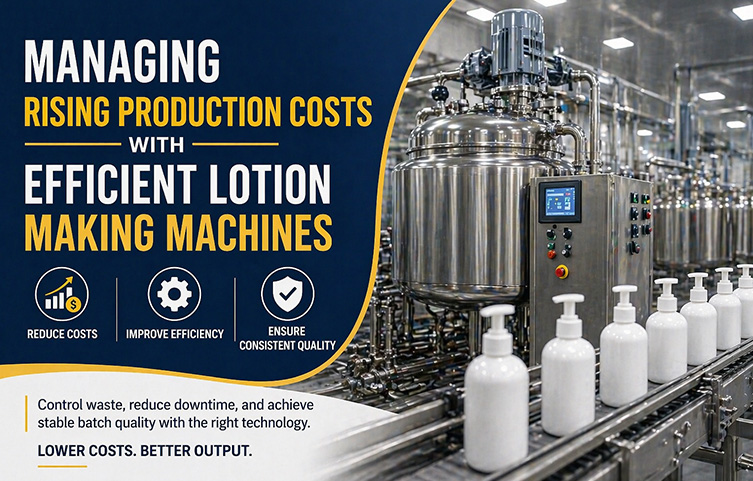
When lotion production cost starts rising, most factories first blame raw material prices. That is only part of the story. On the shop floor, cost usually leaks from small daily problems that keep repeating. A batch takes longer than planned. The operator adds extra thickener to correct texture. Mixing time stretches because the emulsion is not forming properly. Filling waits because the product is still too warm. By the end of the shift, output looks acceptable on paper, but the real cost per batch has already gone up.
This is a common situation in lotion manufacturing. The product may look simple from outside, yet the process is sensitive. Temperature, shear, mixing sequence, holding time, and transfer conditions all affect the final result. If one step is unstable, the factory pays for it through rework, waste, labor pressure, and downtime.
In many UAE, Saudi Arabia, and Oman facilities, the challenge is even sharper. Production teams deal with labor availability issues, pressure to meet dispatch deadlines, high ambient temperatures, and growing quality expectations from retail and export markets. Under these conditions, an efficient lotion making machine becomes less of a convenience and more of a cost-control tool.
How Lotion Production Usually Works in Real Plants
A typical lotion batch is not just mixing liquid ingredients together. The process usually moves through a few critical stages, and each stage can either protect margin or quietly damage it.
On paper, this sequence looks straightforward. In reality, this is where production losses begin. If heating is uneven, one side of the batch behaves differently from the other. If mixing speed is too low, dispersion becomes weak. If it is too high at the wrong stage, air can get trapped. If cooling is delayed, the next step waits. That waiting time is also a cost.
Where Factories Usually Lose Money
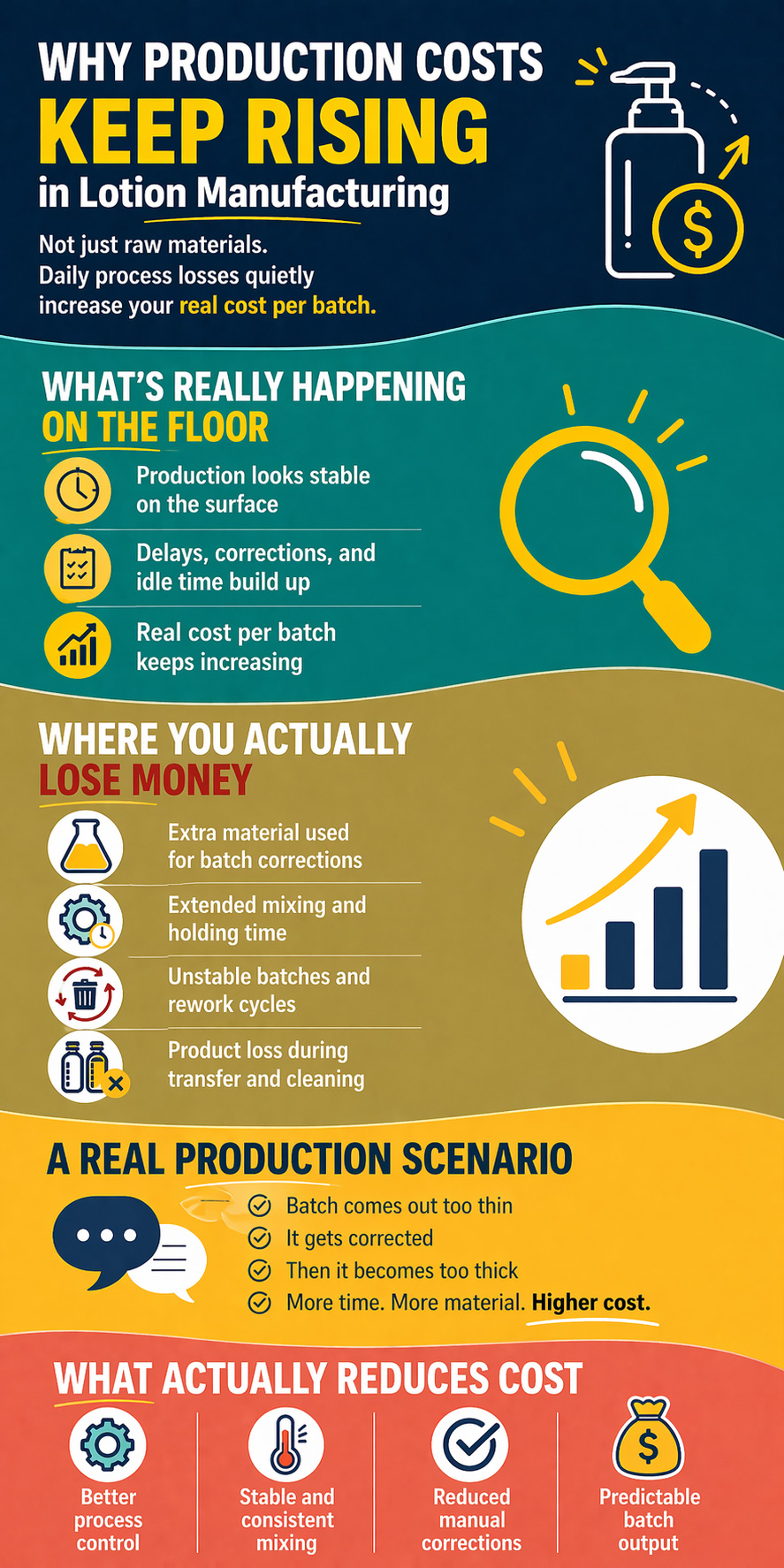
Most production losses in lotion manufacturing do not come from one big breakdown. They come from repeated operational friction.
A common example is batch correction. The lotion is too thin, so the team adjusts it. Then it becomes slightly heavy, so another correction is made. This adds raw material use, extra mixing time, more quality checks, and sometimes delayed filling. One correction may seem small. Over 20 or 30 batches a month, it becomes expensive.
Another problem is manual dependency. In many plants, the final quality still depends too much on operator experience. Skilled people are valuable, but a process should not rely entirely on memory, guesswork, or individual judgment. When one strong operator is absent, output quality should not suffer. Yet this happens often.
There is also product loss during transfer and cleaning. If the machine design leaves residue inside the tank, line, or valve area, the plant loses usable material every batch. In higher-value lotion products, even a 2% to 3% avoidable loss becomes serious over time.
The Wrong Assumption Many Teams Make
A lot of people assume faster production automatically means lower cost. It does not. In lotion manufacturing, higher speed without process control can actually increase total cost.
A rushed batch may give poor emulsification, unstable texture, or more entrapped air. The line may look fast at the mixing stage, but the time lost later in holding, correction, testing, rework, or slow filling wipes out the gain. Better output is not just about how quickly a tank turns. It is about how reliably one good batch moves to the next stage without trouble.
That is the real shift efficient plants make. They stop chasing speed alone and start chasing stable, repeatable output.
What an Efficient Lotion Making Machine Changes
A good lotion making machine improves cost control because it reduces variation. That is the main point. It gives the production team more control over the steps that normally create waste and inconsistency.
This does not mean every factory needs the most advanced setup. It means the machine should match the product behavior and the plant’s production reality. A machine that is oversized, too complex, or difficult to clean can create a different kind of cost problem.
What Changes After Implementation on the Shop Floor
Before a proper machine upgrade, the team often spends time reacting. They adjust. They wait. They correct. They recheck. The process feels busy, but not always productive.
After a suitable lotion making machine is in place, the process becomes calmer. That matters more than many people realize. Operators are not fighting the batch. Quality teams see fewer surprises. Filling receives product with better consistency. Planning becomes easier because batch time is more predictable.
In practical terms, factories often see measurable improvement such as:
The exact number depends on the formula, batch size, and current setup. Still, even small improvement in three areas together, waste, time, and rework, can noticeably reduce production cost per unit.
A Realistic Plant Scenario
Take a personal care factory producing lotions for local retail and export orders. The line runs acceptable output, but batch finish is inconsistent. Some batches fill smoothly. Others need extra holding time because viscosity drifts after cooling. The team is not facing a crisis, but they are constantly under pressure. Dispatch timing becomes tight. Packaging waits. Shift supervisors stay busy with avoidable correction work.
Once the factory moves to a more stable lotion making system with better temperature control and homogenization consistency, the biggest benefit is not just speed. It is predictability. The filling line gets product closer to the target condition, more often. Fewer adjustments are needed. Less time is wasted between departments. This is how cost starts coming down in a real plant, not through marketing claims, but through smoother daily execution.
Why GCC Conditions Make Machine Efficiency More Important
In Gulf production environments, process discipline matters more because the operating environment is already demanding. Heat can affect ingredient handling and product behavior. Skilled labor can be harder to retain for repetitive manual operations. Compliance expectations are increasing, especially when brands supply modern retail chains or export markets. Customers also expect better finish, better feel, and fewer quality variations.
That is why many manufacturers in UAE, KSA, and Oman are moving toward better controlled processing instead of depending on manual correction after the problem appears. Prevention costs less than correction.
What to Check Before Choosing a Lotion Making Machine
The right machine is not simply the one with the biggest capacity or the lowest price. A production manager should check how the system behaves in everyday factory conditions.
These questions matter because a cheap machine that creates extra waste, cleaning time, or production stoppage is not cheap in the long run.
This is a common situation in lotion manufacturing. The product may look simple from outside, yet the process is sensitive. Temperature, shear, mixing sequence, holding time, and transfer conditions all affect the final result. If one step is unstable, the factory pays for it through rework, waste, labor pressure, and downtime.
In many UAE, Saudi Arabia, and Oman facilities, the challenge is even sharper. Production teams deal with labor availability issues, pressure to meet dispatch deadlines, high ambient temperatures, and growing quality expectations from retail and export markets. Under these conditions, an efficient lotion making machine becomes less of a convenience and more of a cost-control tool.
How Lotion Production Usually Works in Real Plants
A typical lotion batch is not just mixing liquid ingredients together. The process usually moves through a few critical stages, and each stage can either protect margin or quietly damage it.
- Water phase ingredients are prepared and heated to the required temperature
- Oil phase materials are processed separately
- Both phases are combined under controlled mixing
- Homogenization is used to create a stable emulsion
- The batch is cooled while maintaining proper agitation
- Fragrance, active ingredients, or heat-sensitive additives are added at the right stage
- The final product is checked for viscosity, appearance, texture, and filling readiness
On paper, this sequence looks straightforward. In reality, this is where production losses begin. If heating is uneven, one side of the batch behaves differently from the other. If mixing speed is too low, dispersion becomes weak. If it is too high at the wrong stage, air can get trapped. If cooling is delayed, the next step waits. That waiting time is also a cost.
Where Factories Usually Lose Money
Most production losses in lotion manufacturing do not come from one big breakdown. They come from repeated operational friction.
A common example is batch correction. The lotion is too thin, so the team adjusts it. Then it becomes slightly heavy, so another correction is made. This adds raw material use, extra mixing time, more quality checks, and sometimes delayed filling. One correction may seem small. Over 20 or 30 batches a month, it becomes expensive.
Another problem is manual dependency. In many plants, the final quality still depends too much on operator experience. Skilled people are valuable, but a process should not rely entirely on memory, guesswork, or individual judgment. When one strong operator is absent, output quality should not suffer. Yet this happens often.
There is also product loss during transfer and cleaning. If the machine design leaves residue inside the tank, line, or valve area, the plant loses usable material every batch. In higher-value lotion products, even a 2% to 3% avoidable loss becomes serious over time.
The Wrong Assumption Many Teams Make
A lot of people assume faster production automatically means lower cost. It does not. In lotion manufacturing, higher speed without process control can actually increase total cost.
A rushed batch may give poor emulsification, unstable texture, or more entrapped air. The line may look fast at the mixing stage, but the time lost later in holding, correction, testing, rework, or slow filling wipes out the gain. Better output is not just about how quickly a tank turns. It is about how reliably one good batch moves to the next stage without trouble.
That is the real shift efficient plants make. They stop chasing speed alone and start chasing stable, repeatable output.
What an Efficient Lotion Making Machine Changes
A good lotion making machine improves cost control because it reduces variation. That is the main point. It gives the production team more control over the steps that normally create waste and inconsistency.
- Heating becomes more even and easier to control
- Mixing and homogenization stay consistent from batch to batch
- Vacuum support can reduce trapped air and improve product finish
- Ingredient incorporation becomes smoother and less dependent on operator guesswork
- Cooling can be managed in a more predictable way
- Discharge becomes cleaner, reducing leftover material in the system
This does not mean every factory needs the most advanced setup. It means the machine should match the product behavior and the plant’s production reality. A machine that is oversized, too complex, or difficult to clean can create a different kind of cost problem.
What Changes After Implementation on the Shop Floor
Before a proper machine upgrade, the team often spends time reacting. They adjust. They wait. They correct. They recheck. The process feels busy, but not always productive.
After a suitable lotion making machine is in place, the process becomes calmer. That matters more than many people realize. Operators are not fighting the batch. Quality teams see fewer surprises. Filling receives product with better consistency. Planning becomes easier because batch time is more predictable.
In practical terms, factories often see measurable improvement such as:
- 5% to 10% lower raw material overuse from fewer batch corrections
- 10% to 20% reduction in cycle delays between mixing and filling
- 15% to 30% lower rejection or rework in unstable products
- Cleaner transfer and discharge, reducing product hold-up losses
- Less operator fatigue from reduced manual intervention
The exact number depends on the formula, batch size, and current setup. Still, even small improvement in three areas together, waste, time, and rework, can noticeably reduce production cost per unit.
A Realistic Plant Scenario
Take a personal care factory producing lotions for local retail and export orders. The line runs acceptable output, but batch finish is inconsistent. Some batches fill smoothly. Others need extra holding time because viscosity drifts after cooling. The team is not facing a crisis, but they are constantly under pressure. Dispatch timing becomes tight. Packaging waits. Shift supervisors stay busy with avoidable correction work.
Once the factory moves to a more stable lotion making system with better temperature control and homogenization consistency, the biggest benefit is not just speed. It is predictability. The filling line gets product closer to the target condition, more often. Fewer adjustments are needed. Less time is wasted between departments. This is how cost starts coming down in a real plant, not through marketing claims, but through smoother daily execution.
Why GCC Conditions Make Machine Efficiency More Important
In Gulf production environments, process discipline matters more because the operating environment is already demanding. Heat can affect ingredient handling and product behavior. Skilled labor can be harder to retain for repetitive manual operations. Compliance expectations are increasing, especially when brands supply modern retail chains or export markets. Customers also expect better finish, better feel, and fewer quality variations.
That is why many manufacturers in UAE, KSA, and Oman are moving toward better controlled processing instead of depending on manual correction after the problem appears. Prevention costs less than correction.
What to Check Before Choosing a Lotion Making Machine
The right machine is not simply the one with the biggest capacity or the lowest price. A production manager should check how the system behaves in everyday factory conditions.
- Can it maintain stable heating and controlled cooling through the full batch?
- Is the mixing and homogenizing arrangement suitable for your lotion viscosity range?
- How much product remains inside after discharge?
- How easy is it to clean between batches and changeovers?
- Does the control system simplify operation or make it unnecessarily complicated?
- Can the machine support future product range expansion without major compromise?
- Is service support available quickly in your market when downtime happens?
These questions matter because a cheap machine that creates extra waste, cleaning time, or production stoppage is not cheap in the long run.



GET A QUOTE
Tell us about your business requirement, one of our technical expert will be in touch with you soon..!
PROCEED
NEW PRODUCTS ALERTS