How Smart Racking Layouts Improve Warehouse Efficiency
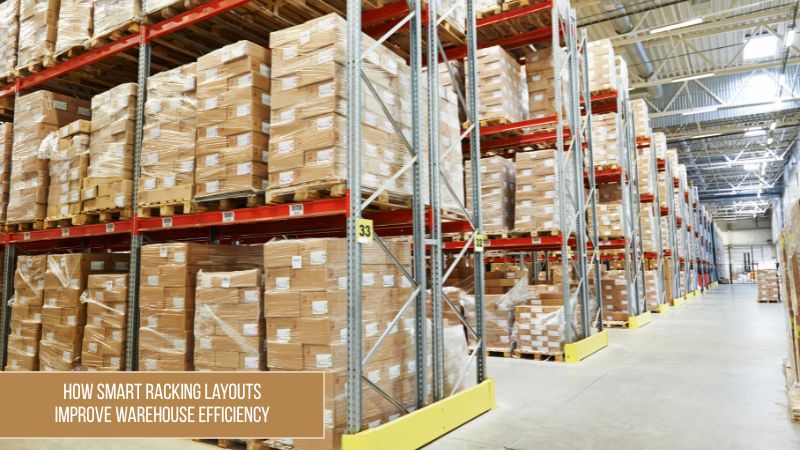
Warehouse efficiency is not only about having enough storage space. In many warehouses, delays happen because the layout is not planned around daily movement. Forklifts travel longer routes. Workers spend extra time searching for stock. Fast-moving items are kept too far from dispatch. Loading areas become crowded during peak hours. These small issues slowly reduce productivity.
A smart racking layout helps solve these problems by arranging storage, aisles, picking zones, and movement paths in a practical way. It does not simply add more racks. It improves how goods enter, move, get picked, and leave the warehouse.
For warehouses in the UAE, Saudi Arabia, Oman, and the wider Middle East, this matters even more. High rental costs, labour availability, heat conditions, fast delivery expectations, and safety requirements all put pressure on warehouse operations. A poor layout increases this pressure. A well-planned layout helps control it.
Where Warehouse Efficiency Is Usually Lost
Many warehouses lose time before anyone notices the real reason. The team may blame manpower shortage, forklift delays, or slow picking. But often, the problem starts with the racking layout itself.
When fast-moving products are stored deep inside the warehouse, every order takes longer. When aisles are not matched to forklift movement, operators slow down or wait for clearance. When inbound and outbound goods cross the same path, congestion becomes normal. These layout mistakes create daily delays.
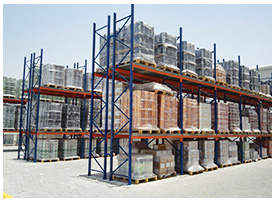
Another common issue is unused vertical space. Some warehouses keep expanding floor space while the available height is not properly used. This increases rental and handling costs without solving the storage problem fully.
What Makes a Racking Layout Smart?
A smart racking layout is planned based on actual warehouse activity. It considers product movement, picking frequency, equipment type, aisle width, stock rotation, and future growth.
The goal is simple: reduce unnecessary movement and make every process smoother.
Fast-moving items should be closer to the picking and dispatch areas. Slow-moving stock can be placed in less active zones. Heavy or bulky goods need safe and accessible storage positions. Items with expiry dates may need FIFO or FEFO flow to avoid old stock sitting behind new stock.
This kind of planning improves speed without forcing workers to rush. That is important. Efficiency should come from better layout, not from putting more pressure on people.
How Smart Racking Layouts Improve Speed
Speed improves when the warehouse layout supports the natural flow of work. Goods should move from receiving to storage, then to picking, packing, and dispatch with minimum backtracking.
If workers or forklifts keep crossing the same areas repeatedly, the layout is slowing the operation. A better layout reduces travel distance, waiting time, and confusion. This helps teams complete more work in the same shift.
In busy warehouses, even saving a few minutes per order can make a big difference across the month. Faster picking, smoother replenishment, and cleaner movement paths all support better output.
How Layout Planning Reduces Warehouse Delays
Warehouse delays usually come from blocked aisles, poor stock placement, unclear zones, and equipment movement issues. Smart racking layouts reduce these problems by giving every activity a clear place.
Receiving areas should not block dispatch. Picking paths should not clash with bulk storage movement. High-demand SKUs should not be stored in hard-to-reach locations. If these basics are handled properly, daily delays naturally reduce.
A well-planned layout also helps supervisors manage the floor better. When zones are clear, it becomes easier to track stock, assign workers, and identify bottlenecks.
 Practical Racking Layout Ideas That Help
Efficiency should never come at the cost of safety. Poor racking layouts increase the risk of forklift collisions, product damage, worker injuries, and blocked emergency routes.
Smart layout planning creates safer movement paths. It reduces blind corners, unnecessary reversing, and crowded aisles. Proper spacing also helps forklift operators move with better control, especially during busy shifts.
In Middle East warehouses, heat and long working hours can also affect workers' focus. A clear, simple, and well-organized layout helps reduce physical strain and avoid confusion on the floor.
Key Factors to Check Before Finalizing a Racking Layout
A smart racking layout is not just a storage decision. It is an operational decision. The right layout can improve speed, reduce delays, increase storage capacity, and make warehouse work safer.
For businesses dealing with labour pressure, high storage costs, and growing order volumes, layout planning should be taken seriously from the beginning. A well-designed racking system helps the warehouse move better every day, not only to store more goods.
When racks, aisles, equipment, and workflow are planned together, the warehouse becomes faster, safer, and easier to manage.
A smart racking layout helps solve these problems by arranging storage, aisles, picking zones, and movement paths in a practical way. It does not simply add more racks. It improves how goods enter, move, get picked, and leave the warehouse.
For warehouses in the UAE, Saudi Arabia, Oman, and the wider Middle East, this matters even more. High rental costs, labour availability, heat conditions, fast delivery expectations, and safety requirements all put pressure on warehouse operations. A poor layout increases this pressure. A well-planned layout helps control it.
Where Warehouse Efficiency Is Usually Lost
Many warehouses lose time before anyone notices the real reason. The team may blame manpower shortage, forklift delays, or slow picking. But often, the problem starts with the racking layout itself.
When fast-moving products are stored deep inside the warehouse, every order takes longer. When aisles are not matched to forklift movement, operators slow down or wait for clearance. When inbound and outbound goods cross the same path, congestion becomes normal. These layout mistakes create daily delays.
Another common issue is unused vertical space. Some warehouses keep expanding floor space while the available height is not properly used. This increases rental and handling costs without solving the storage problem fully.
What Makes a Racking Layout Smart?
A smart racking layout is planned based on actual warehouse activity. It considers product movement, picking frequency, equipment type, aisle width, stock rotation, and future growth.
The goal is simple: reduce unnecessary movement and make every process smoother.
Fast-moving items should be closer to the picking and dispatch areas. Slow-moving stock can be placed in less active zones. Heavy or bulky goods need safe and accessible storage positions. Items with expiry dates may need FIFO or FEFO flow to avoid old stock sitting behind new stock.
This kind of planning improves speed without forcing workers to rush. That is important. Efficiency should come from better layout, not from putting more pressure on people.
How Smart Racking Layouts Improve Speed
Speed improves when the warehouse layout supports the natural flow of work. Goods should move from receiving to storage, then to picking, packing, and dispatch with minimum backtracking.
If workers or forklifts keep crossing the same areas repeatedly, the layout is slowing the operation. A better layout reduces travel distance, waiting time, and confusion. This helps teams complete more work in the same shift.
In busy warehouses, even saving a few minutes per order can make a big difference across the month. Faster picking, smoother replenishment, and cleaner movement paths all support better output.
How Layout Planning Reduces Warehouse Delays
Warehouse delays usually come from blocked aisles, poor stock placement, unclear zones, and equipment movement issues. Smart racking layouts reduce these problems by giving every activity a clear place.
Receiving areas should not block dispatch. Picking paths should not clash with bulk storage movement. High-demand SKUs should not be stored in hard-to-reach locations. If these basics are handled properly, daily delays naturally reduce.
A well-planned layout also helps supervisors manage the floor better. When zones are clear, it becomes easier to track stock, assign workers, and identify bottlenecks.
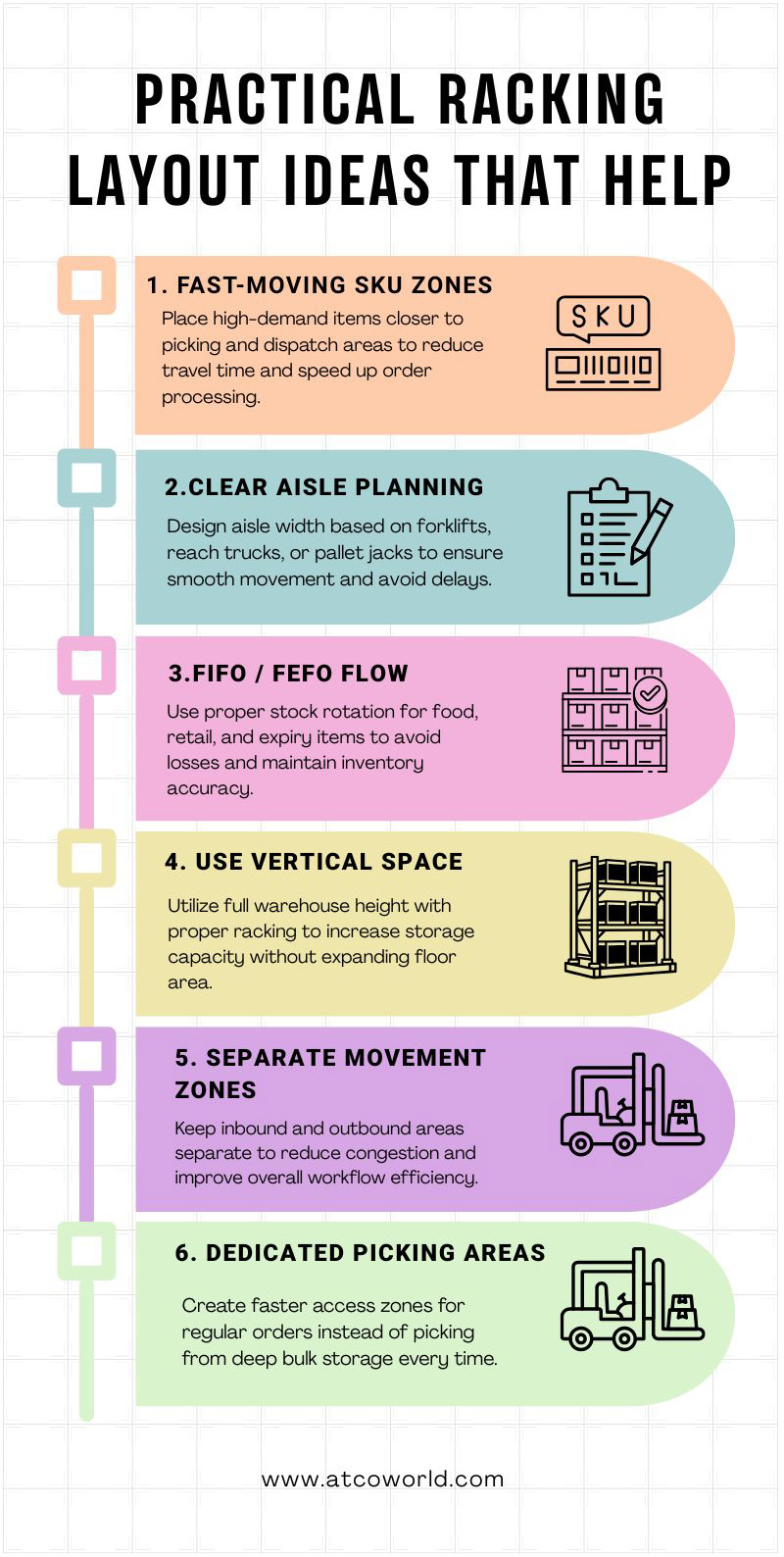
- Fast-Moving SKU Zones: Keep high-demand products near picking, packing, or dispatch areas to reduce travel time.
- Clear Aisle Planning: Match aisle width with the forklift, reach truck, or pallet truck used in the warehouse.
- FIFO / FEFO Flow: Useful for food, packaging, retail, and expiry-based stock where rotation is important.
- Vertical Storage Use: Use warehouse height properly to improve capacity without increasing floor area.
- Separate Inbound and Outbound Movement: Reduce traffic clashes between receiving, storage, and dispatch teams.
- Dedicated Picking Areas: Create faster access zones for regular orders instead of picking from deep bulk storage every time.
Efficiency should never come at the cost of safety. Poor racking layouts increase the risk of forklift collisions, product damage, worker injuries, and blocked emergency routes.
Smart layout planning creates safer movement paths. It reduces blind corners, unnecessary reversing, and crowded aisles. Proper spacing also helps forklift operators move with better control, especially during busy shifts.
In Middle East warehouses, heat and long working hours can also affect workers' focus. A clear, simple, and well-organized layout helps reduce physical strain and avoid confusion on the floor.
Key Factors to Check Before Finalizing a Racking Layout
- Warehouse Size and Height: The layout should use both floor area and vertical space effectively.
- Type of Goods Stored: Pallets, cartons, long items, fragile goods, or heavy products all need different planning.
- Stock Movement: Fast-moving and slow-moving items should not be treated the same.
- Handling Equipment: Forklift type, reach truck capacity, and turning radius affect aisle design.
- Order Picking Method: Full pallet picking and small-item picking require different layouts.
- Future Expansion: The layout should allow growth without major redesign or downtime.
A smart racking layout is not just a storage decision. It is an operational decision. The right layout can improve speed, reduce delays, increase storage capacity, and make warehouse work safer.
For businesses dealing with labour pressure, high storage costs, and growing order volumes, layout planning should be taken seriously from the beginning. A well-designed racking system helps the warehouse move better every day, not only to store more goods.
When racks, aisles, equipment, and workflow are planned together, the warehouse becomes faster, safer, and easier to manage.


GET A QUOTE
Tell us about your business requirement, one of our technical expert will be in touch with you soon..!
PROCEED
NEW PRODUCTS ALERTS