Horizontal Rotary vs Vertical Sealer: Which Is Right for Your Packaging Line?
A flow wrapper may be running at the correct speed, using the right film, and still produce seal failures, damaged packs, or inconsistent package appearance.
When this happens, many production teams focus on temperature settings, film quality, or operator adjustments.
The real issue can be much simpler.
The sealing system may not match the product or production requirement.
For food manufacturers packaging bread, biscuits, snacks, fresh produce, samoon, and bakery products, the choice between a horizontal rotary sealer and a vertical sealer can directly affect production stability, packaging quality, and overall equipment performance.
Understanding how these two sealing systems operate helps production managers make more informed equipment decisions and avoid costly mistakes later.
In a horizontal flow wrapper, packaging film is formed around the product before transverse seals create individual packs.
Although the sealing section is only one part of the machine, it directly affects production speed, seal integrity, product appearance, and machine reliability.
Many buyers compare machine specifications based primarily on maximum output.
However, packaging performance is often determined by how consistently the sealing system handles real production conditions rather than how fast the machine can theoretically operate.
A packaging line producing fewer rejects at a stable speed frequently delivers better results than one chasing maximum output while suffering frequent stoppages.
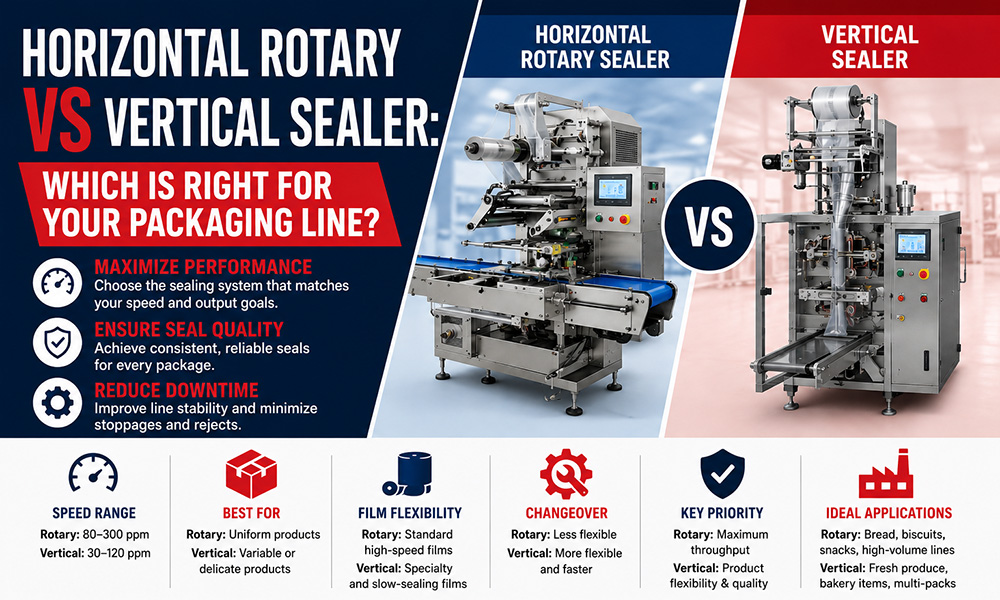
| Factor | Horizontal Rotary | Vertical Sealer |
|---|---|---|
| Typical Speed | 80–300 packs per minute | 30–120 packs per minute |
| Sealing Motion | Continuous motion | Intermittent motion |
| Best For | Uniform products | Variable or delicate products |
| Common Applications | Bread, biscuits, snacks | Fresh produce, specialty bakery items |
| Film Suitability | Standard high-speed films | Specialty and slower-sealing films |
| Main Priority | Maximum throughput | Product flexibility |
A horizontal rotary sealing system uses rotating sealing jaws that move continuously with the film and product flow.
Because the jaws remain in motion, products pass through the sealing area without stopping between cycles.
This continuous movement allows higher operating speeds and smoother product handling.
Rotary sealers are commonly used for:
- Bread and samoon production
- Biscuits and cookies
- Snack foods
- Chocolate products
- High-volume bakery operations
Large industrial bakeries in Saudi Arabia and high-output snack manufacturers across the GCC frequently use rotary sealing systems where production targets require hundreds of packs per minute.
Practical Insight One interesting observation is that continuous-motion packaging often reduces product handling stress. Products experience fewer abrupt movements, helping maintain package consistency at higher speeds.
Vertical sealing systems operate differently.
The product typically pauses briefly while the sealing jaws complete the sealing cycle. Once the seal is formed, the package advances to the next stage.
Although this process generally produces lower output rates, it offers greater control when handling products that vary in size, shape, or positioning.
Typical applications include:
- Fresh produce
- Date packaging
- Delicate bakery products
- Multi-pack formats
- Products with inconsistent dimensions
Factories packaging specialty breads, premium baked goods, or products with frequent format changes often benefit from the additional flexibility provided by vertical sealing systems.
In these situations, consistent package quality may be more valuable than achieving maximum throughput.
Film compatibility is often overlooked during machine evaluation.
Many food manufacturers focus heavily on machine capacity while giving limited attention to the packaging materials that will be used over the machine's lifetime.
Modern food packaging operations use a variety of materials, including polypropylene films, laminated structures, barrier films, and recyclable packaging materials.
Some films perform exceptionally well in high-speed continuous-motion applications. Others require longer sealing dwell times to achieve reliable seal quality.
As sustainability initiatives continue expanding across the UAE, Oman, Saudi Arabia, and the wider Gulf region, manufacturers are increasingly evaluating recyclable and alternative packaging materials.
Selecting a sealing system that supports future packaging requirements can help avoid expensive modifications later.
One of the most common mistakes during equipment selection is focusing exclusively on machine speed.
A production manager may see a rotary system capable of running at 250 or 300 packs per minute and assume it automatically represents the better investment.
In reality, production requirements should drive the decision.
If upstream equipment supplies only 100 products per minute, much of that additional packaging capacity may never be used.
Similarly, if operators regularly stop the machine to manage product variation, theoretical machine speed becomes less important than production consistency.
The goal is not necessarily the fastest machine.
The goal is the most stable packaging line.
A horizontal rotary sealer is often a practical choice when:
- Products have consistent dimensions
- High production output is required
- Continuous operation is a priority
- Production targets exceed 100 packs per minute
- Downtime reduction is critical
Bread factories, biscuit manufacturers, and snack producers frequently fall into this category.
A vertical sealer is often preferred when:
- Products vary in size or shape
- Packaging formats change frequently
- Product protection is critical
- Specialty films are used
- Production flexibility is more important than maximum speed
This is common in fresh produce operations, premium bakery production, and specialty food packaging environments.
The choice between a horizontal rotary sealer and a vertical sealer is rarely about determining which technology is better.
Both systems have proven their value across food manufacturing operations throughout the GCC.
The more useful question is whether the production line requires maximum throughput or greater flexibility.
A bread manufacturer producing thousands of packs per hour may prioritize continuous operation and speed.
A producer handling delicate bakery products or multiple package formats may place greater value on control and adaptability.
Before comparing machine specifications, consider where the biggest challenge exists today.
Is your packaging line limited by speed, or is it limited by consistency?
The answer often provides a clearer direction than any machine brochure or technical specification sheet.


GET A QUOTE
Tell us about your business requirement, one of our technical expert will be in touch with you soon..!
NEW PRODUCTS ALERTS