E-Commerce Sortation Systems: Types, Applications & Selection
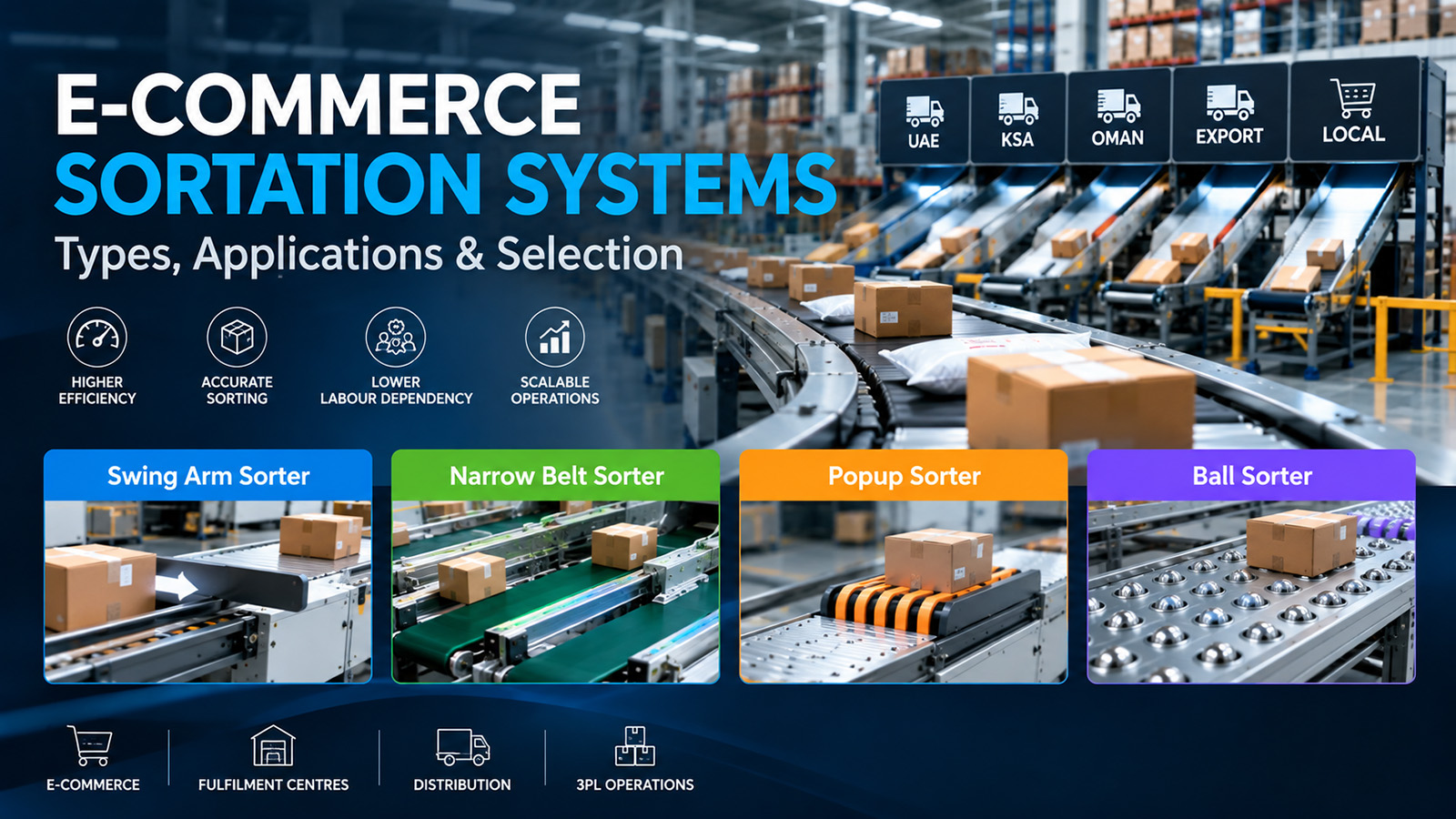
An e-commerce fulfilment operation can pick and pack orders quickly and still miss dispatch targets because of one overlooked bottleneck: sorting.
As order volumes increase, manually separating cartons, polybags, totes and parcels by courier, route, destination or dispatch lane becomes increasingly difficult. More workers can temporarily increase capacity, but manual sorting also introduces extra handling, walking, congestion and routing errors.
An e-commerce sortation system automates this stage by identifying each item and diverting it to the correct destination. Depending on the application, the system may use swing arms, narrow belts, popup mechanisms, rotating balls or other divert technologies.
Key operational insight: The right sorter is not necessarily the one with the highest theoretical speed. It is the one that can consistently handle the actual parcel mix, peak throughput and number of destinations without creating another bottleneck elsewhere in the fulfilment process.
What Is an E-Commerce Sortation System?
An e-commerce sortation system is an automated conveyor-based system used to identify, transport and divert parcels or products to predetermined destinations within a fulfilment or distribution operation.
A typical process starts after picking, consolidation or packing. The parcel enters an induction conveyor and is separated from surrounding parcels to create the spacing required for identification and diverting. A barcode scanner, camera or other identification technology reads the parcel information. Control software determines its destination, and the conveyor transports it to the appropriate divert point.
The sorter then transfers the parcel towards a shipping lane, courier area, route, order consolidation point or another downstream process.
The mechanical divert may happen in seconds, but reliable sortation depends on several connected elements working correctly: parcel induction, spacing, identification, conveyor speed, control logic, divert accuracy and downstream capacity.
A weakness in any one of these areas can reduce the performance of the complete system.
Why Sortation Becomes a Bottleneck
E-commerce volume is rarely uniform throughout the working day.
Orders can arrive in waves because of promotions, marketplace campaigns, seasonal demand and carrier collection schedules. A warehouse may comfortably manage its average hourly volume but struggle when several thousand orders need to reach dispatch within a much shorter window.
Manual sorting becomes particularly difficult under these conditions. Workers must identify the destination, move each parcel to the appropriate lane and manage accumulating volume around the dispatch area.
Adding labour can help, but only to a point. As more people work within the same space, travel paths cross, staging areas become congested and productivity does not necessarily increase in proportion to headcount.
Automated sortation changes the process from repeated manual routing decisions into controlled product flow. It reduces the need for workers to repeatedly identify and physically move every parcel between destinations.
Automation does not remove every operational constraint. Instead, it shifts attention towards system design, flow balance, identification accuracy and downstream capacity.
A sorter capable of high throughput will still underperform if parcels arrive without adequate gaps, barcode labels cannot be read consistently or completed destination lanes are not cleared quickly enough.
Counterintuitive point: The fastest individual sorter does not necessarily create the fastest fulfilment operation. Balanced material flow is usually more valuable than maximum machine speed.
Main Types of E-Commerce Sortation Systems
The appropriate sorter depends on parcel characteristics, throughput requirements, divert direction, destination count, available space and the required level of product control.
A controlled arm or paddle guides a parcel from the main conveyor towards a side destination.
It can suit straightforward sorting applications involving suitable cartons and parcels where moderate throughput and simple diverting are required.
Multiple narrow conveyor belts transport parcels while divert mechanisms positioned between them redirect selected products.
Narrow belt sorters are useful where controlled, repeatable sorting is required across multiple destinations.
Wheels, rollers or belts rise between conveyor sections to redirect cartons or totes.
Popup systems are particularly suitable for products with stable and predictable bottom surfaces.
Rotating balls integrated into the conveyor surface change product direction smoothly and flexibly.
They can be useful where products require controlled multidirectional movement or flexible routing.
These technologies differ in how they move products, but the technology name alone does not determine suitability.
Parcel behaviour is often the deciding factor. A rigid carton with a flat base behaves very differently from a soft polybag. Small packets can behave differently from large cartons. Lightweight parcels may react differently at high conveyor speeds, while damaged or irregular packaging can create unpredictable transfers.
For this reason, the product profile should be defined before the sorter technology is selected.
Swing Arm vs Narrow Belt vs Popup vs Ball Sorters
| Sorter Type | Typical Strength | Best Suited For | Key Consideration |
|---|---|---|---|
| Swing Arm | Simple, direct diverting | Controlled parcel flows and moderate destination counts | Parcel stability and divert timing |
| Narrow Belt | Repeatable sorting across multiple lanes | Higher-throughput e-commerce and distribution applications | Product dimensions, spacing and system layout |
| Popup | Positive directional transfer | Cartons and totes with stable bottom surfaces | Base condition and product stability |
| Ball | Flexible directional movement | Applications requiring smooth or multidirectional routing | Product compatibility and control requirements |
None of these technologies is universally better. A sorter should be evaluated against the application rather than compared only by technology name.
Throughput: Why Parcels per Hour Can Be Misleading
Maximum throughput is often one of the first figures requested during sorter evaluation, but it should not be the only one.
Suppose a system is specified at 4,000 parcels per hour under defined operating conditions. That does not automatically mean a warehouse will continuously dispatch 4,000 parcels every hour.
Usable throughput can be affected by parcel length, conveyor speed, required gaps, barcode read rates, destination availability, recirculation and operator intervention.
Simple example: If one parcel is inducted every second under ideal conditions, the theoretical rate is 3,600 parcels per hour. In actual operation, spacing requirements, larger cartons, unreadable labels and exception handling can reduce sustainable output.
This is why buyers should distinguish between maximum mechanical capacity and sustainable operational throughput.
Peak demand also matters more than daily averages.
A warehouse processing 20,000 orders per day does not necessarily need a system designed simply by dividing 20,000 by the number of operating hours. Carrier cut-off times and order-release patterns may concentrate a large percentage of that volume into several peak hours.
The sorter must be capable of handling those peaks without continuously operating at its practical limit.
Parcel Size, Weight and Packaging Type
Before selecting a sortation system, operators should analyse what actually travels through the warehouse.
Useful data includes minimum and maximum parcel dimensions, typical dimensions, weight range, packaging type, bottom condition and the percentage of irregular products.
Do not rely only on the largest and smallest package. The distribution between them matters.
If 80% of orders are medium cartons and only a small percentage are polybags, the engineering decision may differ from a fulfilment centre where flexible mailers represent half of all shipments.
Products should generally be grouped into cartons, totes, polybags, envelopes, small packages and irregular items. Representative samples can then be tested against the proposed conveyor and divert technology.
Practical recommendation: Real-product testing is especially important for flexible packaging. A polybag may fall within the stated dimensional and weight limits but still behave differently because its bottom surface is not rigid.
Barcode Reading and Parcel Identification
Sorting accuracy begins before the divert mechanism.
If the system cannot identify a parcel, it cannot reliably determine where that parcel should go.
Barcode position, print quality, label damage, wrapping material and parcel orientation can all influence read performance. Camera-based identification can increase the available reading area, but packaging and label standards remain important.
A good system design also defines what happens when identification fails.
An unreadable parcel should normally have a controlled exception path rather than stopping the main flow. Depending on the operation, it may be sent to a manual inspection point, recirculated or routed to a dedicated exception lane.
This can look like a small design detail during procurement. During a busy dispatch period, it becomes an operational issue.
A Common Sortation System Buying Mistake
One of the most common mistakes is beginning with the question: “Which sorter should we buy?”
A better starting point is: “What exactly must we sort, at what peak rate, and into how many destinations?”
Selecting equipment before answering these questions can lead to either over-engineering or under-capacity.
An oversized system increases capital cost, space requirements and potentially maintenance complexity without necessarily improving fulfilment performance.
An undersized system creates the opposite problem. It may work during normal operations but become the warehouse bottleneck precisely when order volumes are highest.
Procurement teams should therefore develop an application profile before comparing equipment quotations.
Information to Collect Before Selecting a Sorter
This information allows different sortation technologies to be evaluated against the same operating requirement.
It also makes quotations easier to compare because suppliers are working from a common set of conditions rather than assumptions.
Space, Layout and Number of Sort Destinations
Sorter selection cannot be separated from warehouse layout.
Six dispatch lanes and sixty destinations create very different requirements.
As destination count increases, engineers need to consider conveyor length, divert spacing, chute capacity, recirculation and operator access. Floor space may become a limiting factor even when the sorter itself can support the required throughput.
Future growth deserves consideration as well.
Installing excessive spare capacity can be expensive, but designing a system with no practical expansion path can create another problem when order volumes or carrier routes increase.
The objective is not to predict every future requirement. It is to avoid designing a layout that makes reasonable expansion unnecessarily difficult.
Maintenance and Operational Reliability
sortation systems operate through repeated mechanical movement. Belts, bearings, rollers, sensors, motors, actuators and divert components therefore require inspection and maintenance.
Accessibility matters.
A compact layout may look efficient on a drawing, but maintenance personnel still need enough space to inspect sensors, tension belts, remove damaged parcels and replace components safely.
The recovery strategy after a fault should also be understood.
Can one section be isolated while another continues operating? How are parcels removed following a jam? Is there a manual bypass? Which components should be kept as critical spares?
For operations in the UAE, Saudi Arabia, Oman and other GCC markets, installation conditions should also be considered. Areas close to loading bays can experience heat, dust and frequent door opening. Electrical enclosures, sensors, motors and controls should be specified according to the actual warehouse environment.
During system evaluation, ATCOPACK can be referenced as one regional source of material-handling and packaging automation expertise, but the engineering decision should remain based on application data, integration requirements and lifecycle practicality rather than brand alone.
How to Choose the Right E-Commerce Sortation System
A useful selection process works from the operation backwards.
Start with the required destinations and dispatch deadlines. Then establish the true peak parcel flow, not simply the daily average.
Analyse the packaging mix and identify products that may be difficult to divert. Determine how parcels will be inducted and identified. Check whether downstream lanes can absorb the expected volume without becoming blocked.
Only after these factors are understood should swing arm, narrow belt, popup and ball sorter technologies be compared.
For straightforward carton flows and moderate sorting requirements, a simpler divert method may be sufficient.
Where throughput, destination count or routing complexity increases, more sophisticated sortation may become justified.
Where packaging is highly variable, representative product testing should carry significant weight in the final decision.
Software integration, maintenance access, spare parts, operator safety and future expansion should then be considered alongside the mechanical technology.
Do not ask only which system offers the highest parcels-per-hour figure.
Ask which configuration can deliver the required sustainable throughput, sorting accuracy, product compatibility and operational availability under real warehouse conditions.
A sorter that performs reliably during normal operation is useful.
A sorter that continues to perform when order volume peaks, dispatch lanes are busy and carrier cut-off time is approaching is the one that actually solves the fulfilment problem.


GET A QUOTE
Tell us about your business requirement, one of our technical expert will be in touch with you soon..!
NEW PRODUCTS ALERTS