CubiScan Freight Dimensioning Systems for Couriers and 3PLs
A busy parcel sorting hub can process hundreds or even thousands of shipments during a single shift. Parcels arrive from different customers, carton sizes vary significantly, and dispatch schedules are often tight. While forkliftsforklifts move pallets, conveyors move cartons, and warehouse teams keep freight flowing, one less visible issue can quietly affect profitability: inaccurate shipment dimensions and weight information.
A carton measured incorrectly by just a few centimetres may lead to wrong dimensional weight calculations. A shipment entered manually into the system may create billing disputes later. When these small errors happen repeatedly throughout the day, they can affect freight charges, warehouse planning, transport utilization, and customer confidence.
This is why many courier companies, fulfillment centres, and third-party logistics providers evaluate CubiScan Freight Dimensioning Systems as part of a wider logistics automation and data accuracy strategy.
Why Freight Measurement Accuracy Matters
Warehouse managers often focus on forklift productivity, storage capacity, picking speed, and dispatch performance. These are important, but shipment data accuracy plays an equally important role in daily logistics efficiency.
Most courier and 3PL businesses calculate freight charges based on actual weight, dimensional weight, or a combination of both. When shipment dimensions are recorded incorrectly, the operation may undercharge, overcharge, or create differences between carrier records and customer invoices.
The issue becomes more serious as shipment volume increases. A facility processing large parcel volumes every day may generate thousands of freight records every week. Small measurement errors multiplied across many shipments can create a noticeable impact on revenue, administration time, and operational planning.
In busy logistics environments across the UAE, Saudi Arabia, Oman, and the wider GCC, speed and accuracy are both important. Customers expect faster deliveries, while logistics operators must control transport cost, labour dependency, and billing accuracy.
Common Challenges with Manual Freight Measurement
Many warehouses still depend on tape measures, separate weighing scales, handwritten notes, and manual data entry. This may look simple at first, but it often creates hidden inefficiencies during peak operations.
- Human measurement errors during busy shifts
- Inconsistent dimension recording between different operators
- Manual data entry mistakes in shipping or billing systems
- Slower parcel processing during peak dispatch hours
- Difficulty measuring irregular cartons, polybags, and mixed freight
- Billing discrepancies, customer queries, and freight disputes
A common mistake is assuming that manual measurements remain accurate even when the warehouse is under pressure. In reality, operator fatigue, urgent loading schedules, and high shipment volumes increase the chance of errors.
When a dispatch team is trying to clear orders quickly, measurement accuracy can unintentionally become a secondary priority. The result may not be visible immediately, but it often appears later as billing corrections, transport inefficiency, or customer complaints.
How CubiScan Freight Dimensioning Systems Work
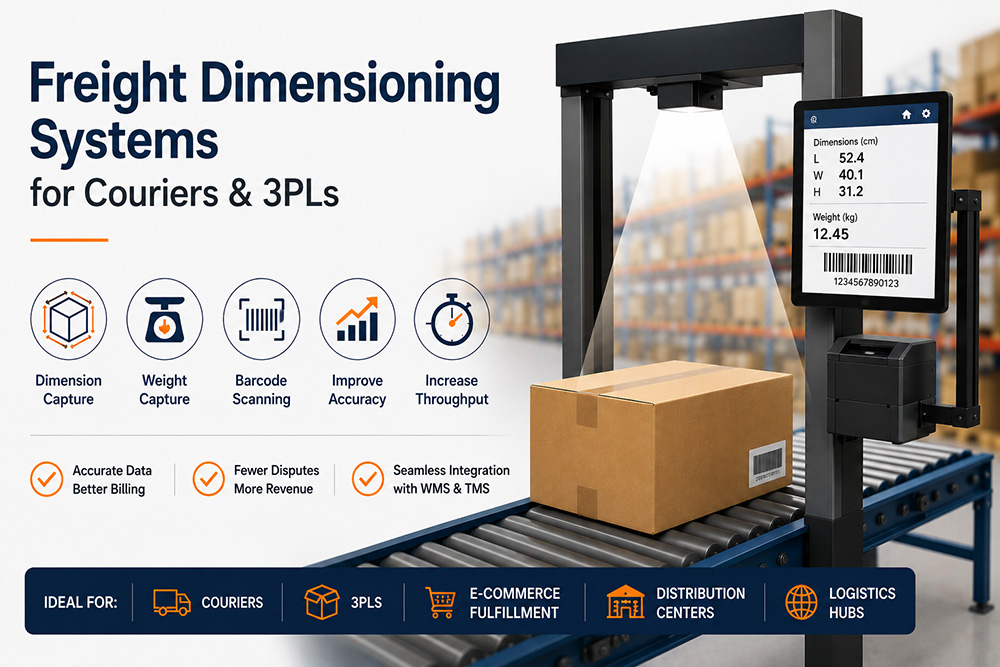
CubiScan Freight Dimensioning Systems automate the capture of shipment dimensions, weight, and identification data. Instead of relying on manual measurements, the system records freight information through an integrated process that combines dimensioning, weighing, and scanning.
As a parcel, carton, polybag, or freight item moves through the measurement station, the system captures length, width, height, weight, and barcode information. This data can then be transferred into warehouse management systems, transportation management systems, shipping software, or ERP platforms.
The main advantage is consistency. Each shipment is measured using a standard method, regardless of operator, shift, workload, or dispatch pressure. For 3PLs handling different customer accounts, this consistency helps create more reliable freight records.
Dimension
Length, width, and height capture
Weight
Accurate shipment weight data
Scan
Barcode and shipment ID capture
Record
Data sent to WMS, TMS, ERP, or billing software
Benefits for Couriers and 3PL Operations
Many companies first consider freight dimensioning systems to improve billing accuracy. This is important, but the operational benefits usually go further.
Accurate shipment data helps improve transport planning, warehouse slotting, vehicle loading, freight consolidation, and storage decisions. When teams know the actual dimensions of every shipment, they can make better decisions about space, movement, and dispatch priority.
For courier hubs, faster and more accurate parcel processing can reduce bottlenecks during peak hours. For 3PL companies, reliable freight data supports transparent customer billing and consistent service across multiple accounts.
E-commerce fulfillment centres can also benefit from better dimensional data because it supports carton selection, packing accuracy, and shipping cost control. In cold storage or food distribution operations, reducing unnecessary handling can also help maintain smoother movement through controlled zones.
The Hidden Cost of Poor Freight Data
One overlooked cost is revenue leakage caused by under-measured freight. When shipment dimensions are recorded smaller than actual size, dimensional weight calculations may not reflect the real transport space used.
The financial impact of one shipment may look small. Across thousands of shipments every month, the cumulative effect can become significant.
Another hidden cost is administrative effort. Teams may spend valuable time resolving billing disputes, checking shipment records, and correcting freight data that could have been captured accurately at the start of the process.
Poor data can also affect vehicle utilization. If transport teams plan loading based on estimated shipment sizes, vehicles may leave with unused space or face last-minute loading changes at the dock.
What to Check Before Selecting a Freight Dimensioning System
Not every operation has the same requirement. A courier hub handling small parcels may need a different setup from a 3PL warehouse handling mixed cartons, pallets, and irregular freight.
- Average daily shipment volume and peak-hour load
- Parcel, carton, polybag, and freight size range
- Required measurement accuracy for billing and operations
- Barcode scanning and shipment identification needs
- Integration with WMS, TMS, ERP, or courier software
- Available floor space near receiving, sorting, packing, or dispatch
- Calibration, maintenance, and operator training requirements
Workflow design is also important. A dimensioning system should support the movement of freight, not create a new bottleneck. Placement within receiving, sorting, packing, or dispatch can strongly influence productivity.
Safety, Maintenance, and Long-Term Reliability
Although freight dimensioning systems are mainly associated with data capture, safety and reliability should not be ignored.
Repeated manual handling of parcels for measurement can increase operator fatigue and repetitive strain risk. Automated measurement can reduce unnecessary handling while keeping the process more consistent.
Regular calibration, software updates, and preventive maintenance are important for long-term accuracy. Even advanced systems depend on correct setup and maintenance discipline to deliver reliable operational data.
In high-temperature warehouse conditions common in the Middle East, equipment placement, ventilation, power stability, and maintenance access should also be considered during planning.
As shipment volumes grow and logistics operations become more data-driven, the quality of freight information becomes just as important as the speed of freight movement. Before evaluating a CubiScan Freight Dimensioning System, managers should ask one practical question: does the current shipment data truly reflect the freight moving through the facility, or are hidden inaccuracies affecting cost, billing accuracy, and planning decisions every day?


GET A QUOTE
Tell us about your business requirement, one of our technical expert will be in touch with you soon..!
NEW PRODUCTS ALERTS