Burger and Sausage Production Equipment: Patty Formers, Meatball Machines & Meat Stuffers
When Manual Meat Preparation Becomes a Bottleneck
A central kitchen may begin the day with orders for burger patties, meatballs, and sausages for several outlets. At first, the team manages the work by hand. One person weighs portions, another shapes patties, and another fills sausage casings.
As production increases, the process becomes harder to control. Patty weights begin to vary. Meatballs are not uniform. Sausages may be overfilled, underfilled, or twisted at different lengths. More staff are added, but the section still struggles to maintain speed and consistency.
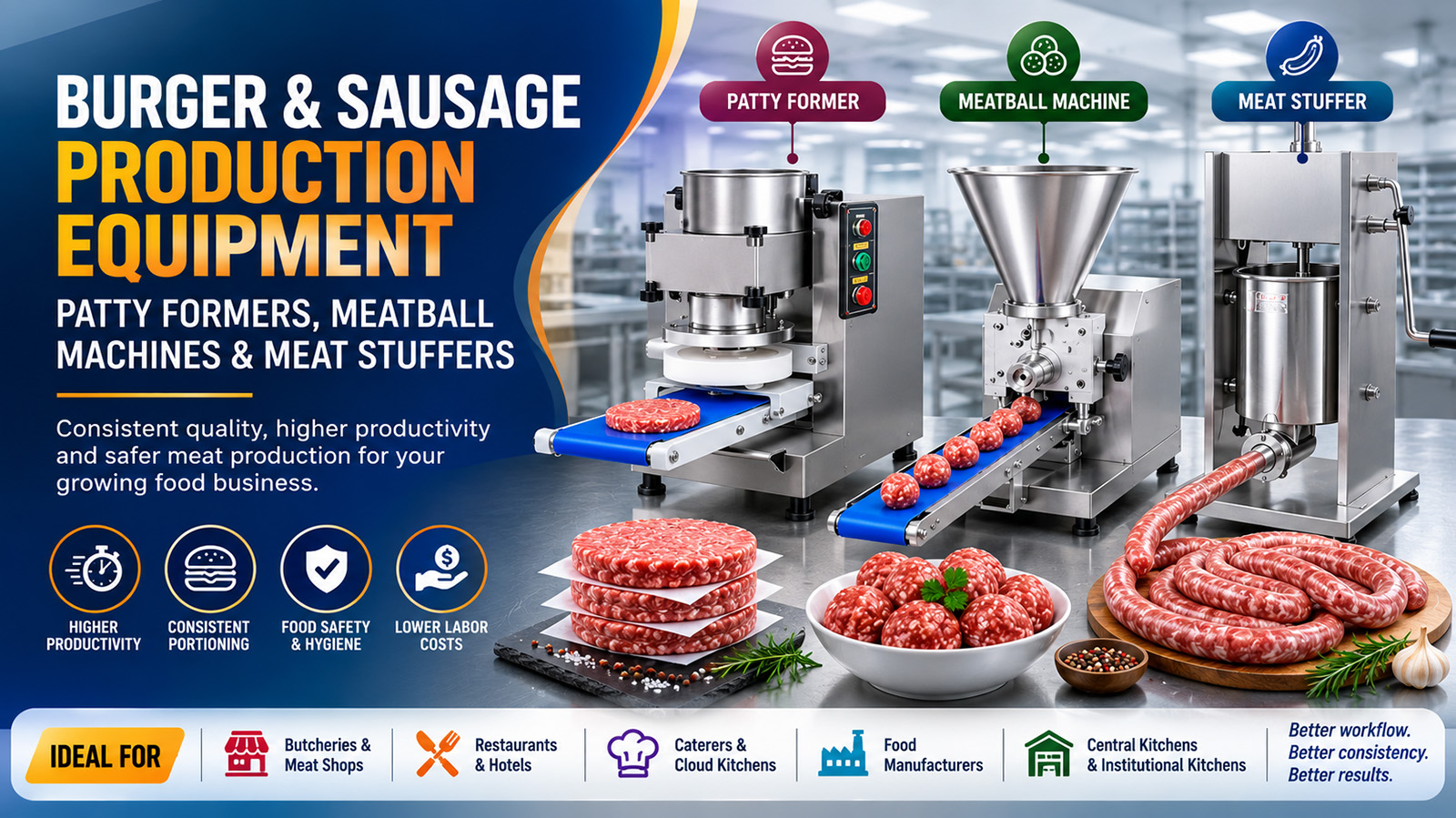
This is usually the point where burger and sausage production equipment becomes necessary. Patty formers, meatball machines , and meat stuffers help standardize repetitive work, reduce manual handling, and create a steadier production flow.
The correct machine, however, should not be selected only by looking at its maximum output. Product recipe, batch size, cleaning time, available space, staff skill, and the next stage of production all affect the final result.
How Patty Formers Improve Burger Production
A patty former portions prepared meat and shapes it into a consistent diameter, thickness, and weight. This helps commercial kitchens, butcheries, supermarkets, and meat processing facilities maintain a standard product across every batch.
Consistent patties are easier to cook because they require similar cooking times. They also make food costing more accurate. When hand-formed patties vary by even a small amount, the extra meat used across hundreds of portions becomes an unnoticed cost.
The machine must still be matched to the product. Lean meat, high-fat mixtures, coarse grinds, soft emulsions, and recipes containing vegetables or binders behave differently during forming. A recipe that works well by hand may require adjustment when it is processed through a machine.
The forming plate, pressure setting, feed method, and meat temperature all influence the final shape. If the mixture is too warm or too soft, patties may lose definition. If the feed pressure is too high, the texture may become dense or compressed.
Before choosing a patty former, the actual product should be tested at the required portion size. A machine that performs well with one recipe may not give the same result with another.
Where Meatball Machines Add Value
Meatball machines are useful when a kitchen produces repeated batches of meatballs, kofta, or similar formed products. Their main advantage is portion consistency.
Uniform meatballs cook more evenly and are easier to pack, count, and portion. This is important in hotel banquets, catering production, central kitchens, and multi-outlet operations where every tray or meal must follow the same standard.
The required meatball size should be considered carefully. A machine designed for small portions may not suit larger products. The recipe also matters because sticky, soft, or heavily mixed products may need different settings or forming components.
Production managers should also check how quickly the machine can be cleaned between recipes. If the equipment takes too long to dismantle, wash, dry, and reassemble, the labour saved during production may be lost during cleaning.
Selecting the Right Meat Stuffer
A meat stuffer pushes prepared sausage mixture into natural, collagen, or synthetic casings. Manual, hydraulic, and vacuum-assisted models are commonly used, depending on production volume and product requirements.
Manual stuffers are generally suitable for smaller batches and simple operations. Hydraulic stuffers provide more controlled filling with less operator effort. Vacuum-assisted systems can help reduce trapped air and support more consistent filling in larger production environments.
The stuffer should match the casing diameter, product texture, batch quantity, and required filling speed. A small machine may create delays if it needs to be refilled too often. A much larger machine may occupy unnecessary space and take longer to clean.
Nozzle size is another practical detail. The correct nozzle helps the mixture move smoothly into the casing without excessive pressure. Poor nozzle selection can slow filling, damage casings, or create inconsistent sausage density.
Production Flow Matters More Than Machine Speed
A high-capacity machine cannot improve output if the surrounding workflow is poorly planned. The mincer and mixer must prepare the correct quantity of meat at the correct temperature. Trays, racks, casings, packaging materials, and finished-product space must be ready before production begins.
A common mistake is placing the forming or stuffing machine wherever floor space is available. This often creates long walking distances, crossing movement, and limited cleaning access.
The production sequence should move in one direction:
Raw meat, clean trays, packaging materials, and washed machine parts should not repeatedly cross the same path. A clear forward flow reduces handling time and lowers the risk of contamination.
In the UAE, Saudi Arabia, Oman, and other Gulf markets, high ambient temperatures make chilled handling especially important. Meat should not remain in the preparation area longer than necessary. Machine output must therefore match the capacity of packing, chilling, and dispatch operations.
Consistency, Yield, and Cost Control
Portion control is one of the strongest reasons to automate forming. Overweight portions increase food cost. Underweight portions create quality complaints and inconsistent customer experience.
Uniform size also improves cooking performance. Patties with different thicknesses do not cook at the same rate. Meatballs of different sizes may be overcooked or undercooked in the same tray. Sausages with uneven filling can split, shrink differently, or cook inconsistently.
The machine alone cannot guarantee consistency. Meat temperature, grind size, ingredient ratio, mixing time, and resting time all affect the final product. Standard recipes and batch procedures are still necessary.
A well-controlled process reduces hidden costs such as rework, rejected pieces, extra checking, cooking loss, staff supervision, and customer complaints.
Hygiene and Cleaning Should Influence the Purchase
Meat processing equipment must be cleaned thoroughly after use. Hoppers, forming plates, pistons, nozzles, seals, and internal product paths can hold residue if access is poor.
Smooth stainless steel surfaces are helpful, but hygienic design depends on more than material. The machine should be easy to dismantle, inspect, wash, dry, and reassemble.
A machine that saves production time but requires excessive cleaning time may not improve the full shift. Difficult cleaning can also encourage rushed sanitation at the end of a busy day.
Before selection, confirm the following points:
Where different meats or allergen-containing recipes are produced, changeover procedures must be clearly defined. Cleaning tools and removable parts should also have a dedicated storage area.
Maintenance and Staff Dependency
Production equipment must remain reliable during peak demand. Wear parts such as seals, blades, plates, belts, sensors, and nozzles should be checked regularly.
Procurement teams should ask about spare-parts availability, technical support, common maintenance needs, and the time required for basic repairs. A low purchase price can become expensive if the machine remains out of service during a banquet schedule or a large dispatch order.
More than one employee should be trained to operate, adjust, clean, and reassemble the machine. When only one person understands the setup, absence or staff turnover can stop production completely.
Simple operating instructions, cleaning records, and daily inspection routines help reduce this risk.
Practical Equipment Evaluation Checklist
Before approving a patty former, meatball machine, or meat stuffer, the decision should be based on actual working conditions.
ATCOKITCHEN can be referenced during technical planning when equipment selection must be coordinated with the wider preparation layout, utilities, hygiene flow, and expected production demand. The equipment itself is only one part of the decision.
The final question is practical: can the planned burger and sausage production section maintain portion consistency, safe meat handling, manageable cleaning, and reliable output on the busiest working day?
A central kitchen may begin the day with orders for burger patties, meatballs, and sausages for several outlets. At first, the team manages the work by hand. One person weighs portions, another shapes patties, and another fills sausage casings.
As production increases, the process becomes harder to control. Patty weights begin to vary. Meatballs are not uniform. Sausages may be overfilled, underfilled, or twisted at different lengths. More staff are added, but the section still struggles to maintain speed and consistency.
This is usually the point where burger and sausage production equipment becomes necessary. Patty formers, meatball machines , and meat stuffers help standardize repetitive work, reduce manual handling, and create a steadier production flow.
The correct machine, however, should not be selected only by looking at its maximum output. Product recipe, batch size, cleaning time, available space, staff skill, and the next stage of production all affect the final result.
How Patty Formers Improve Burger Production
A patty former portions prepared meat and shapes it into a consistent diameter, thickness, and weight. This helps commercial kitchens, butcheries, supermarkets, and meat processing facilities maintain a standard product across every batch.
Consistent patties are easier to cook because they require similar cooking times. They also make food costing more accurate. When hand-formed patties vary by even a small amount, the extra meat used across hundreds of portions becomes an unnoticed cost.
The machine must still be matched to the product. Lean meat, high-fat mixtures, coarse grinds, soft emulsions, and recipes containing vegetables or binders behave differently during forming. A recipe that works well by hand may require adjustment when it is processed through a machine.
The forming plate, pressure setting, feed method, and meat temperature all influence the final shape. If the mixture is too warm or too soft, patties may lose definition. If the feed pressure is too high, the texture may become dense or compressed.
Before choosing a patty former, the actual product should be tested at the required portion size. A machine that performs well with one recipe may not give the same result with another.
Where Meatball Machines Add Value
Meatball machines are useful when a kitchen produces repeated batches of meatballs, kofta, or similar formed products. Their main advantage is portion consistency.
Uniform meatballs cook more evenly and are easier to pack, count, and portion. This is important in hotel banquets, catering production, central kitchens, and multi-outlet operations where every tray or meal must follow the same standard.
The required meatball size should be considered carefully. A machine designed for small portions may not suit larger products. The recipe also matters because sticky, soft, or heavily mixed products may need different settings or forming components.
Production managers should also check how quickly the machine can be cleaned between recipes. If the equipment takes too long to dismantle, wash, dry, and reassemble, the labour saved during production may be lost during cleaning.
Selecting the Right Meat Stuffer
A meat stuffer pushes prepared sausage mixture into natural, collagen, or synthetic casings. Manual, hydraulic, and vacuum-assisted models are commonly used, depending on production volume and product requirements.
Manual stuffers are generally suitable for smaller batches and simple operations. Hydraulic stuffers provide more controlled filling with less operator effort. Vacuum-assisted systems can help reduce trapped air and support more consistent filling in larger production environments.
The stuffer should match the casing diameter, product texture, batch quantity, and required filling speed. A small machine may create delays if it needs to be refilled too often. A much larger machine may occupy unnecessary space and take longer to clean.
Nozzle size is another practical detail. The correct nozzle helps the mixture move smoothly into the casing without excessive pressure. Poor nozzle selection can slow filling, damage casings, or create inconsistent sausage density.
Production Flow Matters More Than Machine Speed
A high-capacity machine cannot improve output if the surrounding workflow is poorly planned. The mincer and mixer must prepare the correct quantity of meat at the correct temperature. Trays, racks, casings, packaging materials, and finished-product space must be ready before production begins.
A common mistake is placing the forming or stuffing machine wherever floor space is available. This often creates long walking distances, crossing movement, and limited cleaning access.
The production sequence should move in one direction:
- Chilled meat receiving and storage
- Trimming and preparation
- Mincing and mixing
- Forming or stuffing
- Portion checking and tray loading
- Packing and return to controlled temperature
Raw meat, clean trays, packaging materials, and washed machine parts should not repeatedly cross the same path. A clear forward flow reduces handling time and lowers the risk of contamination.
In the UAE, Saudi Arabia, Oman, and other Gulf markets, high ambient temperatures make chilled handling especially important. Meat should not remain in the preparation area longer than necessary. Machine output must therefore match the capacity of packing, chilling, and dispatch operations.
Consistency, Yield, and Cost Control
Portion control is one of the strongest reasons to automate forming. Overweight portions increase food cost. Underweight portions create quality complaints and inconsistent customer experience.
Uniform size also improves cooking performance. Patties with different thicknesses do not cook at the same rate. Meatballs of different sizes may be overcooked or undercooked in the same tray. Sausages with uneven filling can split, shrink differently, or cook inconsistently.
The machine alone cannot guarantee consistency. Meat temperature, grind size, ingredient ratio, mixing time, and resting time all affect the final product. Standard recipes and batch procedures are still necessary.
A well-controlled process reduces hidden costs such as rework, rejected pieces, extra checking, cooking loss, staff supervision, and customer complaints.
Hygiene and Cleaning Should Influence the Purchase
Meat processing equipment must be cleaned thoroughly after use. Hoppers, forming plates, pistons, nozzles, seals, and internal product paths can hold residue if access is poor.
Smooth stainless steel surfaces are helpful, but hygienic design depends on more than material. The machine should be easy to dismantle, inspect, wash, dry, and reassemble.
A machine that saves production time but requires excessive cleaning time may not improve the full shift. Difficult cleaning can also encourage rushed sanitation at the end of a busy day.
Before selection, confirm the following points:
- Food-contact parts can be removed without complicated tools
- Internal corners and product paths are visible and reachable
- Cleaned components can dry fully before reassembly
- Electrical areas are protected from the planned cleaning method
- Seals, gaskets, and wear parts are easy to inspect and replace
Where different meats or allergen-containing recipes are produced, changeover procedures must be clearly defined. Cleaning tools and removable parts should also have a dedicated storage area.
Maintenance and Staff Dependency
Production equipment must remain reliable during peak demand. Wear parts such as seals, blades, plates, belts, sensors, and nozzles should be checked regularly.
Procurement teams should ask about spare-parts availability, technical support, common maintenance needs, and the time required for basic repairs. A low purchase price can become expensive if the machine remains out of service during a banquet schedule or a large dispatch order.
More than one employee should be trained to operate, adjust, clean, and reassemble the machine. When only one person understands the setup, absence or staff turnover can stop production completely.
Simple operating instructions, cleaning records, and daily inspection routines help reduce this risk.
Practical Equipment Evaluation Checklist
Before approving a patty former, meatball machine, or meat stuffer, the decision should be based on actual working conditions.
- Confirm the products, recipes, portion sizes, and casing diameters
- Calculate required output per shift, not only per hour
- Include cleaning, changeover, and staff break time
- Test the real product before final selection
- Check access for cleaning and preventive maintenance
- Confirm power supply, drainage, floor space, and operator clearance
- Review chilled holding and packing capacity after forming
- Confirm spare parts, service support, and operator training
ATCOKITCHEN can be referenced during technical planning when equipment selection must be coordinated with the wider preparation layout, utilities, hygiene flow, and expected production demand. The equipment itself is only one part of the decision.
The final question is practical: can the planned burger and sausage production section maintain portion consistency, safe meat handling, manageable cleaning, and reliable output on the busiest working day?
GET A QUOTE
Tell us about your business requirement, one of our technical expert will be in touch with you soon..!
PROCEED
NEW PRODUCTS ALERTS