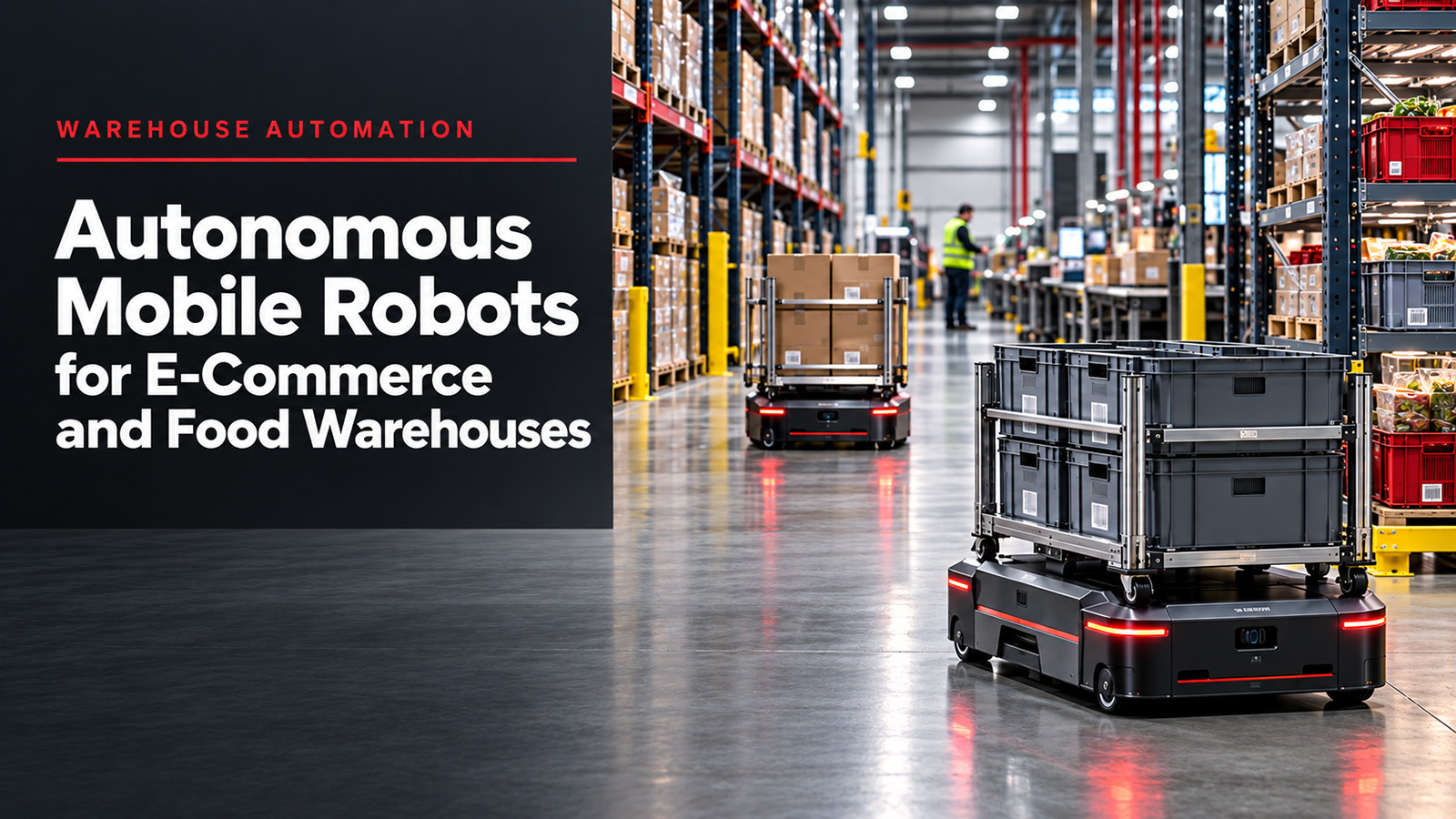
A picker finishes an e-commerce order, but the tote sits at the end of the aisle waiting for collection. Nearby, a forklift carrying a pallet pauses while staff cross towards the packing area. In the food section, another team is trying to move stock quickly enough to keep dispatch on schedule.
Each delay may last only a few minutes. Across a busy shift, those waits disrupt the flow between storage, picking, packing, and loading. Autonomous mobile robots (AMRs) can help with some of these movements. The useful question is which journeys take people away from work that needs their attention.
Where AMRs fit in the operation
An AMR is a mobile machine that navigates through a facility to transport a suitable load. Depending on its design, it may carry totes or carts, move mobile racks, or support pallet transport. It travels between assigned pickup and drop-off points while responding to obstacles. Its navigation method, load capacity, and handoff process depend on the system selected.
In an e-commerce warehouse, an AMR might take completed picks to packing, bring empty totes to picking stations, or support replenishment. In a food warehouse, it might move suitable loads between storage, packing, and dispatch, provided the machine and route meet the facility’s temperature, hygiene, and handling requirements.
These jobs differ from lifting pallets into high racking or unloading a vehicle. Forklifts, reach trucks, pallet trucks, and trained operators may still be needed. Identify journeys that are frequent and repeatable, with loads and routes that match the robot’s capabilities.
Why adding robots may leave delays in place
A common selection mistake is to count daily movements without checking when and where they occur. A clear route during a site visit may be blocked during the afternoon dispatch peak. If returns, staging pallets, or empty carts occupy the route, an AMR may spend time waiting or taking a longer path.
Handoffs matter as much as travel speed. A robot that reaches packing quickly still waits if there is nowhere to leave its load. If staff must search for a tote or correct each delivery manually, the work has shifted to the next station.
Follow a typical load through a full shift. Note where it starts, where it waits, who takes responsibility for it, and what happens when the destination is busy. Watch aisle crossings, packing queues, charging areas, and dock approaches. This shows whether transport is the bottleneck or whether the layout and work stations need attention first.
Food warehouse routes need closer inspection
Food distribution adds conditions that an ambient warehouse trial can miss. A route may cross temperature zones, pass a washdown area, or run through doors used by people and forklifts. Picking, loading, and dispatch may peak at the same time.
Check the machine’s stated operating temperature, charging conditions, cleanability, and suitability for the actual route. Confirm how loads will be contained and whether frequent door opening affects temperature control. A successful test in a dry ambient area does not establish that the same machine will perform well in a cold store.
Fleet capacity should reflect the busiest period, not just a daily average. Include time spent waiting to collect or release a load. Otherwise, a system that appears adequate on paper may create a queue when several orders must leave within one dispatch window.
Plan safety, uptime, and recovery together
AMRs share space with pedestrians and other handling equipment. Review crossings, blind corners, reversing areas, and places where staff may enter a robot’s path. Obstacle detection and stopping features are part of the system, but clear traffic rules and a site-specific risk assessment are still necessary. The applicable safety requirements should be confirmed for the equipment and installation; ISO 3691-4 addresses driverless industrial trucks and their systems, including relevant AMR types.
Ask what happens when a robot stops mid-route, a pickup point is blocked, or the connection to the warehouse management system fails. The team needs a safe way to recover the load and continue moving orders. Charging space, battery care, maintenance access, software support, and spare parts all affect uptime and operating cost.
A realistic pilot should include an obstructed aisle, a busy drop-off point, a missed scan, and peak dispatch. Measure completed movements, waiting time, worker walking distance, and time lost at handoffs. A high trip count alone does not prove that orders leave sooner.
What to check before selecting an AMR
Choose one proposed route and document the conditions it must handle:
- Load: weight, dimensions, stability, containment, and pickup method.
- Route: floor condition, aisle clearance, doors, crossings, and pedestrian traffic.
- Demand: trips during the busiest shift, queue time, and required handoff speed.
- Environment: temperature, cleaning practices, charging location, and food handling controls.
- Integration: how jobs are assigned, confirmed, and recovered when systems are unavailable.
The strongest starting point is a specific movement that repeatedly delays other work. If the journey can be measured, handed off cleanly, and operated safely alongside the existing fleet, it is a sound candidate for an AMR trial. Which repeated journey is consuming the most time in your busiest shift?