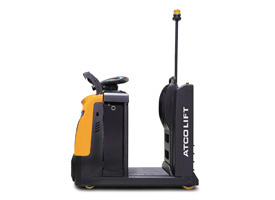
Stand-on Tow Tractor
A Stand-on Tow Tractor is a material transfer vehicle used to pull load carriers, carts, and trailers across warehouse floors and production sites. It supports routine internal movement requirements across Oman in industrial, storage, and commercial operations. The equipment is suitable for medium-distance hauling within structured layouts and operates effectively in confined working zones. Typical models are built to manage towing loads between 3 and 5 tons and function well in aisle-based storage environments and indoor logistics systems.

The unit supports grouped trailer transport, allowing bulk movement across internal routes. With towing capacities generally ranging from 3,000 kg to 5,000 kg, it suits routine load circulation in factories and warehouses. The standing operator platform supports efficient stop-and-go handling, especially where repeated short runs are required. A compact structural layout enables movement through narrow aisles and tight passageways.
In day-to-day use, it becomes part of the facility’s internal supply chain, supporting movement of packaged goods, raw materials, and production components. The design focuses on consistent maneuverability, stable handling on smooth floors, and suitability for continuous operational cycles across industrial facilities.
Technical Specifications
| Product Code | ALT30N | ALT50N |
| Power type | Battery | |
| Operator type | Stand-on | |
| Load Capacity / rated load Q(t) | 3.0 | 5.0 |
| Rated drawbar pull F(N) | 800 | 1000 |
| Wheelbase Y(mm) | 1155 | |
| Service weight(kg) | 950 | 1020 |
| Tires | Solid rubber | |
| Height of tiller in drive position min./ max. h(mm) | 1280 | |
| Overall length l(mm) | 1429 | |
| Overall width b(mm) | 810 | |
| Ground clearance, centre of wheelbase m(mm) | 50 | |
| Turning radius Wa(mm) | 1333 | |
| Service brake | Electromagnetic | |
| Type of drive control | AC-Speed Control | |
| Sound level at driver's ear acc.to EN 12053 dB(A) | <70kg | |
Key Features
- Stand-on driving layout suitable for repetitive internal transport work
- Towing capacity range from 3 to 5 tons for multi-cart movement
- Electric steering system for improved handling in confined areas
- AC traction drive setup for controlled speed variation
- Short wheelbase structure for better turning in narrow aisles
- Side battery removal option for quicker servicing and shift continuity
- Operator support backrest to assist stability during movement
- Vibration-reducing platform structure for smoother operation
- Control handle with integrated safety switches and direction controls
Stand-on Tow Tractor
Brochure | Quotation | Availability
Fill the form with valid details to receive the information.
Frequently Asked Questions
They are frequently used in storage facilities, port-side warehouses, and regional distribution centers to move carts and load carriers between sections. Operations in Muscat and Sohar often rely on tow tractors for shifting materials across internal routes without interrupting handling and sorting activities.
These units are generally designed to pull grouped loads such as parts bins, cartons, and pallet trailers within a combined towing capacity of around 3 to 5 tons. This range supports routine material circulation between receiving, storage, and dispatch zones across industrial facilities.
Yes, it is well suited for repeated short to medium-distance travel within large indoor layouts. It helps move goods across different sections of a warehouse or processing site, reducing the need for manual transport and improving consistency in daily material movement routines.
The stand-on design allows quicker movement between stops, which is useful in facilities where operators frequently connect and disconnect trailers. This setup helps reduce time lost in repeated mounting and dismounting, especially in busy handling zones that require constant movement.
Floor condition, aisle width, turning space, and trailer alignment should be evaluated. Smooth indoor surfaces are ideal for stable towing. Proper route planning helps maintain safe movement across storage and processing areas while preventing congestion during peak working hours.
It supports planned internal transport routes by moving grouped loads at scheduled intervals. This reduces scattered movement across the facility and helps maintain an organized flow between departments, particularly in structured warehouse operations and regional distribution networks.

Customer Testimonials
GET A QUOTE
Tell us about your business requirement, one of our technical expert will be in touch with you soon..!
NEW PRODUCTS ALERTS